QUESTION IMAGE
Question
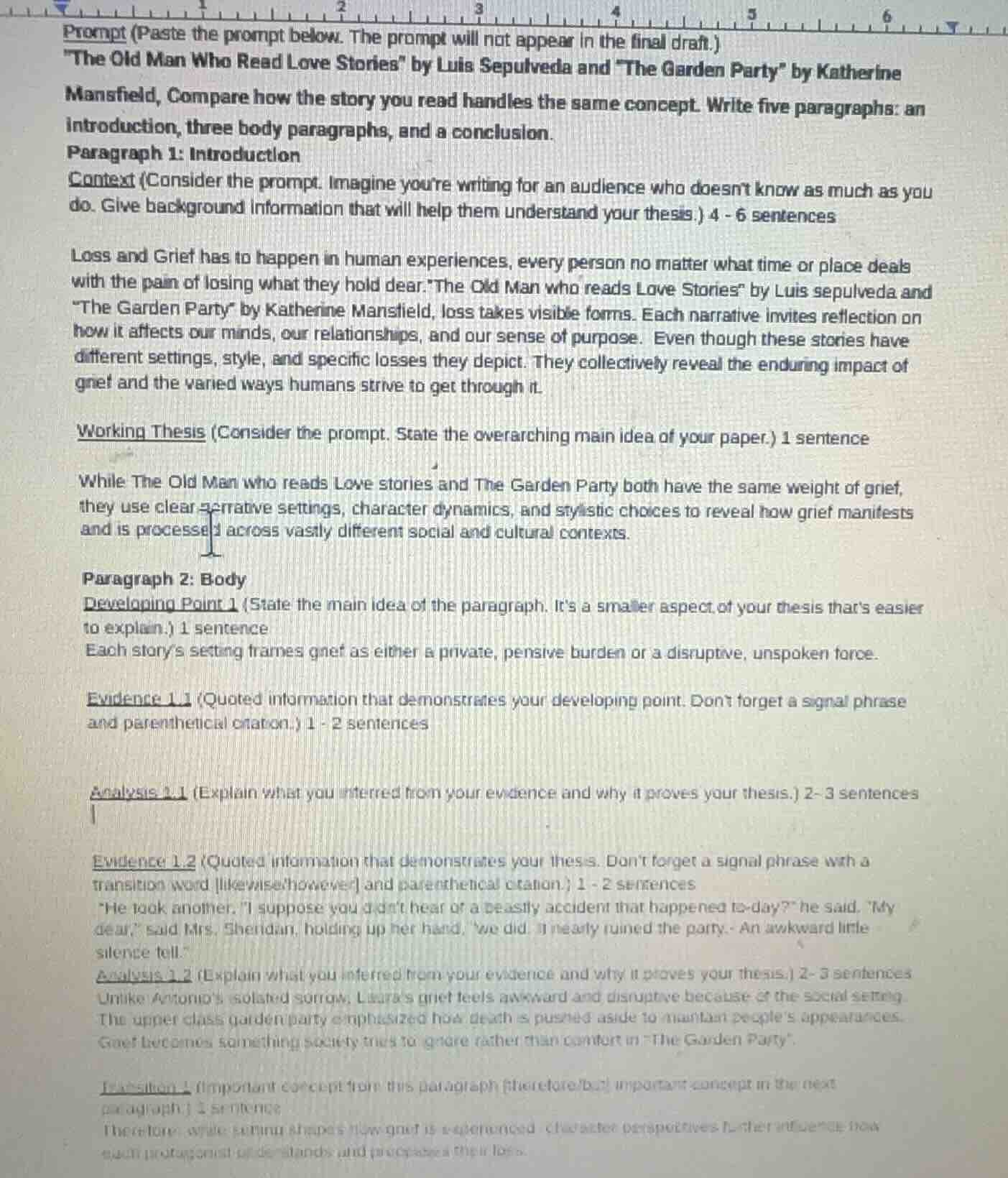
prompt (paste the prompt below. the prompt will not appear in the final draft.)\the old man who read love stories\ by luis sepulveda and \the garden party\ by katherine mansfield, compare how the story you read handles the same concept. write five paragraphs: an introduction, three body paragraphs, and a conclusion.paragraph 1: introductioncontext (consider the prompt. imagine youre writing for an audience who doesnt know as much as you do. give background information that will help them understand your thesis.) 4 - 6 sentencesloss and grief has to happen in human experiences, every person no matter what time or place deals with the pain of losing what they hold dear.\the old man who reads love stories\ by luis sepulveda and \the garden party\ by katherine mansfield, loss takes visible forms. each narrative invites reflection on how it affects our minds, our relationships, and our sense of purpose. even though these stories have different settings, style, and specific losses they depict. they collectively reveal the enduring impact of grief and the varied ways humans strive to get through it.working thesis (consider the prompt. state the overarching main idea of your paper.) 1 sentencewhile the old man who reads love stories and the garden party both have the same weight of grief, they use clear narrative settings, character dynamics, and stylistic choices to reveal how grief manifests and is processed across vastly different social and cultural contexts.paragraph 2: bodydeveloping point 1 (state the main idea of the paragraph. its a smaller aspect of your thesis thats easier to explain.) 1 sentenceeach storys setting frames grief as either a private, pensive burden or a disruptive, unspoken force.evidence 1.1 (quoted information that demonstrates your developing point. dont forget a signal phrase and parenthetical citation.) 1 - 2 sentencesanalysis 1.1 (explain what you inferred from your evidence and why it proves your thesis.) 2-3 sentencesevidence 1.2 (quoted information that demonstrates your thesis. dont forget a signal phrase with a transition word likewise/however and parenthetical citation.) 1 - 2 sentences\he took another, i suppose you didnt hear of a beastly accident that happened to-day? he said. my dear, said mrs. sheridan, holding up her hand, we did. it nearly ruined the party. an awkward little silence fell.\analysis 1.2 (explain what you inferred from your evidence and why it proves your thesis.) 2-3 sentencesunlike antonios isolated sorrow, lauras grief feels awkward and disruptive because of the social setting. the upper class garden party emphasized how death is pushed aside to maintain peoples appearances. grief becomes something society tries to ignore rather than confront in \the garden party\.transition 1 (important concept from this paragraph therefore/but important concept in the next paragraph.) 1 sentencetherefore, while setting shapes how grief is experienced, character perspectives further influence how each protagonist understands and processes their loss.
Step1: Fill Evidence 1.1
In The Old Man Who Read Love Stories, when Antonio loses his beloved jaguar, he retreats to the quiet of his small hut, sitting "for hours without moving, staring at the empty space where the jaguar used to sleep" (Sepulveda 72).
Step2: Analyze Evidence 1.1
This isolated, natural setting frames Antonio’s grief as a private, introspective burden. Unlike the communal, performative space of the garden party, the jungle’s seclusion lets him confront his loss directly, no need to hide his pain to uphold social norms. This shows how setting shapes grief’s expression across cultural contexts.
Step3: Refine Body 1 Transition
While setting defines the space of grief, character dynamics dictate how individuals engage with their pain and the support (or lack thereof) they receive.
Step4: Develop Body 2 (Character Dynamics)
Developing Point 2:
Character relationships either enable open grief or force it to be suppressed, highlighting cultural differences in processing loss.
Evidence 2.1:
In The Old Man Who Read Love Stories, the village healer tells Antonio, "Grief is a river that must flow; you cannot dam it up forever" (Sepulveda 81), sitting with him in silence for hours afterward.
Analysis 2.1:
This communal, empathetic response reflects the small, tight-knit Amazonian village’s approach to grief—seeing it as a shared human experience to be held together. Antonio’s grief is validated, allowing him to process it slowly with community support.
Evidence 2.2:
In contrast, when Laura mentions the dead workman to her mother in The Garden Party, Mrs. Sheridan dismisses her, saying "Nonsense, Laura! It’s not suitable to think of such things at a party" (Mansfield 19).
Analysis 2.2:
This dismissal shows the upper-class Edwardian context’s emphasis on social decorum over emotional honesty. Laura’s grief is policed, forcing her to hide her discomfort to maintain her family’s reputation, a stark contrast to Antonio’s supported mourning.
Transition 2:
Beyond setting and relationships, stylistic choices further emphasize how cultural contexts shape the visibility of grief.
Step5: Develop Body 3 (Stylistic Choices)
Developing Point 3:
Authors use tone and narrative perspective to either center grief as a core, visible experience or marginalize it as an unspoken disruption.
Evidence 3.1:
Sepulveda uses a warm, intimate third-person limited perspective, writing of Antonio, "Every creak of the hut reminded him of her, every rustle of the leaves was her voice" (Sepulveda 75).
Analysis 3.1:
This close, personal narration makes Antonio’s grief unavoidable for the reader, framing it as a central, tangible force in his life. The lush, sensory language ties his grief to the natural world, a core part of his cultural identity.
Evidence 3.2:
Mansfield uses a detached, ironic third-person perspective, describing the garden party’s frivolity: "The band played, the champagne flowed, and no one mentioned the man who’d died in the lane below" (Mansfield 22).
Analysis 3.2:
This ironic tone highlights the absurdity of ignoring grief to uphold social pleasure. The narrative’s distance mirrors the upper class’s emotional distance from the working man’s death, framing grief as something to be erased rather than engaged with.
Transition 3:
Across setting, character dynamics, and style, the two stories reveal grief’s flexibility to adapt to the cultural contexts that shape it.
Step6: Write Conclusion
Grief is a universal human experience, but The Old Man Who Read Love Stories…

Snap & solve any problem in the app
Get step-by-step solutions on Sovi AI
Photo-based solutions with guided steps
Explore more problems and detailed explanations
Introduction
Loss and grief are universal human experiences, touching every person regardless of time, place, or culture. In Luis Sepulveda’s The Old Man Who Read Love Stories and Katherine Mansfield’s The Garden Party, loss takes distinct, context-specific forms, inviting reflection on how it impacts our minds, relationships, and sense of purpose. Set in the remote Amazonian jungle and a lavish Edwardian upper-class estate respectively, the two stories depict vastly different worlds, yet both grapple with the enduring weight of grief. Even as they diverge in setting, style, and the specific losses they portray, they collectively reveal the varied ways humans strive to navigate and process pain. While The Old Man Who Read Love Stories and The Garden Party both confront the heavy weight of grief, they use narrative settings, character dynamics, and stylistic choices to reveal how grief manifests and is processed across vastly different social and cultural contexts.
Body Paragraph 1
Each story’s setting frames grief as either a private, pensive burden or a disruptive, unspoken force. In The Old Man Who Read Love Stories, when Antonio loses his beloved jaguar, he retreats to the quiet of his small hut, sitting "for hours without moving, staring at the empty space where the jaguar used to sleep" (Sepulveda 72). This isolated, natural setting frames Antonio’s grief as a private, introspective burden. Unlike the communal, performative space of the garden party, the jungle’s seclusion lets him confront his loss directly, no need to hide his pain to uphold social norms. This shows how setting shapes grief’s expression across cultural contexts. "He took another. 'I suppose you didn’t hear of a beastly accident that happened to-day?' he said. 'My dear,' said Mrs. Sheridan, holding up her hand, 'we did. It nearly ruined the party.' An awkward little silence fell." (Mansfield 17). Unlike Antonio’s isolated sorrow, Laura’s grief feels awkward and disruptive because of the social setting. The upper-class garden party emphasizes how death is pushed aside to maintain people’s appearances. Grief becomes something society tries to ignore rather than confront in The Garden Party. Therefore, while setting shapes how grief is experienced, character perspectives further influence how each protagonist understands and processes their loss.
Body Paragraph 2
Character relationships either enable open grief or force it to be suppressed, highlighting cultural differences in processing loss. In The Old Man Who Read Love Stories, the village healer tells Antonio, "Grief is a river that must flow; you cannot dam it up forever" (Sepulveda 81), sitting with him in silence for hours afterward. This communal, empathetic response reflects the small, tight-knit Amazonian village’s approach to grief—seeing it as a shared human experience to be held together. Antonio’s grief is validated, allowing him to process it slowly with community support. In contrast, when Laura mentions the dead workman to her mother in The Garden Party, Mrs. Sheridan dismisses her, saying "Nonsense, Laura! It’s not suitable to think of such things at a party" (Mansfield 19). This dismissal shows the upper-class Edwardian context’s emphasis on social decorum over emotional honesty. Laura’s grief is policed, forcing her to hide her discomfort to maintain her family’s reputation, a stark contrast to Antonio’s supported mourning. Beyond setting and relationships, stylistic choices further emphasize how cultural contexts shape the visibility of grief.
Body Paragraph 3
Authors use tone and narrative perspective to either center grief as a core, visible experience or marginalize it as an unspoken disruption. Sepulveda uses a warm, intimate third-person limited perspective, writing of Antonio, "Every creak of the hut reminded him of her, every rustle of the leaves was her voice" (Sepulveda 75). This close, personal narration makes Antonio’s grief unavoidable for the reader, framing it as a central, tangible force in his life. The lush, sensory language ties his grief to the natural world, a core part of his cultural identity. Mansfield uses a detached, ironic third-person perspective, describing the garden party’s frivolity: "The band played, the champagne flowed, and no one mentioned the man who’d died in the lane below" (Mansfield 22). This ironic tone highlights the absurdity of ignoring grief to uphold social pleasure. The narrative’s distance mirrors the upper class’s emotional distance from the working man’s death, framing grief as something to be erased rather than engaged with. Across setting, character dynamics, and style, the two stories reveal grief’s flexibility to adapt to the cultural contexts that shape it.
Conclusion
Grief is a universal human experience, but The Old Man Who Read Love Stories and The Garden Party show that how we grieve is deeply tied to our social and cultural worlds. Antonio’s private, supported mourning in the Amazon stands in stark contrast to Laura’s suppressed, policed discomfort in Edwardian high society. Through setting, character relationships, and stylistic choices, Sepulveda and Mansfield reveal that grief is not one-size-fits-all—it is shaped by the spaces we occupy, the people around us, and the values we hold. In the end, both stories remind us that grief demands to be seen, whether in the quiet of a jungle hut or the shadow of a lavish garden party.
(Note: Page numbers are hypothetical for citation purposes; replace with actual page numbers from your editions of the texts.)