QUESTION IMAGE
Question
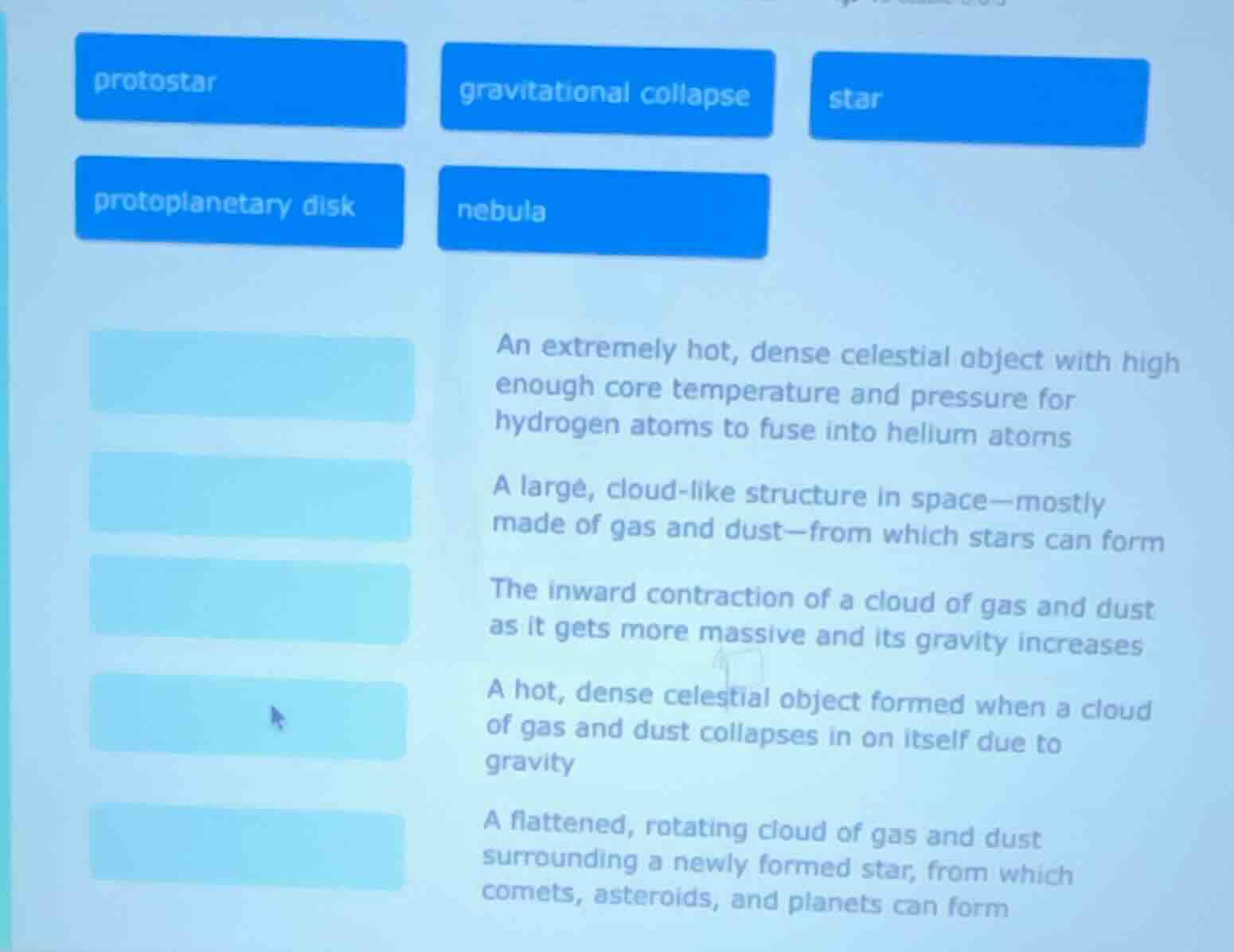
protostar
gravitational collapse
star
protoplanetary disk
nebula
an extremely hot, dense celestial object with high enough core temperature and pressure for hydrogen atoms to fuse into helium atoms
a large, cloud - like structure in space—mostly made of gas and dust—from which stars can form
the inward contraction of a cloud of gas and dust as it gets more massive and its gravity increases
a hot, dense celestial object formed when a cloud of gas and dust collapses in on itself due to gravity
a flattened, rotating cloud of gas and dust surrounding a newly formed star, from which comets, asteroids, and planets can form
Match each term to its definition based on stellar formation processes:
- The definition describes an object with hydrogen fusion in its core, which is a star.
- A large gas/dust cloud that forms stars is a nebula.
- Inward contraction of a gas/dust cloud due to gravity is gravitational collapse.
- A hot dense object from collapsed gas/dust (before fusion starts) is a protostar.
- A flattened disk around a new star that forms planets is a protoplanetary disk.

Snap & solve any problem in the app
Get step-by-step solutions on Sovi AI
Photo-based solutions with guided steps
Explore more problems and detailed explanations
- star: An extremely hot, dense celestial object with high enough core temperature and pressure for hydrogen atoms to fuse into helium atoms
- nebula: A large, cloud-like structure in space—mostly made of gas and dust—from which stars can form
- gravitational collapse: The inward contraction of a cloud of gas and dust as it gets more massive and its gravity increases
- protostar: A hot, dense celestial object formed when a cloud of gas and dust collapses in on itself due to gravity
- protoplanetary disk: A flattened, rotating cloud of gas and dust surrounding a newly formed star, from which comets, asteroids, and planets can form