QUESTION IMAGE
Question
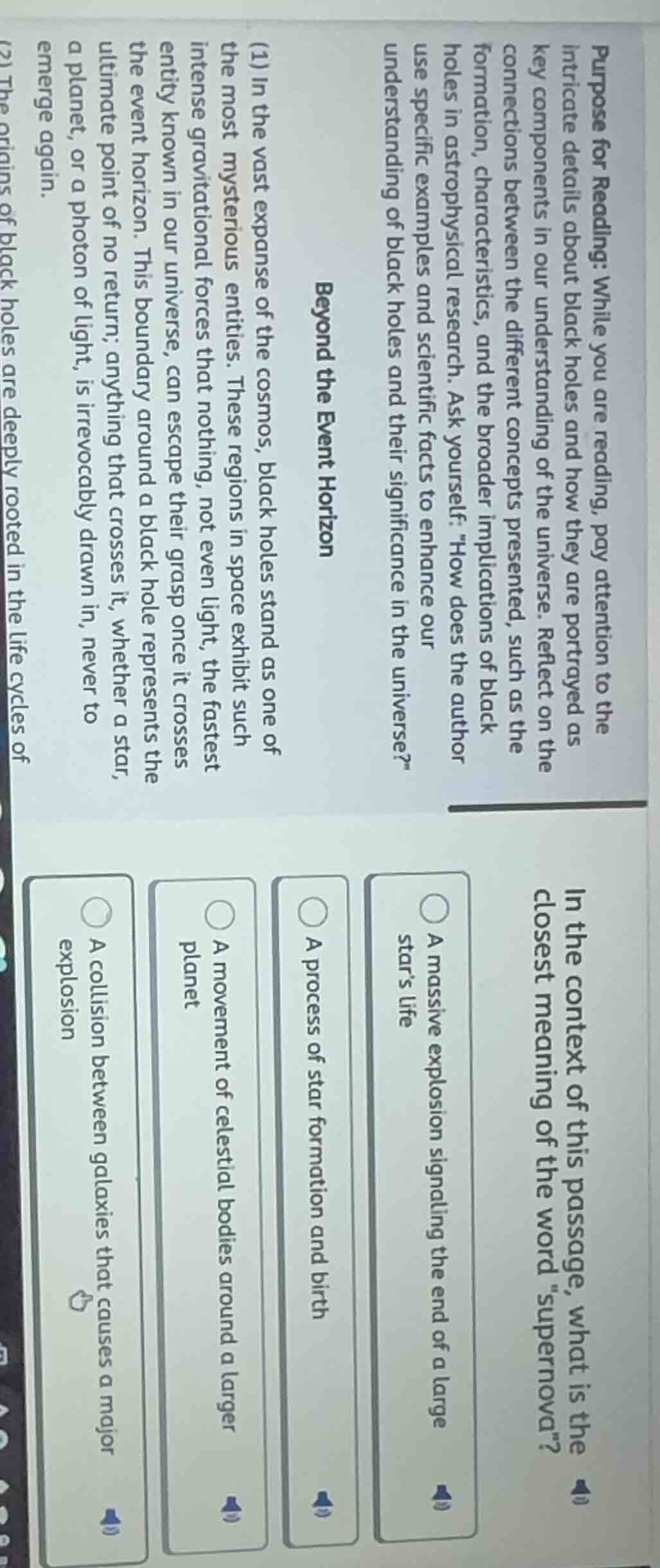
purpose for reading: while you are reading, pay attention to the intricate details about black holes and how they are portrayed as key components in our understanding of the universe. reflect on the connections between the different concepts presented, such as the formation, characteristics, and the broader implications of black holes in astrophysical research. ask yourself: \how does the author use specific examples and scientific facts to enhance our understanding of black holes and their significance in the universe?\
beyond the event horizon
(1) in the vast expanse of the cosmos, black holes stand as one of the most mysterious entities. these regions in space exhibit such intense gravitational forces that nothing, not even light, the fastest entity known in our universe, can escape their grasp once it crosses the event horizon. this boundary around a black hole represents the ultimate point of no return; anything that crosses it, whether a star, a planet, or a photon of light, is irrevocably drawn in, never to emerge again.
(2) the origins of black holes are deeply rooted in the life cycles of
in the context of this passage, what is the closest meaning of the word \supernova\?
○ a massive explosion signaling the end of a large star’s life
○ a process of star formation and birth
○ a movement of celestial bodies around a larger planet
○ a collision between galaxies that causes a major explosion
A supernova is a massive explosion that occurs at the end of a large star's life cycle, often leading to the formation of black holes or neutron stars. The other options: a movement of celestial bodies around a larger planet is orbital motion, star formation is about creating stars, and galaxy collision explosion is a different cosmic event not defining a supernova.

Snap & solve any problem in the app
Get step-by-step solutions on Sovi AI
Photo-based solutions with guided steps
Explore more problems and detailed explanations
A. A massive explosion signaling the end of a large star’s life