QUESTION IMAGE
Question
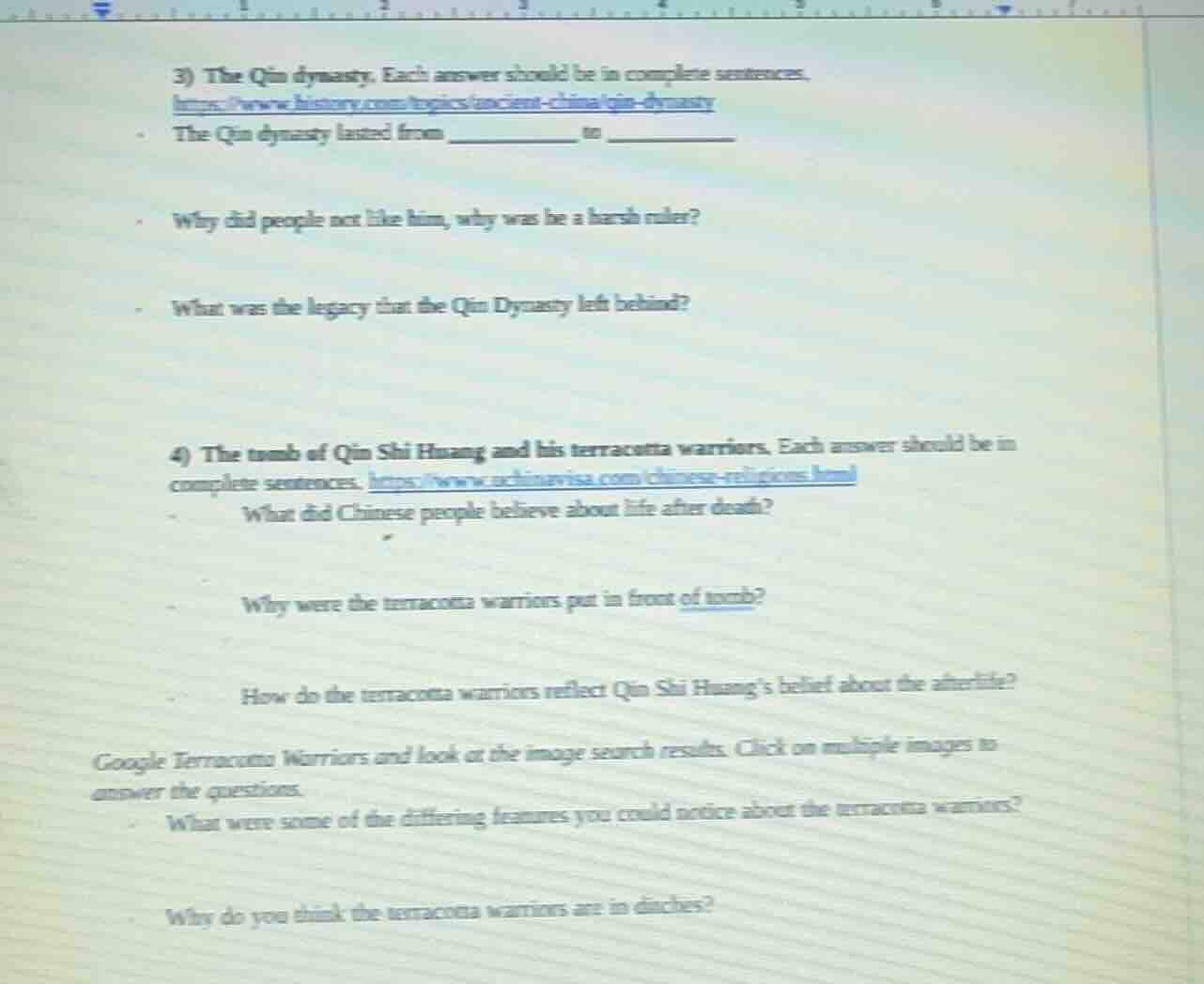
- the qin dynasty. each answer should be in complete sentences. https://www.history.com/topics/ancient-china/qin-dynasty the qin dynasty lasted from ____ to ____ why did people not like him, why was he a harsh ruler? what was the legacy that the qin dynasty left behind? 4) the tomb of qin shi huang and his terracotta warriors. each answer should be in complete sentences. https://www.uchinavisa.com/chinese-religions.html what did chinese people believe about life after death? why were the terracotta warriors put in front of tomb? how do the terracotta warriors reflect qin shi huang’s belief about the afterlife? google terracotta warriors and look at the image search results. click on multiple images to answer the questions. what were some of the differing features you could notice about the terracotta warriors? why do you think the terracotta warriors are in ditches?
Brief Explanations
For Section 3 (Qin Dynasty):
- The Qin Dynasty's time frame is a established historical fact based on ancient records and archaeological evidence.
- Qin Shi Huang's harsh policies included forced labor, strict legal punishments, and heavy taxes that burdened the population.
- The dynasty's key legacies stem from its unification reforms and lasting infrastructure.
For Section 4 (Qin Shi Huang's Tomb & Terracotta Warriors):
- Ancient Chinese afterlife beliefs drew from traditional animist and ancestral worship ideas, focusing on continuity of needs.
- The terracotta warriors' purpose ties directly to the belief that rulers needed protection in the afterlife.
- The warriors' scale and detail mirror Qin Shi Huang's desire to maintain his power and status beyond death.
- The unique features of the warriors are confirmed by archaeological studies of the site.
- The ditches were part of the planned tomb complex to organize and protect the military formation.

Snap & solve any problem in the app
Get step-by-step solutions on Sovi AI
Photo-based solutions with guided steps
Explore more problems and detailed explanations
Section 3: The Qin Dynasty
- The Qin dynasty lasted from 221 BCE to 206 BCE.
- People disliked Qin Shi Huang because he imposed extremely harsh legal punishments, forced hundreds of thousands of people into backbreaking forced labor for projects like the Great Wall and his tomb, and levied cripplingly high taxes that left many families in poverty.
- The Qin Dynasty left behind the legacy of unifying China's warring states into a single centralized empire, standardizing written script, weights, measures, and currency across the realm, and laying the groundwork for the Great Wall of China as we know it today.
Section 4: The tomb of Qin Shi Huang and his terracotta warriors
- Ancient Chinese people believed that life after death was a continuation of earthly life, so the deceased would need the same goods, services, and protection that they had while alive, including food, servants, and military forces.
- The terracotta warriors were placed in front of the tomb to act as an eternal military guard, protecting Qin Shi Huang and his tomb from threats in the afterlife and maintaining his status as an emperor even in death.
- The terracotta warriors reflect Qin Shi Huang's belief about the afterlife by being a full-scale, detailed replica of his real imperial army—this shows he expected to command military power, maintain his imperial status, and have the same level of protection in the afterlife that he enjoyed during his reign on Earth.
- Some differing features of the terracotta warriors include unique facial features, hairstyles, and expressions for each figure, as well as distinct military ranks and roles marked by different armor, headgear, and weapons (such as swords, spears, and crossbows).
- The terracotta warriors are in ditches because the ditches were part of a carefully planned underground military complex designed to mimic a real imperial army formation, and the ditches helped organize the warriors into structured battle units while also protecting the figures from damage over time.