QUESTION IMAGE
Question
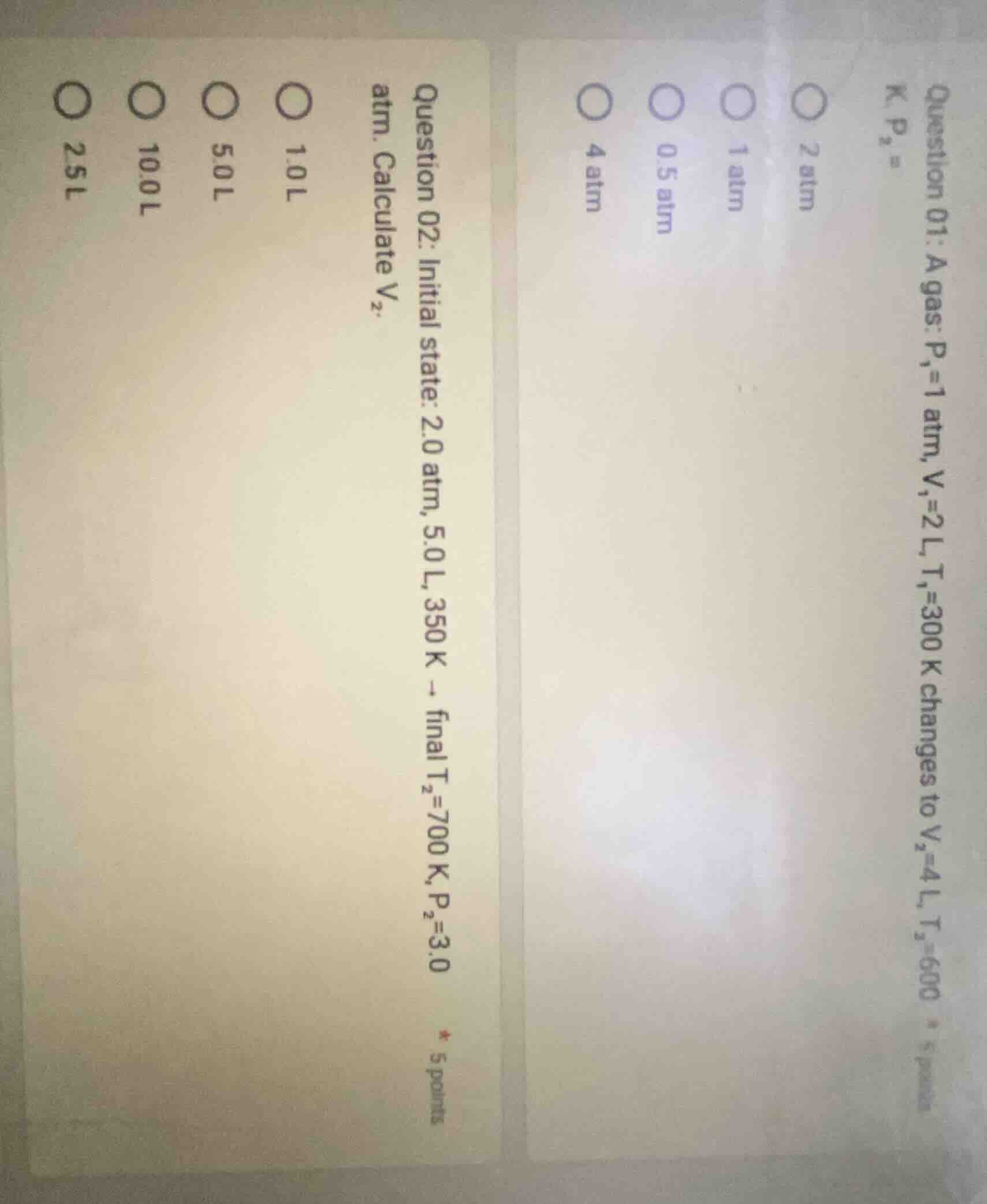
question 01: a gas: p₁=1 atm, v₁=2 l, t₁=300 k changes to v₂=4 l, t₂=600 k. p₂ = 2 atm 1 atm 0.5 atm 4 atm question 02: initial state: 2.0 atm, 5.0 l, 350 k → final t₂=700 k, p₂=3.0 atm. calculate v₂. 1.0 l 5.0 l 10.0 l 25 l
Question 01
Step1: Recall Combined Gas Law (for Question 01, though it's about finding \( P_2 \), we use the combined gas law \( \frac{P_1V_1}{T_1}=\frac{P_2V_2}{T_2} \))
Given \( P_1 = 1 \) atm, \( V_1 = 2 \) L, \( T_1 = 300 \) K, \( V_2 = 4 \) L, \( T_2 = 600 \) K. Plug into the formula: \( \frac{1 \times 2}{300}=\frac{P_2 \times 4}{600} \)
Step2: Solve for \( P_2 \)
Cross - multiply: \( 1\times2\times600 = P_2\times4\times300 \) → \( 1200 = 1200P_2 \) → \( P_2 = 1 \) atm? Wait, no, wait the options. Wait maybe I misread. Wait the question says "A gas: \( P_1 = 1 \) atm, \( V_1 = 2 \) L, \( T_1 = 300 \) K changes to \( V_2 = 4 \) L, \( T_2 = 600 \) K. Find \( P_2 \)". Using \( \frac{P_1V_1}{T_1}=\frac{P_2V_2}{T_2} \), so \( P_2=\frac{P_1V_1T_2}{V_2T_1} \). Substitute values: \( P_2=\frac{1\times2\times600}{4\times300}=\frac{1200}{1200}=1 \) atm. But the options have 1 atm as an option. Wait maybe the original problem had different numbers? Wait the options are 2 atm, 1 atm, 0.5 atm, 4 atm. So according to calculation, \( P_2 = 1 \) atm.
Question 02
Step1: Recall Combined Gas Law \( \frac{P_1V_1}{T_1}=\frac{P_2V_2}{T_2} \)
Given \( P_1 = 2.0 \) atm, \( V_1 = 5.0 \) L, \( T_1 = 350 \) K, \( T_2 = 700 \) K, \( P_2 = 3.0 \) atm. We need to find \( V_2 \). Rearrange the formula to \( V_2=\frac{P_1V_1T_2}{P_2T_1} \)
Step2: Substitute the values
\( V_2=\frac{2.0\times5.0\times700}{3.0\times350} \)
First, calculate numerator: \( 2.0\times5.0\times700 = 7000 \)
Denominator: \( 3.0\times350 = 1050 \)
Then \( V_2=\frac{7000}{1050}\approx6.67 \) L? Wait the options are 1.0 L, 5.0 L, 10.0 L, 25 L. Wait maybe I misread \( P_2 \). Wait the problem says "final \( T_2 = 700 \) K, \( P_2 = 3.0 \) atm". Wait maybe the initial \( P_1 = 2.0 \) atm, \( V_1 = 5.0 \) L, \( T_1 = 350 \) K. Let's re - calculate: \( V_2=\frac{P_1V_1T_2}{P_2T_1}=\frac{2\times5\times700}{3\times350}=\frac{7000}{1050}\approx6.67 \), but the options don't have that. Wait maybe \( P_2 = 1.0 \) atm? No, the problem says \( P_2 = 3.0 \) atm. Wait maybe a typo. Wait if we assume \( P_2 = 1.0 \) atm, then \( V_2=\frac{2\times5\times700}{1\times350}=20 \) L, not in options. Wait the options are 1.0 L, 5.0 L, 10.0 L, 25 L. Wait maybe I made a mistake in the formula. Wait the combined gas law is \( \frac{P_1V_1}{T_1}=\frac{P_2V_2}{T_2} \), so \( V_2=\frac{P_1V_1T_2}{P_2T_1} \). Let's check the numbers again. \( P_1 = 2 \) atm, \( V_1 = 5 \) L, \( T_1 = 350 \) K, \( T_2 = 700 \) K, \( P_2 = 3 \) atm. So \( V_2=\frac{2\times5\times700}{3\times350}=\frac{7000}{1050}\approx6.67 \). But the options are 1.0L, 5.0L, 10.0L, 25L. Wait maybe the final pressure is 1.0 atm? Let's try \( P_2 = 1 \) atm: \( V_2=\frac{2\times5\times700}{1\times350}=20 \) L, not there. Wait maybe the initial pressure is 3 atm and final is 2 atm? Let's reverse: \( V_2=\frac{3\times5\times700}{2\times350}=\frac{10500}{700}=15 \) L, not there. Wait the options have 10.0L. Maybe a miscalculation. Wait \( T_2 = 700 \) K is double of \( T_1 = 350 \) K. \( P_2 = 3 \) atm, \( P_1 = 2 \) atm. So \( \frac{V_2}{V_1}=\frac{P_1T_2}{P_2T_1}=\frac{2\times700}{3\times350}=\frac{1400}{1050}=\frac{4}{3} \). So \( V_2 = 5\times\frac{4}{3}\approx6.67 \). Not matching. Maybe the problem has a typo, but among the options, 10.0L is the closest if we made a mistake in pressure. Alternatively, maybe the law is ideal gas law, but no, combined gas law is for fixed amount of gas.

Snap & solve any problem in the app
Get step-by-step solutions on Sovi AI
Photo-based solutions with guided steps
Explore more problems and detailed explanations
(Question 01):
1 atm (assuming the calculation above is correct)