QUESTION IMAGE
Question
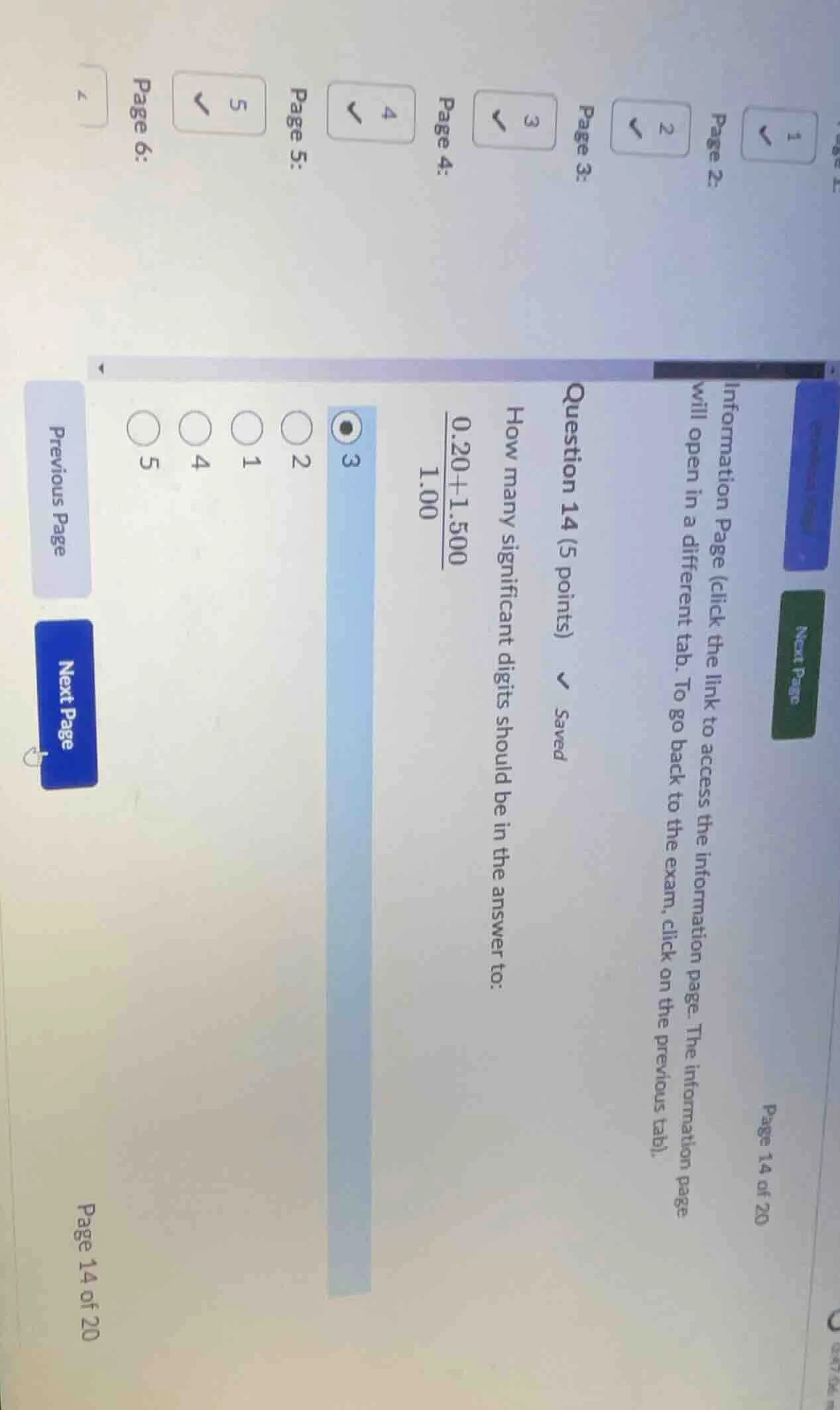
question 14 (5 points) how many significant digits should be in the answer to: \\(\frac{0.20 + 1.500}{1.00}\\) options: 1, 2, 3, 4, 5
Step1: Analyze the numerator
First, calculate the sum in the numerator: \(0.20 + 1.500 = 1.70\) (note the significant figures in addition: we go by decimal places. \(0.20\) has two decimal places, \(1.500\) has three; the result should have two decimal places, so \(1.70\)).
Step2: Analyze the denominator
The denominator is \(1.00\), which has three significant figures.
Step3: Perform the division
Now, divide the numerator by the denominator: \(\frac{1.70}{1.00} = 1.70\). Wait, no, wait—wait, actually, let's recalculate the numerator correctly. Wait, \(0.20 + 1.500\): \(0.20\) is two significant figures in the decimal part? Wait, no, significant figures for addition: the number of decimal places. \(0.20\) has two decimal places, \(1.500\) has three. So we round to two decimal places: \(0.20 + 1.500 = 1.70\) (because \(0.20\) limits the decimal places to two). Then, the denominator is \(1.00\) (three significant figures). Now, when dividing, the result should have the same number of significant figures as the least precise measurement. Wait, the numerator after addition: \(1.70\) has three significant figures (the trailing zero after the decimal is significant because it's a measured value? Wait, \(0.20\) has two significant figures (the 2 and the 0 after the decimal), \(1.500\) has four? Wait, no: \(0.20\) is two significant figures (the 2 and the 0 are significant because it's written as \(0.20\), indicating that the zero is significant). \(1.500\) has four significant figures (1,5,0,0). When adding, \(0.20 + 1.500 = 1.700\)? Wait, no, addition is about decimal places. \(0.20\) is to the hundredth place, \(1.500\) is to the thousandth. So we add them: \(0.20 + 1.500 = 1.700\) (because we can write \(0.20\) as \(0.200\) to match decimal places, then add: \(0.200 + 1.500 = 1.700\)). Ah, I made a mistake earlier. So numerator is \(1.700\) (from adding \(0.20\) (which can be considered as \(0.200\) for addition) and \(1.500\)). Then denominator is \(1.00\) (three significant figures). Now, dividing \(1.700\) by \(1.00\): the denominator has three significant figures, the numerator (after addition) has four? Wait, no, the original numbers: \(0.20\) (two significant figures), \(1.500\) (four), \(1.00\) (three). When adding \(0.20\) (two sig figs) and \(1.500\) (four sig figs), the result's precision is limited by the least precise, which is \(0.20\) (two decimal places). Wait, no, significant figures for addition: it's about decimal places, not significant figures. So \(0.20\) has two decimal places, \(1.500\) has three. So the sum should have two decimal places: \(0.20 + 1.500 = 1.70\) (rounded to two decimal places). Now, \(1.70\) has three significant figures (the 1,7, and 0 are significant because it's written with a decimal). The denominator is \(1.00\) (three significant figures). So when dividing \(1.70\) by \(1.00\), the result is \(1.70\), which has three significant figures? Wait, no, wait: \(0.20\) is two significant figures (the 2 and the 0), \(1.500\) is four, \(1.00\) is three. Wait, maybe I messed up the initial addition. Let's do it again: \(0.20 + 1.500 = 1.700\) (exact sum). Now, the numerator is \(1.700\) (four significant figures), denominator is \(1.00\) (three). When dividing, the result should have three significant figures (because the denominator has three, which is less than four). So \(1.700 \div 1.00 = 1.70\) (three significant figures). Wait, but the options are 3,2,4,5,1. Wait, maybe I made a mistake. Wait, let's check the original numbers:
Wait, the numerator: \(0.20 + 1.500\). \(0.20\) has two si…

Snap & solve any problem in the app
Get step-by-step solutions on Sovi AI
Photo-based solutions with guided steps
Explore more problems and detailed explanations
3