QUESTION IMAGE
Question
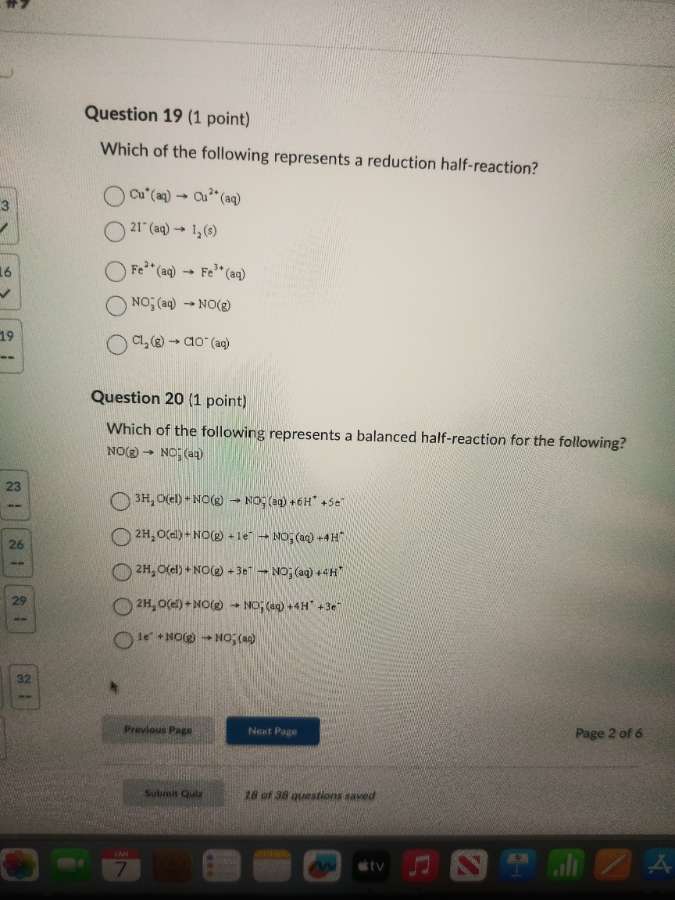
question 19 (1 point)
which of the following represents a reduction half - reaction?
\\(\ce{cu^{+}(aq) -> cu^{2+}(aq)}\\)
\\(\ce{2i^{-}(aq) -> i_{2}(s)}\\)
\\(\ce{fe^{2+}(aq) -> fe^{3+}(aq)}\\)
\\(\ce{no^{-}_{3}(aq) -> no(g)}\\)
\\(\ce{cl_{2}(g) -> clo^{-}(aq)}\\)
question 20 (1 point)
which of the following represents a balanced half - reaction for the following?
\\(\ce{no(g) -> no^{-}_{3}(aq)}\\)
\\(\ce{3h_{2}o(l) + no(g) -> no^{-}_{3}(aq) + 6h^{+} + 5e^{-}}\\)
\\(\ce{2h_{2}o(l) + no(g) + 1e^{-} -> no^{-}_{3}(aq) + 4h^{+}}\\)
\\(\ce{2h_{2}o(l) + no(g) + 3e^{-} -> no^{-}_{3}(aq) + 4h^{+}}\\)
\\(\ce{2h_{2}o(l) + no(g) -> no^{-}_{3}(aq) + 4h^{+} + 3e^{-}}\\)
\\(\ce{1e^{-} + no(g) -> no^{-}_{3}(aq)}\\)
previous page next page
page 2 of 6
submit quiz 18 of 38 questions saved
Question 19
Step1: Recall reduction definition
Reduction is gain of electrons (oxidation state decreases).
Step2: Analyze each option
- \( \text{Cu}^+(\text{aq}) \to \text{Cu}^{2+}(\text{aq}) \): Oxidation state of Cu increases from +1 to +2 (oxidation, not reduction).
- \( 2\text{I}^-(\text{aq}) \to \text{I}_2(\text{s}) \): Oxidation state of I increases from -1 to 0 (oxidation).
- \( \text{Fe}^{2+}(\text{aq}) \to \text{Fe}^{3+}(\text{aq}) \): Oxidation state of Fe increases from +2 to +3 (oxidation).
- \( \text{NO}_3^-(\text{aq}) \to \text{NO}(\text{g}) \): Let oxidation state of N in \( \text{NO}_3^- \) be \( x \): \( x + 3(-2) = -1 \Rightarrow x = +5 \). In \( \text{NO} \), \( x + (-2) = 0 \Rightarrow x = +2 \). Oxidation state decreases (gain of electrons) → reduction.
- \( \text{Cl}_2(\text{g}) \to \text{ClO}^-(\text{aq}) \): Oxidation state of Cl in \( \text{Cl}_2 \) is 0; in \( \text{ClO}^- \), \( x + (-2) = -1 \Rightarrow x = +1 \) (oxidation, increase).
Question 20
Step1: Balance atoms (N, O, H) and charge
- N: Balanced (1 N on each side).
- O: Add \( \text{H}_2\text{O} \) to balance. \( \text{NO}(\text{g}) \to \text{NO}_3^-(\text{aq}) \): Need 2 more O on left → add \( 2\text{H}_2\text{O}(\text{l}) \) (provides 2 O and 4 H).
- H: Add \( \text{H}^+ \) to balance. After adding \( 2\text{H}_2\text{O} \), we have 4 H on left → add \( 4\text{H}^+ \) on right.
- Charge: Oxidation state of N in \( \text{NO} \) is +2; in \( \text{NO}_3^- \), +5. So N loses 3 electrons (oxidation? Wait, no—wait, \( \text{NO} \to \text{NO}_3^- \) is oxidation (N goes from +2 to +5, loses 3 e⁻). Wait, but let's check each option:
Option 1: \( 3\text{H}_2\text{O}(\text{l}) + \text{NO}(\text{g}) \to \text{NO}_3^-(\text{aq}) + 6\text{H}^+ + 5e^- \): Charge: Left 0, right: \( -1 + 6(+1) + 5(-1) = 0 \). But N oxidation: +2 → +5 (loses 3 e⁻, not 5). Incorrect.
Option 2: \( 2\text{H}_2\text{O}(\text{l}) + \text{NO}(\text{g}) + 1e^- \to \text{NO}_3^-(\text{aq}) + 4\text{H}^+ \): Charge: Left \( 0 + 0 + (-1) = -1 \); right \( -1 + 4(+1) = +3 \). Not balanced. Incorrect.
Option 3: \( 2\text{H}_2\text{O}(\text{l}) + \text{NO}(\text{g}) + 3e^- \to \text{NO}_3^-(\text{aq}) + 4\text{H}^+ \): Charge: Left \( 0 + 0 + 3(-1) = -3 \); right \( -1 + 4(+1) = +3 \). Not balanced (should be equal). Wait, no—wait, oxidation: N loses 3 e⁻, so reaction should have \( -3e^- \) on right (or \( +3e^- \) on left for reduction, but this is oxidation). Wait, maybe I messed up. Let's redo:
Balanced half-reaction for \( \text{NO}(\text{g}) \to \text{NO}_3^-(\text{aq}) \) (oxidation, since N goes from +2 to +5):
- Balance N: \( \text{NO} \to \text{NO}_3^- \) (balanced).
- Balance O: Add \( 2\text{H}_2\text{O} \) to left (needs 2 O: \( \text{NO} + 2\text{H}_2\text{O} \to \text{NO}_3^- \)).
- Balance H: Add \( 4\text{H}^+ \) to right (\( \text{NO} + 2\text{H}_2\text{O} \to \text{NO}_3^- + 4\text{H}^+ \)).
- Balance charge: Left charge 0, right: \( -1 + 4(+1) = +3 \). So N loses 3 e⁻ (since +2 → +5, loses 3 e⁻) → add \( 3e^- \) to right:
\( \text{NO}(\text{g}) + 2\text{H}_2\text{O}(\text{l}) \to \text{NO}_3^-(\text{aq}) + 4\text{H}^+ + 3e^- \)
Wait, but looking at options:
Option 4: \( 2\text{H}_2\text{O}(\text{l}) + \text{NO}(\text{g}) \to \text{NO}_3^-(\text{aq}) + 4\text{H}^+ + 3e^- \): This matches. Let's check charge: Left 0, right: \( -1 + 4(+1) + 3(-1) = 0 \). Correct.

Snap & solve any problem in the app
Get step-by-step solutions on Sovi AI
Photo-based solutions with guided steps
Explore more problems and detailed explanations
(Question 19): \( \boldsymbol{\text{NO}_3^-(\text{aq}) \to \text{NO}(\text{g})} \)