QUESTION IMAGE
Question
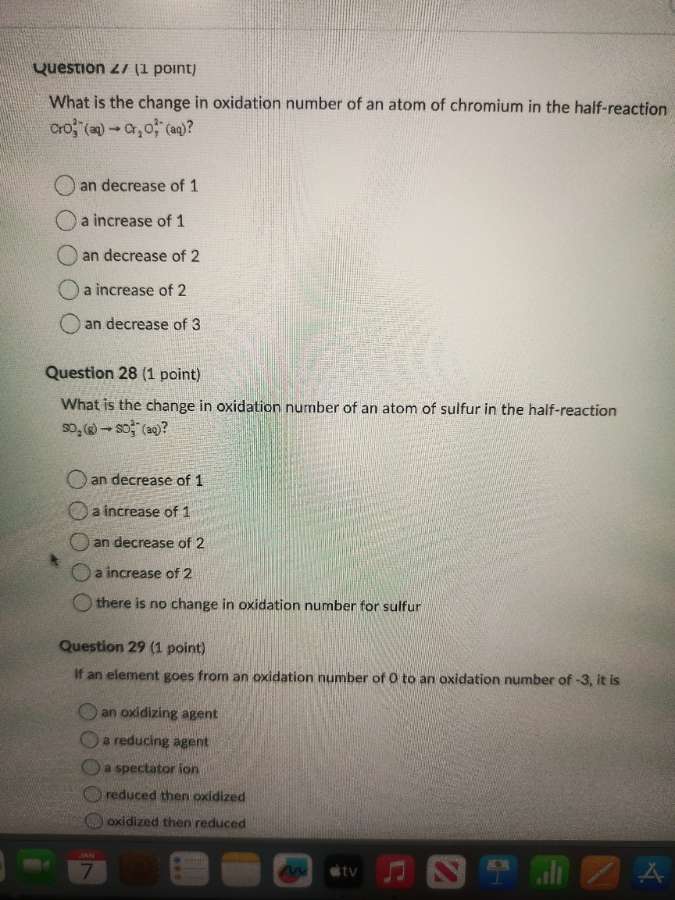
question 27 (1 point)
what is the change in oxidation number of an atom of chromium in the half - reaction (ce{cro_3^{2-}(aq) -> cr_2o_7^{2-}(aq)})?
- an decrease of 1
- a increase of 1
- an decrease of 2
- a increase of 2
- an decrease of 3
question 28 (1 point)
what is the change in oxidation number of an atom of sulfur in the half - reaction (ce{so_3(g) -> so_3^{2-}(aq)})?
- an decrease of 1
- a increase of 1
- an decrease of 2
- a increase of 2
- there is no change in oxidation number for sulfur
question 29 (1 point)
if an element goes from an oxidation number of 0 to an oxidation number of - 3, it is
- an oxidizing agent
- a reducing agent
- a spectator ion
- reduced then oxidized
- oxidized then reduced
Question 27
Step1: Find oxidation number in \( \text{CrO}_3^{2-} \)
Let oxidation number of Cr be \( x \). Oxygen is -2. So \( x + 3(-2) = -2 \). Solving: \( x - 6 = -2 \) → \( x = 4 \).
Step2: Find oxidation number in \( \text{Cr}_2\text{O}_7^{2-} \)
Let oxidation number of Cr be \( y \). Oxygen is -2. So \( 2y + 7(-2) = -2 \). Solving: \( 2y - 14 = -2 \) → \( 2y = 12 \) → \( y = 6 \).
Step3: Calculate change
Change: \( 6 - 4 = +2 \) (increase of 2).
Step1: Find oxidation number in \( \text{SO}_3 \)
Let oxidation number of S be \( x \). Oxygen is -2. So \( x + 3(-2) = 0 \) (neutral compound). Solving: \( x - 6 = 0 \) → \( x = 6 \).
Step2: Find oxidation number in \( \text{SO}_3^{2-} \)
Let oxidation number of S be \( y \). Oxygen is -2. So \( y + 3(-2) = -2 \). Solving: \( y - 6 = -2 \) → \( y = 4 \).
Step3: Calculate change
Change: \( 4 - 6 = -2 \) (decrease of 2).
Oxidation number decreases from 0 to -3 (gain of electrons). A substance that gains electrons is reduced, and the species that causes reduction (by being reduced itself) is an oxidizing agent? Wait, no: Wait, when oxidation number decreases, the element is reduced (gains electrons). The species that is reduced is an oxidizing agent? Wait, no: The oxidizing agent is reduced (gains electrons), reducing agent is oxidized (loses electrons). Wait, the element goes from 0 (neutral) to -3 (gained 3 electrons, reduced). So the element is being reduced, so it is an oxidizing agent? Wait, no: Wait, the substance that is reduced is the oxidizing agent (because it oxidizes another substance by taking electrons). Wait, let's recall: Oxidizing agent: gets reduced (oxidation number decreases). Reducing agent: gets oxidized (oxidation number increases). So if oxidation number decreases (0 → -3), the element is reduced, so it is an oxidizing agent? Wait, no, wait: Wait, the element itself is being reduced (so it is the oxidizing agent? Or is it the substance that is the oxidizing agent? Wait, the question is "If an element goes from an oxidation number of 0 to an oxidation number of -3, it is...". So the element's oxidation number decreases (reduced), so the element is an oxidizing agent? Wait, no, maybe I mixed up. Wait, oxidizing agent: causes oxidation (so it is reduced). Reducing agent: causes reduction (so it is oxidized). So if the element is reduced (oxidation number down), it is an oxidizing agent? Wait, no, the element itself is the one being reduced, so it is the oxidizing agent? Wait, let's take an example: Cl₂ (0) → Cl⁻ (-1): Cl is reduced, so Cl₂ is an oxidizing agent. So here, the element (let's say N₂ → N³⁻) is reduced, so it is an oxidizing agent? Wait, but the options: "an oxidizing agent", "a reducing agent", etc. Wait, the element is reduced (gains electrons), so it is an oxidizing agent (because it oxidizes another substance by accepting electrons). Wait, but the options: Let's check the options. The options are: oxidizing agent, reducing agent, spectator ion, reduced then oxidized, oxidized then reduced. So when oxidation number decreases (0 → -3), the element is reduced (gains electrons), so it is an oxidizing agent? Wait, no, maybe I made a mistake. Wait, no: Wait, the reducing agent is oxidized (loses electrons, oxidation number increases). Oxidizing agent is reduced (gains electrons, oxidation number decreases). So if the element's oxidation number decreases (0 to -3), it is reduced, so it is an oxidizing agent? Wait, but the element is the one being reduced, so it is the oxidizing agent. Wait, but let's think again. Suppose the element is X: X (0) → X⁻³ (gained 3 e⁻, reduced). So X is reduced, so X is an oxidizing agent (because it oxidizes another substance by taking electrons from it). So the answer should be "an oxidizing agent"? Wait, no, maybe I messed up. Wait, no, the reducing agent is oxidized (loses electrons). So if X is reduced (gains electrons), X is the oxidizing agent. So the correct option is "an oxidizing agent"? Wait, but let's check the options again. The options are: an oxidizing agent, a reducing agent, a spectator ion, reduced then oxidized, oxidized then reduced. So the element's oxidation number decreases (reduced), so it is an oxidizing agent. Wait, but maybe I got it wrong. Wait, no, let's recall the definitions:
- Oxidation: loss of electrons (oxidation number increases)
- Reduction: gain of electrons (oxidation number decreases)
- Oxidizing agent: substance that is reduced (causes oxidation)
- Red…

Snap & solve any problem in the app
Get step-by-step solutions on Sovi AI
Photo-based solutions with guided steps
Explore more problems and detailed explanations
a increase of 2