QUESTION IMAGE
Question
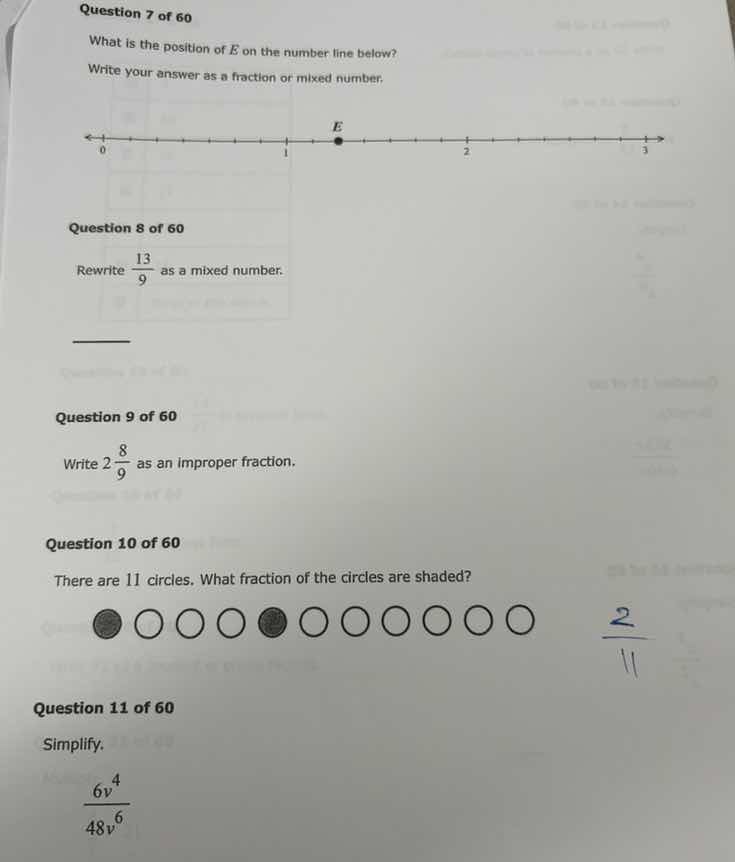
question 7 of 60
what is the position of e on the number line below?
write your answer as a fraction or mixed number.
e
0 1 2 3
question 8 of 60
rewrite \\(\frac{13}{9}\\) as a mixed number.
question 9 of 60
write \\(2\frac{8}{9}\\) as an improper fraction.
question 10 of 60
there are 11 circles. what fraction of the circles are shaded?
question 11 of 60
simplify.
\\(\frac{6v^4}{48v^6}\\)
Question 7
Step1: Determine the number of divisions between 0 and 1 (or 1 and 2)
Looking at the number line, from 0 to 1, there are 8 equal divisions (since between 0 and 1, the marks are at intervals that make 8 parts to get from 0 to 1). Wait, actually, let's check the distance from 1 to 2. From 1 to 2, how many spaces? Let's see, E is between 1 and 2. Let's count the number of units between 1 and E. Wait, maybe the number of segments between 0 and 1: from 0 to 1, there are 8 small ticks? Wait, no, let's re - examine. The number line has 0, then some ticks, then 1, then E, then more ticks, then 2, then more ticks, then 3. Let's assume that between 0 and 1, there are 8 equal parts? Wait, no, maybe between 1 and 2, there are 8 parts? Wait, no, let's think again. Let's see, from 1 to 2, if we count the number of intervals. Let's say that from 1 to 2, there are 8 equal segments. Then each segment has a length of $\frac{1}{8}$. Wait, no, maybe 8? Wait, no, let's look at the position of E. Let's see, 1 is at a certain point, and E is 2 units (if we count the ticks) after 1? Wait, no, maybe the number of divisions between 0 and 1 is 8. Wait, maybe I made a mistake. Let's start over.
Wait, the number line: 0, then 8 small intervals to 1 (so each interval is $\frac{1}{8}$), then from 1, E is 2 intervals away? Wait, no, let's count the number of ticks between 0 and 1. Let's see, 0, then 8 ticks, then 1. So each tick is $\frac{1}{8}$. Then from 1, E is 2 ticks? Wait, no, maybe the number of intervals between 1 and 2 is 8. Wait, maybe the correct way is: Let's see, the distance from 1 to 2 is divided into 8 equal parts. So each part is $\frac{1}{8}$. Then E is 2 parts after 1? Wait, no, looking at the number line, E is at 1 + $\frac{2}{8}$? Wait, no, maybe the number of divisions between 0 and 1 is 8, so each division is $\frac{1}{8}$. Then from 1, moving 2 divisions (each of $\frac{1}{8}$) gives 1+$\frac{2}{8}$ = 1$\frac{1}{4}$? Wait, no, maybe the number of divisions between 1 and 2 is 8. Wait, maybe I miscounted. Let's assume that between 0 and 1, there are 8 equal segments, so each segment has a length of $\frac{1}{8}$. Then from 1, E is 2 segments to the right. So the position of E is 1 + $\frac{2}{8}$ = 1$\frac{1}{4}$? Wait, no, 2/8 simplifies to 1/4. Wait, maybe the number of divisions between 1 and 2 is 8, so each division is $\frac{1}{8}$. So E is at 1 + $\frac{2}{8}$ = 1$\frac{1}{4}$? Wait, maybe the correct number of divisions is 8 between 0 and 1, so each unit is $\frac{1}{8}$. Then from 1, E is 2 units, so 1 + $\frac{2}{8}$ = 1$\frac{1}{4}$? Wait, no, 2/8 is 1/4, so 1 + 1/4 = 1$\frac{1}{4}$? Wait, maybe I made a mistake. Let's check again.
Wait, maybe the number of intervals between 0 and 1 is 8, so each interval is 1/8. Then from 0 to 1, 8 intervals. Then from 1 to 2, also 8 intervals. So E is 2 intervals after 1, so 1 + 2(1/8)=1 + 1/4 = 1$\frac{1}{4}$? Wait, no, 2(1/8)=1/4, so 1 + 1/4 = 1$\frac{1}{4}$. Wait, but maybe the number of intervals is 10? No, the problem says "write your answer as a fraction or mixed number". Let's assume that between 1 and 2, there are 8 equal parts, so each part is 1/8. Then E is 2 parts after 1, so 1 + 2/8 = 1 + 1/4 = 1$\frac{1}{4}$. Wait, but maybe the number of divisions is 8. So the position of E is 1$\frac{1}{4}$? Wait, no, maybe 1$\frac{2}{8}$ which simplifies to 1$\frac{1}{4}$.
Wait, maybe I should count the number of ticks between 0 and 1. Let's see, 0, then 8 ticks, then 1. So each tick is 1/8. Then from 1, E is at the 2nd tick, so 1 + 2*(1/8)=1 + 1/4 = 1$\frac{1}{4}$.
Step2: Confirm the po…
Step1: Divide the numerator by the denominator
To rewrite an improper fraction $\frac{a}{b}$ (where $a > b$) as a mixed number, we divide $a$ by $b$. For $\frac{13}{9}$, divide 13 by 9. 9 goes into 13 once with a remainder of 13 - 9 = 4.
Step2: Write the mixed number
The mixed number is written as the quotient (1) followed by the remainder (4) over the original denominator (9). So $\frac{13}{9}=1\frac{4}{9}$.
Step1: Recall the formula for converting mixed number to improper fraction
The formula for converting a mixed number $a\frac{b}{c}$ (where $a$ is the whole number, $b$ is the numerator of the fraction, and $c$ is the denominator) to an improper fraction is $\frac{a\times c + b}{c}$.
Step2: Apply the formula
For $2\frac{8}{9}$, $a = 2$, $b = 8$, and $c = 9$. So we calculate $2\times9+8=18 + 8=26$. Then the improper fraction is $\frac{26}{9}$.

Snap & solve any problem in the app
Get step-by-step solutions on Sovi AI
Photo-based solutions with guided steps
Explore more problems and detailed explanations
$1\frac{1}{4}$ (or $\frac{5}{4}$)