QUESTION IMAGE
Question
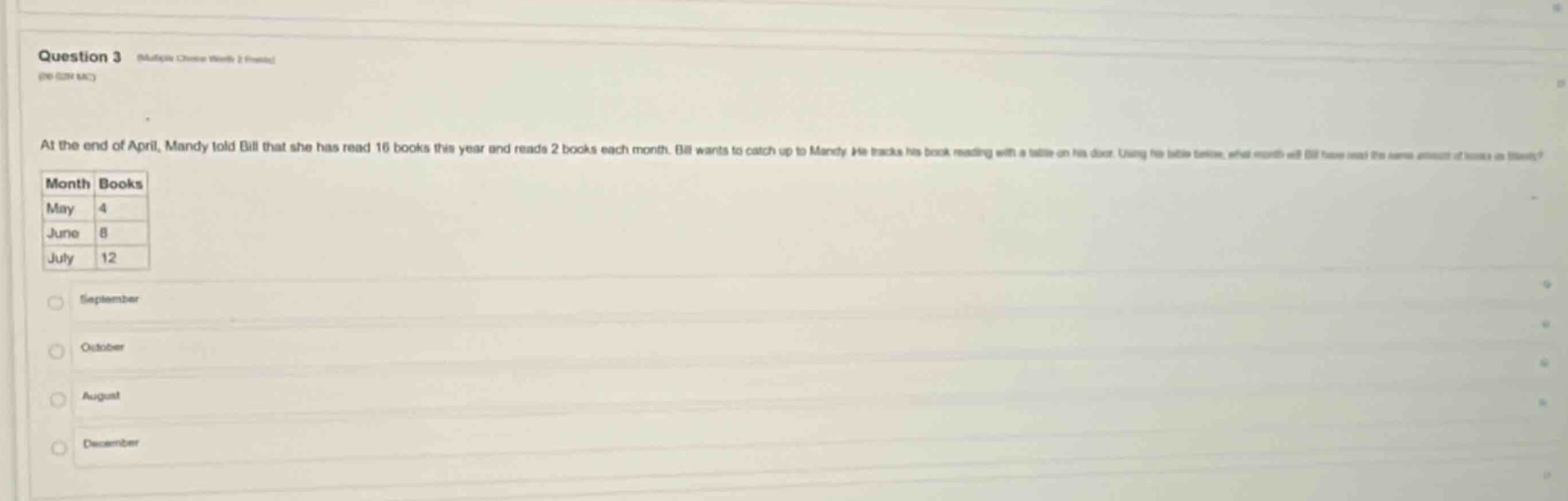
question 3 (multiple choice worth 2 points) (08.02 mc) at the end of april, mandy told bill that she has read 16 books this year and reads 2 books each month. bill wants to catch up to mandy. he tracks his book reading with a table on his door. using his table below, what month will bill have read the same amount of books as mandy?
| month | books |
|---|---|
| june | 8 |
| july | 12 |
options:
- september
- october
- august
- december
Step1: Analyze Mandy's book - reading pattern
Mandy has read 16 books by the end of April and reads 2 books each month. Let \( m \) be the number of months after April. The number of books Mandy has read after \( m \) months is given by the formula \( M(m)=16 + 2m \).
Step2: Analyze Bill's book - reading pattern
From the table, Bill reads 4 books in May, 8 books in June, 12 books in July. We can see that Bill reads 4 books each month (the common difference between consecutive months' book counts: \( 8 - 4=4 \), \( 12 - 8 = 4 \)). Let \( n \) be the number of months after April. In May, \( n = 1 \), books \( = 4 \); June, \( n=2 \), books \( = 8 \); July, \( n = 3 \), books \( = 12 \). So the number of books Bill has read after \( n \) months is \( B(n)=4n \) (since in May (\( n = 1 \)), \( 4\times1=4 \); June (\( n = 2 \)), \( 4\times2 = 8 \); July (\( n=3 \)), \( 4\times3=12 \)).
Step3: Find the month when \( M(m)=B(n) \)
We want to find \( m \) and \( n \) such that \( 16 + 2m=4n \). Also, note that the number of months after April for Mandy and Bill should be the same (because we are looking for the time when they have read the same number of books, so the time elapsed since April is the same for both). So \( m=n \).
Substitute \( m = n \) into the equation \( 16+2m = 4m \).
Subtract \( 2m \) from both sides: \( 16=4m - 2m=2m \).
Then solve for \( m \): \( m=\frac{16}{2}=8 \).
Since April is the starting point, after 8 months from April, the month is April + 8 months. April + 1 month = May, April + 2 months = June, April + 3 months = July, April + 4 months = August, April + 5 months = September, April + 6 months = October, April + 7 months = November, April + 8 months = December? Wait, no, wait. Wait, maybe I made a mistake in the variable definition.
Wait, let's re - define. Let's consider the number of months after April. Let \( t \) be the number of months after April.
For Mandy: Number of books \( M(t)=16 + 2t \)
For Bill: From the table, in May (\( t = 1 \)): 4 books, June (\( t = 2 \)): 8 books, July (\( t=3 \)): 12 books. So the pattern is Bill reads 4 books per month, so \( B(t)=4t \)
We set \( 16 + 2t=4t \)
\( 16=4t - 2t \)
\( 16 = 2t \)
\( t = 8 \)
Wait, but when \( t = 1 \) (May), Bill has 4 books, Mandy has \( 16+2\times1 = 18 \) books. When \( t = 2 \) (June), Bill has 8, Mandy has \( 16 + 2\times2=20 \). When \( t=3 \) (July), Bill has 12, Mandy has \( 16+2\times3 = 22 \). When \( t = 4 \) (August), Bill has \( 4\times4 = 16 \), Mandy has \( 16+2\times4=24 \). When \( t = 5 \) (September), Bill has \( 4\times5 = 20 \), Mandy has \( 16+2\times5 = 26 \). When \( t=6 \) (October), Bill has \( 4\times6=24 \), Mandy has \( 16+2\times6 = 28 \). Wait, this is not matching. Wait, maybe my initial assumption about Bill's formula is wrong.
Wait, let's re - examine Bill's data.
May: 4 books (total by May)
June: 8 books (total by June)
July: 12 books (total by July)
So the total number of books Bill has read by month \( t \) (where \( t = 1 \) for May, \( t = 2 \) for June, \( t=3 \) for July) is \( B(t)=4t \)
Mandy's total by month \( t \) (where \( t = 1 \) for May, because April is \( t = 0 \)): At \( t = 0 \) (April), Mandy has 16 books. At \( t = 1 \) (May), Mandy has \( 16+2\times1=18 \) books. At \( t = 2 \) (June), \( 16 + 2\times2 = 20 \) books. At \( t=3 \) (July), \( 16+2\times3 = 22 \) books. At \( t = 4 \) (August), \( 16+2\times4 = 24 \) books. At \( t=5 \) (September), \( 16+2\times5 = 26 \) books. At \( t = 6 \) (October), \( 16+2\times6=28 \) books. At \( t=7 \) (November), \( 16+2\t…

Snap & solve any problem in the app
Get step-by-step solutions on Sovi AI
Photo-based solutions with guided steps
Explore more problems and detailed explanations
December (the option corresponding to December)