QUESTION IMAGE
Question
question 6 (1 point)
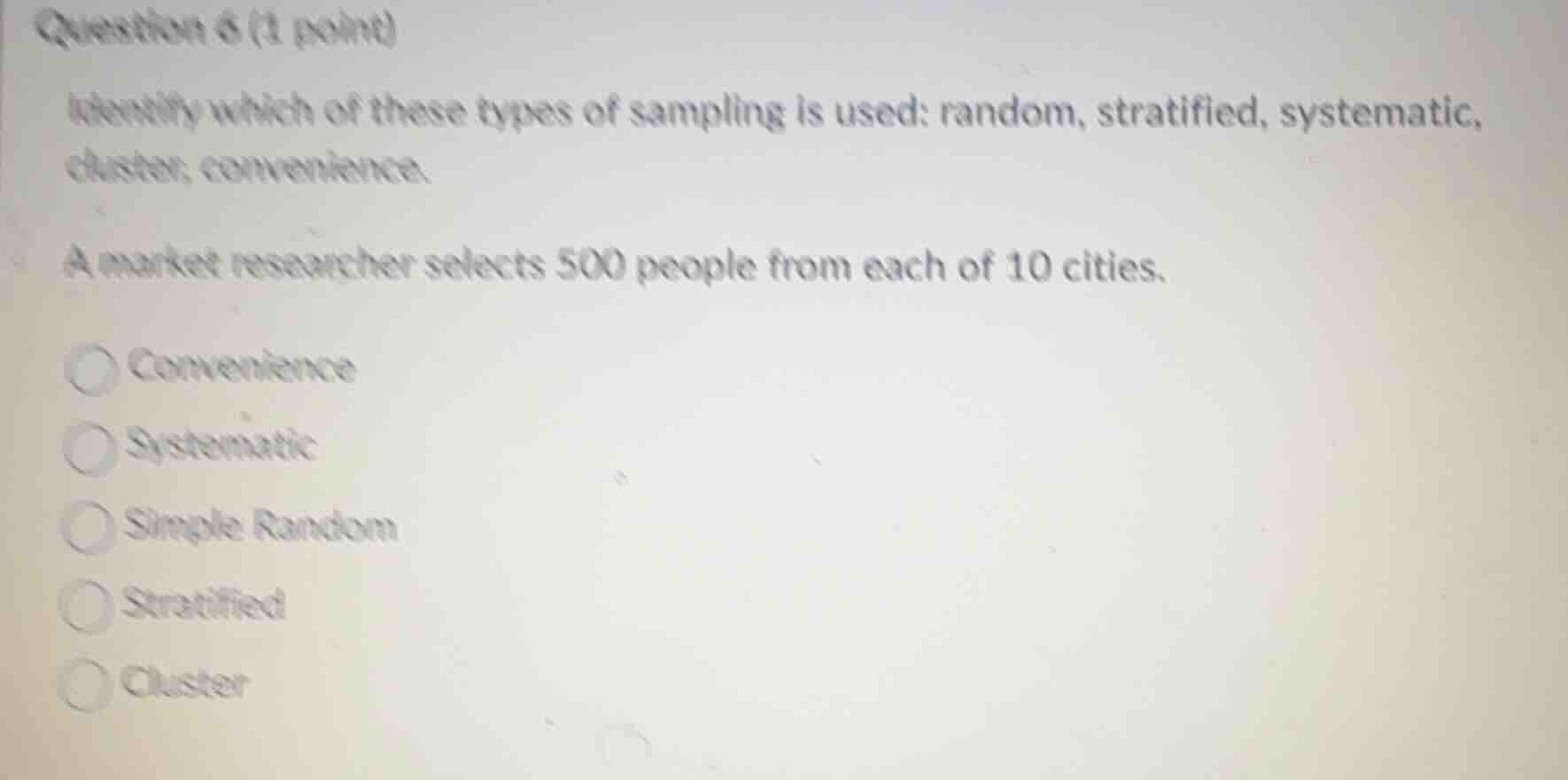
identify which of these types of sampling is used: random, stratified, systematic, cluster, convenience.
a market researcher selects 500 people from each of 10 cities.
convenience
systematic
simple random
stratified
cluster
Brief Explanations
- Recall the definitions of each sampling method:
- Convenience Sampling: Uses samples that are easy to reach.
- Systematic Sampling: Selects every k-th individual.
- Simple Random Sampling: Each individual has an equal chance of being selected.
- Stratified Sampling: Divides the population into strata (groups with similar characteristics) and samples from each stratum.
- Cluster Sampling: Divides the population into clusters (groups), and then samples entire clusters.
- Analyze the given scenario: A market researcher selects 500 people from each of 10 cities. Here, the cities can be considered as clusters, and the researcher is sampling entire clusters (by selecting people from each city, which is a cluster). Wait, no—wait, actually, if we think of the population as being divided into clusters (cities), and we are sampling from each cluster (selecting 500 from each city), but actually, cluster sampling is when you select some clusters and sample all from them, while stratified is when you sample from each stratum. Wait, no, let's re - check. Wait, in this case, the cities are clusters, and the researcher is taking samples from each cluster (500 from each of 10 cities). But actually, the correct method here is Cluster Sampling? Wait, no, wait: Stratified sampling is when the population is divided into strata (homogeneous groups) and a sample is taken from each stratum. Cluster sampling is when the population is divided into clusters (heterogeneous groups), and then some clusters are selected and all members of the selected clusters are sampled. Wait, in this problem, the researcher is selecting 500 from each of 10 cities. So the cities are clusters, and we are sampling from each cluster (not just selecting some clusters). Wait, maybe I made a mistake. Wait, no—let's re - define:
- Cluster Sampling: The population is divided into clusters (e.g., cities). Then, a random sample of clusters is selected, and all elements within the selected clusters are included in the sample. But in this case, the researcher is selecting from each of 10 cities (so all 10 clusters are selected, and then 500 from each). Wait, maybe the problem is that the cities are clusters, and we are sampling from each cluster. But actually, the correct answer is Cluster Sampling? Wait, no, wait another approach:
Wait, the key is: In cluster sampling, the clusters are groups, and we sample entire clusters or parts? Wait, no, let's check the definitions again.
- Stratified Sampling: The population is divided into strata (groups with similar characteristics), and a sample is taken from each stratum. For example, if we have different income groups (strata) and sample from each.
- Cluster Sampling: The population is divided into clusters (groups, like cities), and then a random sample of clusters is selected, and all members of the selected clusters are surveyed. But in our problem, the researcher is selecting 500 from each of 10 cities. So all 10 cities (clusters) are selected, and then a sample from each cluster. Wait, maybe the problem is that the cities are clusters, and we are sampling from each cluster. But the correct method here is Cluster Sampling? Wait, no, I think I messed up. Wait, let's take an example. Suppose the population is all people in a country. The cities are clusters. If we do cluster sampling, we might randomly select a few cities and then sample all people in those cities. But in this case, we are selecting 500 from each of 10 cities (so we are using all 10 cities as clusters a…

Snap & solve any problem in the app
Get step-by-step solutions on Sovi AI
Photo-based solutions with guided steps
Explore more problems and detailed explanations
Cluster (The sampling method used is Cluster Sampling, as the cities are considered clusters and the researcher samples from each of these clusters (selecting 500 people from each of the 10 cities).)