QUESTION IMAGE
Question
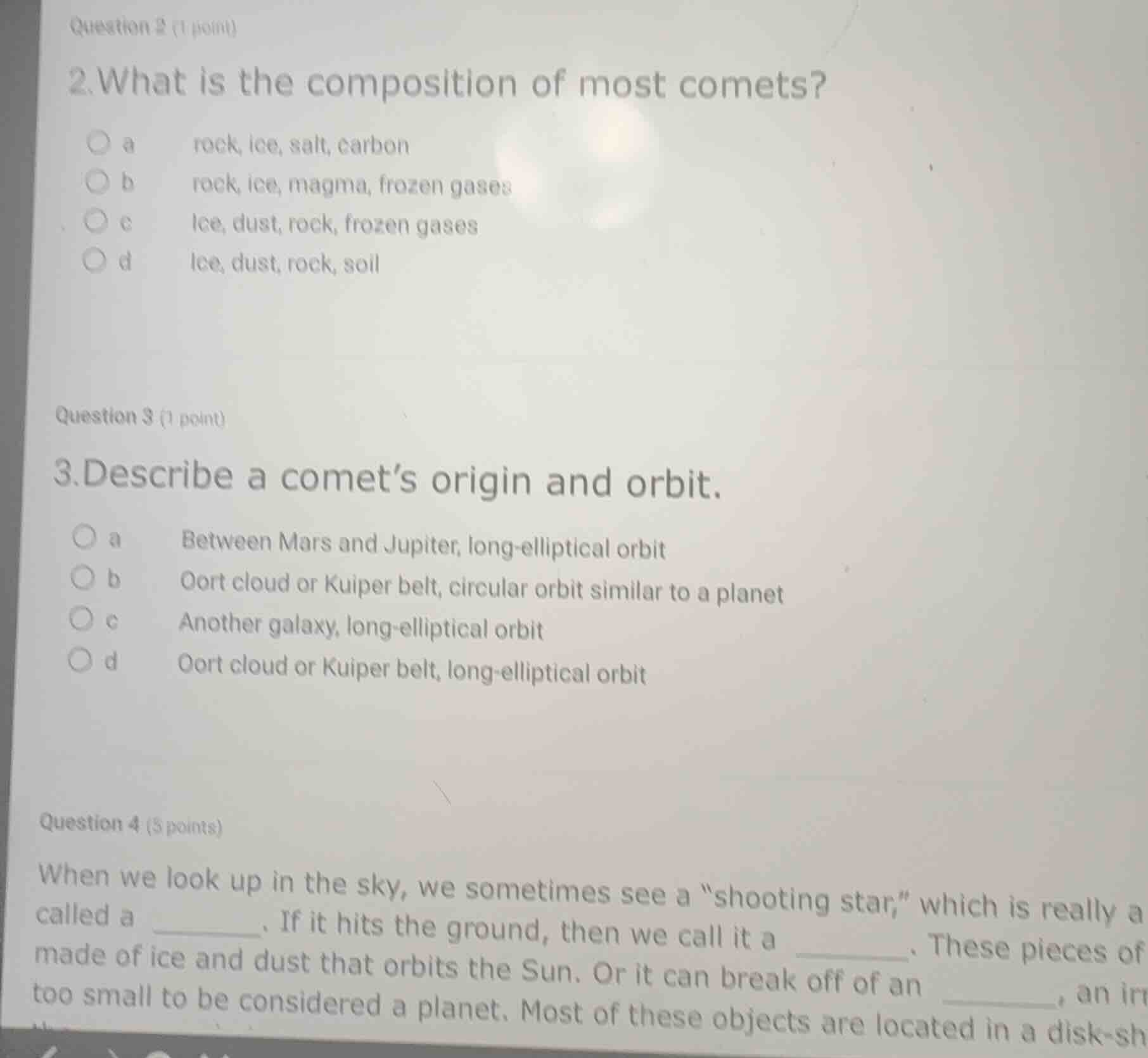
question 2 (1 point)
- what is the composition of most comets?
a rock, ice, salt, carbon
b rock, ice, magma, frozen gases
c ice, dust, rock, frozen gases
d ice, dust, rock, soil
question 3 (1 point)
- describe a comet’s origin and orbit.
a between mars and jupiter, long - elliptical orbit
b oort cloud or kuiper belt, circular orbit similar to a planet
c another galaxy, long - elliptical orbit
d oort cloud or kuiper belt, long - elliptical orbit
question 4 (5 points)
when we look up in the sky, we sometimes see a \shooting star,\ which is really a called a. if it hits the ground, then we call it a. these pieces of made of ice and dust that orbits the sun. or it can break off of an, an irr too small to be considered a planet. most of these objects are located in a disk - sh
Question 2
Comets are often described as "dirty snowballs." Their typical composition includes ice (water ice, and other ices like carbon dioxide, ammonia), dust (small solid particles), rock (solid mineral particles), and frozen gases (like methane, carbon monoxide). Option a has salt and carbon which are not typical main components. Option b has magma which is not a component of comets. Option d has soil which is not a comet component. Option c lists ice, dust, rock, frozen gases which matches the known composition.
Comets originate from the Oort cloud (a spherical cloud of icy bodies far from the Sun) or the Kuiper belt (a region of icy objects beyond Neptune). Their orbits are highly elliptical (long - elliptical), taking them from the outer solar system close to the Sun and back out. Option a: The region between Mars and Jupiter is the asteroid belt, not a comet origin. Option b: Comet orbits are not circular like planets. Option c: Comets are from our solar system, not another galaxy. Option d correctly states the origin (Oort cloud or Kuiper belt) and orbit (long - elliptical).
A "shooting star" is actually a meteor (the streak of light from a space object burning up in the atmosphere). If it hits the ground, it's a meteorite. The objects made of ice and dust orbiting the Sun are comets, and they can also break off from an asteroid (though the text seems to have a typo, likely "asteroid" here as asteroids are small, irregularly shaped objects, many in the asteroid belt).

Snap & solve any problem in the app
Get step-by-step solutions on Sovi AI
Photo-based solutions with guided steps
Explore more problems and detailed explanations
c. Ice, dust, rock, frozen gases