QUESTION IMAGE
Question
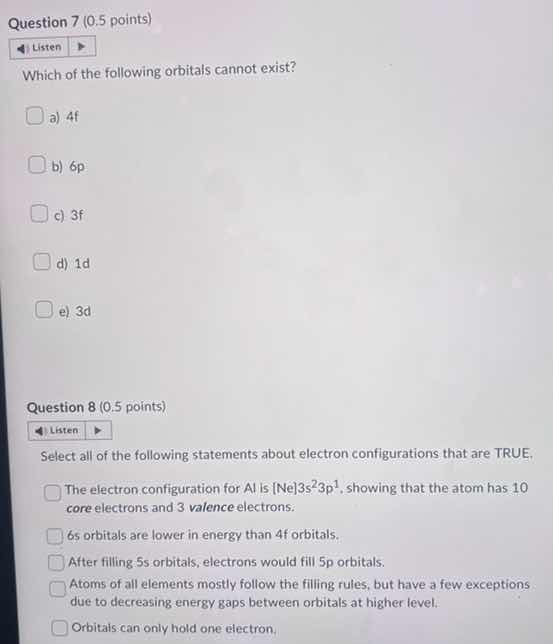
question 7 (0.5 points) listen which of the following orbitals cannot exist? a) 4f b) 6p c) 3f d) 1d e) 3d question 8 (0.5 points) listen select all of the following statements about electron configurations that are true. the electron configuration for al is ne3s²3p¹, showing that the atom has 10 core electrons and 3 valence electrons. 6s orbitals are lower in energy than 4f orbitals. after filling 5s orbitals, electrons would fill 5p orbitals. atoms of all elements mostly follow the filling rules, but have a few exceptions due to decreasing energy gaps between orbitals at higher level. orbitals can only hold one electron,
Question 7
Step1: Recall orbital rules
Orbitals follow $n > l$, where $n$ = principal quantum number, $l$ = azimuthal quantum number ($l=0=s,1=p,2=d,3=f$).
Step2: Check each option
a) 4f: $n=4, l=3$, $4>3$ → valid
b) 6p: $n=6, l=1$, $6>1$ → valid
c) 3f: $n=3, l=3$, $3
ot>3$ → invalid
d) 1d: $n=1, l=2$, $1
ot>2$ → invalid
e) 3d: $n=3, l=2$, $3>2$ → valid
- For Al, $[Ne]3s^23p^1$: Ne has 10 electrons (core), valence = $2+1=3$ → True.
- 6s orbitals have lower energy than 4f (Aufbau principle) → True.
- Aufbau principle: fill lower energy orbitals first; 5s < 5p, so 5s fills before 5p → False.
- Most elements follow filling rules, but exceptions (e.g., Cr, Cu) occur due to small energy gaps at higher levels → True.
- Orbitals hold max 2 electrons (Pauli exclusion principle) → False.

Snap & solve any problem in the app
Get step-by-step solutions on Sovi AI
Photo-based solutions with guided steps
Explore more problems and detailed explanations
c) 3f, d) 1d
---