QUESTION IMAGE
Question
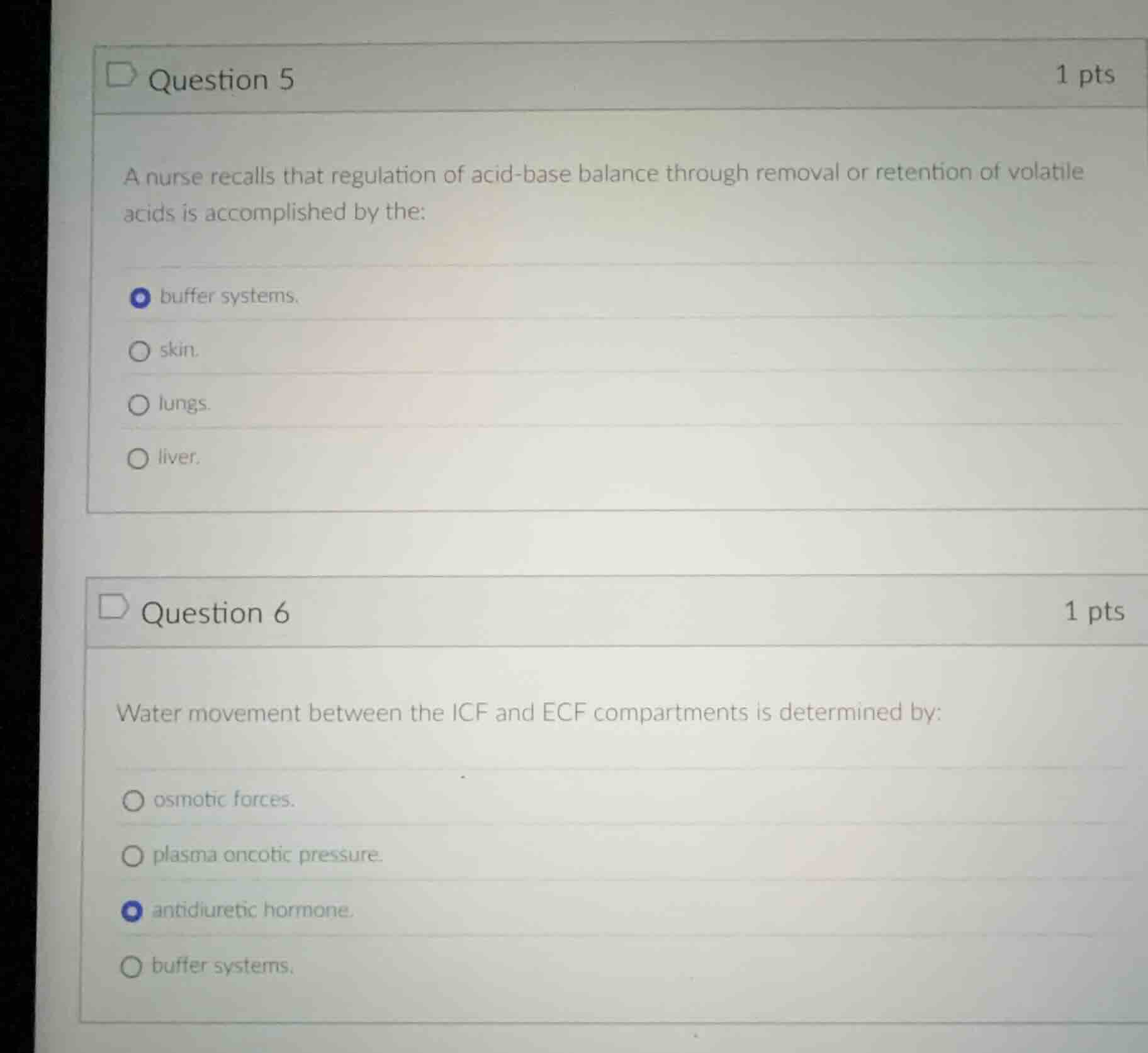
question 5
1 pts
a nurse recalls that regulation of acid - base balance through removal or retention of volatile acids is accomplished by the:
- buffer systems.
- skin.
- lungs.
- liver.
question 6
1 pts
water movement between the icf and ecf compartments is determined by:
- osmotic forces.
- plasma oncotic pressure.
- antidiuretic hormone.
- buffer systems.
Response
Question 5
Brief Explanations
To determine the correct answer, we analyze the role of each option in acid - base balance regulation:
- Buffer systems: They act quickly to resist changes in pH by binding or releasing H⁺, but they don't remove or retain volatile acids.
- Skin: The skin's main functions are related to protection, sensation, and thermoregulation, not acid - base balance regulation through volatile acid handling.
- Lungs: The lungs regulate acid - base balance by removing (through exhalation) or retaining (by slowing down respiration) carbonic acid (a volatile acid, as \(H_2CO_3\) can dissociate into \(CO_2\) and \(H_2O\), and \(CO_2\) is volatile).
- Liver: The liver is involved in many metabolic processes, but not in the regulation of acid - base balance through volatile acid removal or retention.
So the correct answer is the lungs.
Brief Explanations
To find the correct answer, we analyze the role of each option in water movement between ICF (Intracellular Fluid) and ECF (Extracellular Fluid):
- Osmotic forces: Osmotic pressure, which is mainly determined by the concentration of solutes, drives the movement of water across cell membranes between ICF and ECF. Water moves from an area of lower solute concentration (higher water concentration) to an area of higher solute concentration (lower water concentration) to equalize the osmotic pressure.
- Plasma oncotic pressure: Plasma oncotic pressure mainly affects the movement of fluid between the blood plasma (a part of ECF) and the interstitial fluid (another part of ECF), not between ICF and ECF.
- Antidiuretic hormone (ADH): ADH mainly regulates water reabsorption in the kidneys, which affects the overall volume of ECF, but it does not directly determine the movement of water between ICF and ECF.
- Buffer systems: Buffer systems are involved in pH regulation, not water movement between fluid compartments.
So the correct answer is osmotic forces.

Snap & solve any problem in the app
Get step-by-step solutions on Sovi AI
Photo-based solutions with guided steps
Explore more problems and detailed explanations
C. lungs