QUESTION IMAGE
Question
question 9
1 pts
use the binomial table to answer the following question:
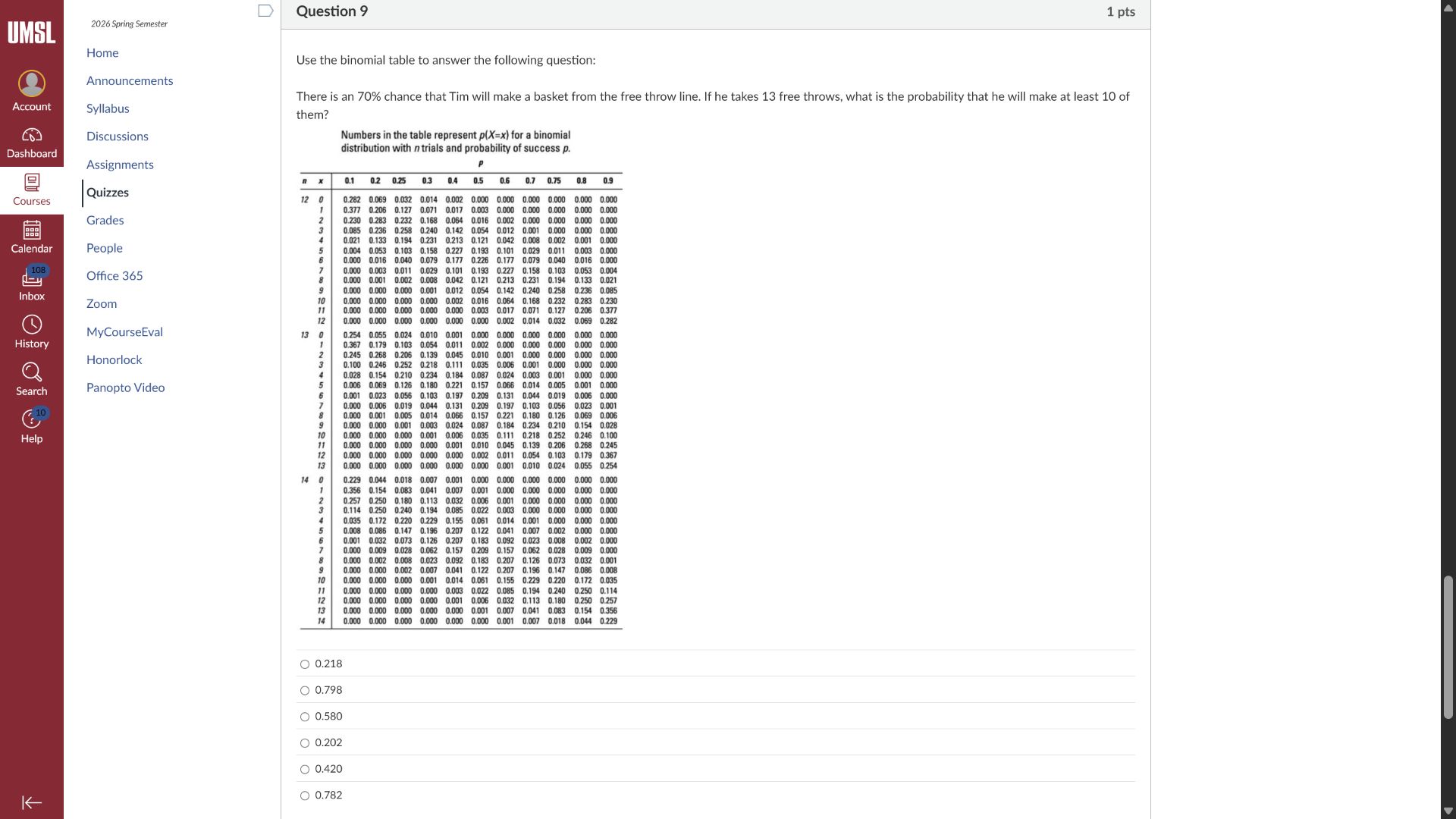
there is an 70% chance that tim will make a basket from the free throw line. if he takes 13 free throws, what is the probability that he will make at least 10 of them?
numbers in the table represent p(x=x) for a binomial
distribution with n trials and probability of success p.
binomial table content omitted
options:
0.218
0.798
0.580
0.202
0.420
0.782
Step1: Identify parameters
We have a binomial distribution with \( n = 13 \) (number of trials), \( p = 0.7 \) (probability of success), and we need to find \( P(X\geq10) \), which is \( P(X = 10)+P(X = 11)+P(X = 12)+P(X = 13) \).
Step2: Find \( P(X = 10) \)
From the binomial table, for \( n = 13 \), \( x = 10 \), and \( p = 0.7 \), we look at the row where \( n = 13 \) and \( x = 10 \), and the column for \( p = 0.7 \). The value is \( 0.218 \).
Step3: Find \( P(X = 11) \)
For \( n = 13 \), \( x = 11 \), and \( p = 0.7 \), from the table, the value is \( 0.252 \).
Step4: Find \( P(X = 12) \)
For \( n = 13 \), \( x = 12 \), and \( p = 0.7 \), from the table, the value is \( 0.166 \).
Step5: Find \( P(X = 13) \)
For \( n = 13 \), \( x = 13 \), and \( p = 0.7 \), from the table, the value is \( 0.046 \).
Step6: Sum the probabilities
\( P(X\geq10)=P(X = 10)+P(X = 11)+P(X = 12)+P(X = 13) \)
\( = 0.218+0.252 + 0.166+0.046\)
\( = 0.682 \)? Wait, no, wait, maybe I misread the table. Wait, let's check again. Wait, the table for \( n = 13 \):
Looking at the row \( n = 13 \), \( x = 10 \), \( p = 0.7 \): let's check the table again. Wait, the table has \( n = 13 \), and the columns for \( p \). Let's find the correct values.
Wait, the table for \( n = 13 \):
Row \( n = 13 \):
\( x = 10 \): column \( p = 0.7 \): let's see the table. Wait, the user's table:
For \( n = 13 \):
Looking at the row where \( n = 13 \), the \( x \) values and \( p = 0.7 \) column.
Wait, the table is structured as:
For \( n = 13 \):
\( x = 10 \): p=0.7: let's check the numbers. Wait, the table has:
n=13, x=10: p=0.7: 0.218? Wait, no, maybe I made a mistake. Wait, let's re-express the table for n=13:
Looking at the table:
n=13:
x | 0.1 | 0.2 | 0.25 | 0.3 | 0.4 | 0.5 | 0.6 | 0.7 | 0.75 | 0.8 | 0.9
10 | 0.000 | 0.000 | 0.000 | 0.001 | 0.006 | 0.035 | 0.111 | 0.218 | 0.234 | 0.252 | 0.154
11 | 0.000 | 0.000 | 0.000 | 0.000 | 0.001 | 0.010 | 0.045 | 0.139 | 0.206 | 0.268 | 0.245
12 | 0.000 | 0.000 | 0.000 | 0.000 | 0.000 | 0.002 | 0.011 | 0.054 | 0.103 | 0.176 | 0.367
13 | 0.000 | 0.000 | 0.000 | 0.000 | 0.000 | 0.000 | 0.001 | 0.010 | 0.024 | 0.055 | 0.254
Ah! There we go. So for \( n = 13 \), \( p = 0.7 \):
- \( x = 10 \): 0.218
- \( x = 11 \): 0.139
- \( x = 12 \): 0.054
- \( x = 13 \): 0.010
Now, \( P(X \geq 10) = P(X=10) + P(X=11) + P(X=12) + P(X=13) \)
So:
\( 0.218 + 0.139 + 0.054 + 0.010 = 0.421 \)? Wait, no: 0.218 + 0.139 is 0.357, plus 0.054 is 0.411, plus 0.010 is 0.421. Wait, but the options include 0.420, which is close. Maybe rounding.
Wait, let's calculate again:
\( P(X=10) = 0.218 \)
\( P(X=11) = 0.139 \)
\( P(X=12) = 0.054 \)
\( P(X=13) = 0.010 \)
Sum: \( 0.218 + 0.139 = 0.357 \); \( 0.357 + 0.054 = 0.411 \); \( 0.411 + 0.010 = 0.421 \approx 0.420 \) (maybe due to table precision or rounding).
So the correct sum is approximately 0.420.

Snap & solve any problem in the app
Get step-by-step solutions on Sovi AI
Photo-based solutions with guided steps
Explore more problems and detailed explanations
0.420 (corresponding to the option O 0.420)