QUESTION IMAGE
Question
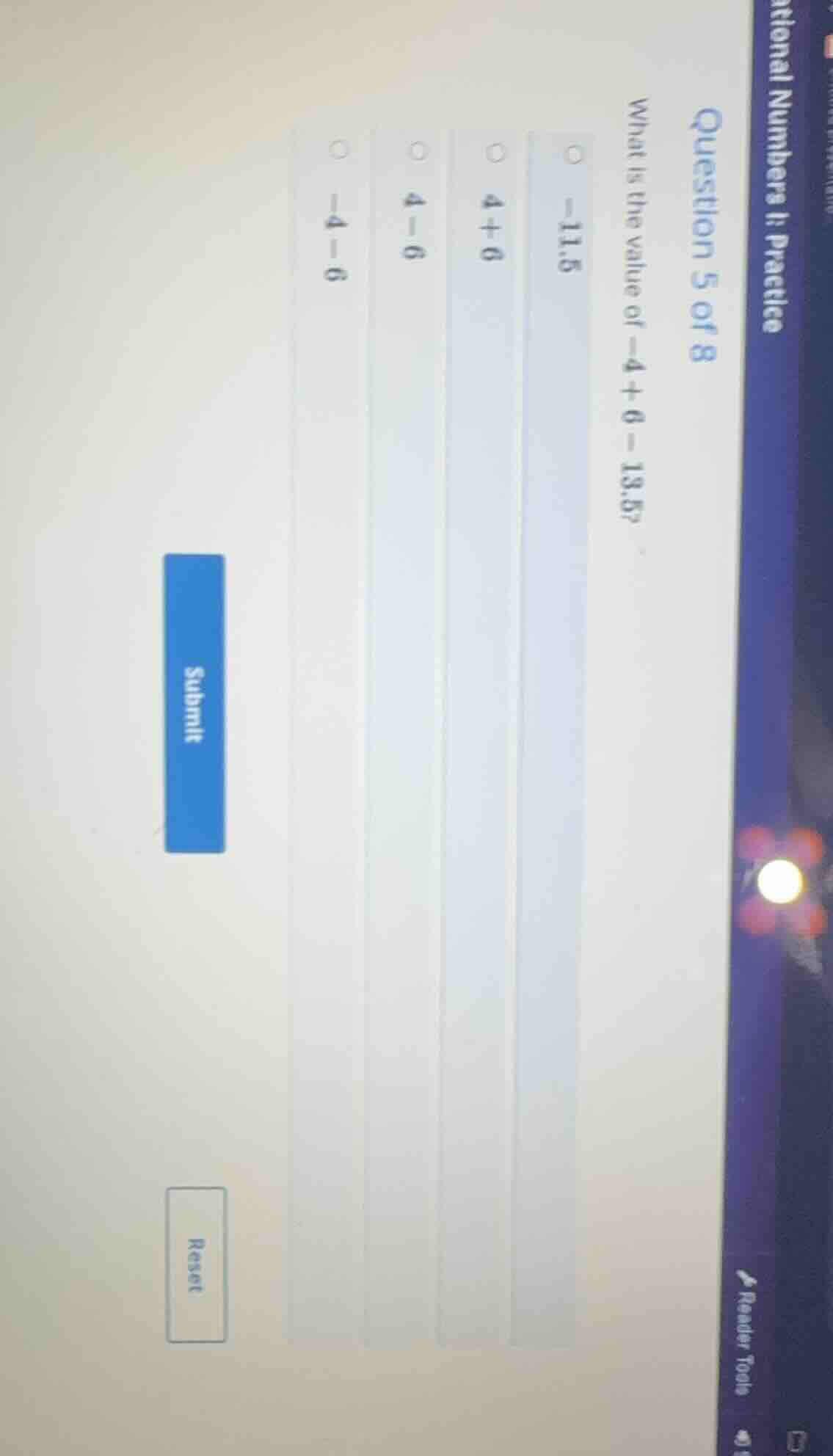
question 5 of 8 what is the value of -4 + 6 - 13.5? -11.5 4 + 6 4 - 6 -4 - 6
Step1: Calculate -4 + 6
First, we perform the addition of -4 and 6. Since 6 is positive and has a greater absolute value than -4, we subtract the absolute values: \(6 - 4 = 2\), and the result takes the sign of the number with the greater absolute value (which is positive here), so \(-4 + 6 = 2\)? Wait, no, wait, the original expression is \(-4 + 6 - 13.5\). Wait, I misread. Let's correct.
Step1: Simplify -4 + 6
We calculate \(-4 + 6\). Using the rule for adding integers with different signs: subtract the absolute values (\(6 - 4 = 2\)) and take the sign of the number with the larger absolute value (6 is positive), so \(-4 + 6 = 2\)? Wait, no, wait, the problem is \(-4 + 6 - 13.5\). Wait, maybe I made a mistake. Wait, let's do it step by step.
Step1: Compute -4 + 6
\(-4 + 6 = 2\) (because 6 - 4 = 2, and positive since 6 > 4 in absolute value? Wait, no: -4 + 6 is the same as 6 - 4, which is 2. Then,
Step2: Subtract 13.5 from the result
Now we have \(2 - 13.5\). To subtract, we can rewrite it as \(2 + (-13.5) = -11.5\). Wait, but let's check the options. One of the options is -11.5. Wait, but let's re-express the original expression: \(-4 + 6 - 13.5\). Let's group the terms: \((-4 - 13.5) + 6\)? Wait, no, addition is associative, so \(-4 + 6 - 13.5 = (-4 - 13.5) + 6 = -17.5 + 6 = -11.5\). Yes, that's correct.
Wait, but let's check the options. The first option is -11.5. So that's the answer.
Wait, maybe I messed up the initial steps. Let's do it again:
Original expression: \(-4 + 6 - 13.5\)
First, add -4 and 6: \(-4 + 6 = 2\)
Then, subtract 13.5 from 2: \(2 - 13.5 = -11.5\)
Yes, so the value is -11.5, which is one of the options.

Snap & solve any problem in the app
Get step-by-step solutions on Sovi AI
Photo-based solutions with guided steps
Explore more problems and detailed explanations
-11.5 (the option corresponding to -11.5)