QUESTION IMAGE
Question
question 1
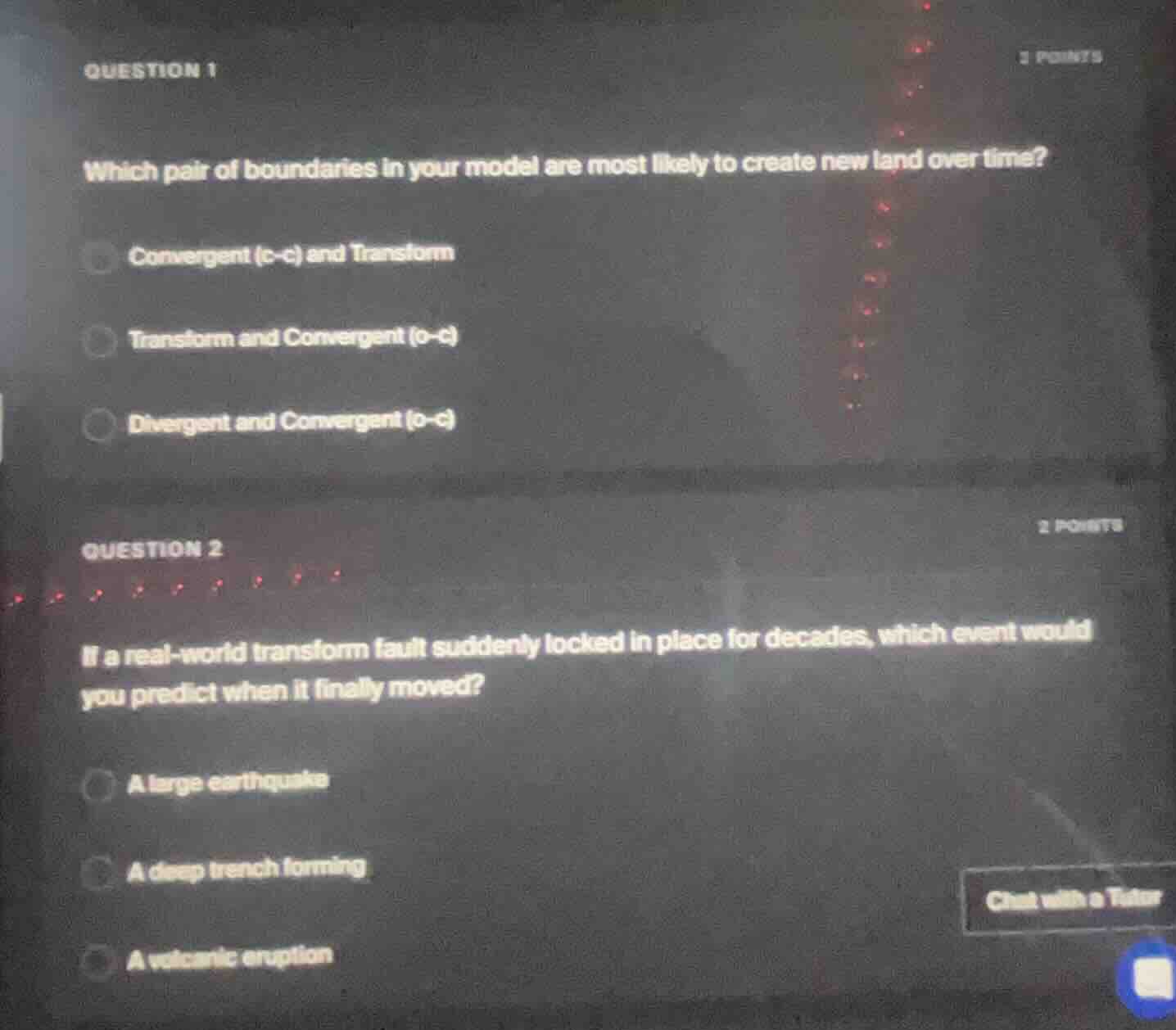
which pair of boundaries in your model are most likely to create new land over time?
convergent (c-c) and transform
transform and convergent (o-c)
divergent and convergant (o-c)
question 2
2 points
if a real - world transform fault suddenly locked in place for decades, which event would
you predict when it finally moved?
a large earthquake
a deep trench forming
a volcanic eruption
Question 1
To determine which boundaries create new land, we analyze plate boundary types:
- Divergent boundaries: Plates move apart, allowing magma to rise and form new crust (e.g., mid - ocean ridges, rift valleys that can develop into new land).
- Convergent (o - c, ocean - continental) boundaries: Oceanic plate subducts, but volcanic arcs (like island arcs) can form new land from volcanic activity.
- Convergent (c - c, continental - continental) boundaries: Plates collide, causing mountain - building (no new land creation, just deformation).
- Transform boundaries: Plates slide past, no new land creation (just faulting).
So Divergent (creates new crust) and Convergent (o - c, volcanic new land) are the pair that creates new land.
Transform faults involve plates sliding past each other. When a transform fault is locked, stress builds up as the plates try to move but can't. When the fault finally moves, the accumulated stress is released suddenly, which causes a large earthquake.
- A deep trench forms at convergent (o - c) boundaries, not transform.
- Volcanic eruptions are associated with divergent or convergent (o - c) boundaries, not transform faults.

Snap & solve any problem in the app
Get step-by-step solutions on Sovi AI
Photo-based solutions with guided steps
Explore more problems and detailed explanations
Divergent and Convergant (o - c)