QUESTION IMAGE
Question
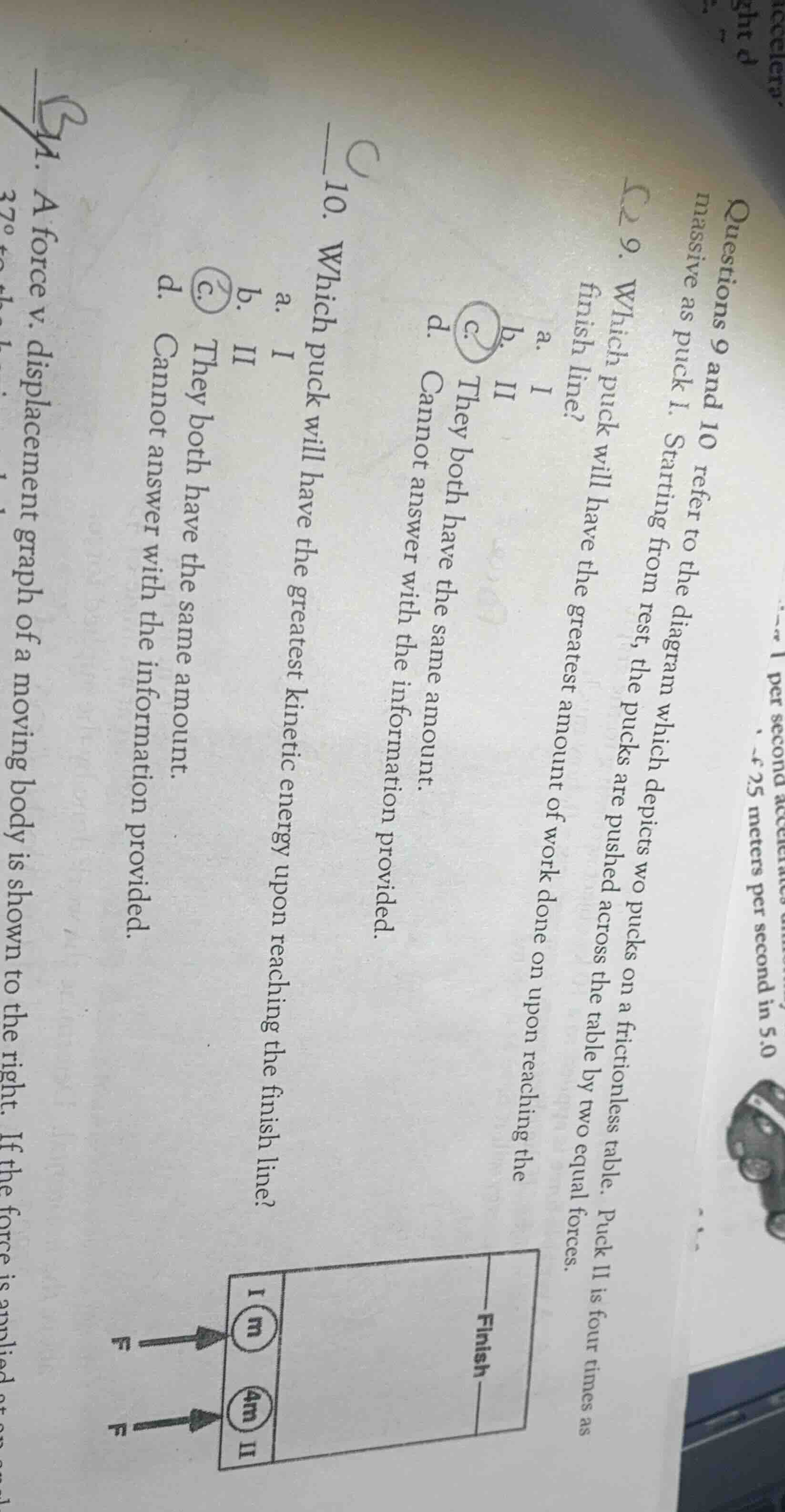
questions 9 and 10 refer to the diagram which depicts two pucks on a frictionless table. puck ii is four times as massive as puck i. starting from rest, the pucks are pushed across the table by two equal forces.
- which puck will have the greatest amount of work done on upon reaching the finish line?
a. i
b. ii
c. they both have the same amount.
d. cannot answer with the information provided.
- which puck will have the greatest kinetic energy upon reaching the finish line?
a. i
b. ii
c. they both have the same amount.
d. cannot answer with the information provided.
Question 9
Step1: Recall the work formula
Work is calculated as \( W = F \cdot d \), where \( F \) is the force and \( d \) is the displacement in the direction of the force.
Step2: Analyze the forces and displacements
Both pucks are pushed with equal forces (\( F \)). We need to find the displacement of each puck. Using Newton's second law \( F = ma \), for Puck I (mass \( m \)): \( a_1=\frac{F}{m} \), for Puck II (mass \( 4m \)): \( a_2 = \frac{F}{4m} \). Using the kinematic equation \( d=v_0t+\frac{1}{2}at^2 \), with \( v_0 = 0 \), so \( d=\frac{1}{2}at^2 \). Let the time taken for Puck I to reach the finish line be \( t_1 \) and for Puck II be \( t_2 \). The distance to the finish line is the same, let's call it \( D \). So \( D=\frac{1}{2}a_1t_1^2=\frac{1}{2}a_2t_2^2 \). Substituting \( a_1 \) and \( a_2 \): \( \frac{1}{2}\cdot\frac{F}{m}\cdot t_1^2=\frac{1}{2}\cdot\frac{F}{4m}\cdot t_2^2 \), simplifying gives \( t_2^2 = 4t_1^2 \), so \( t_2 = 2t_1 \). Now, calculate work for Puck I: \( W_1=F\cdot d_1 \), but \( d_1=\frac{1}{2}a_1t_1^2=\frac{1}{2}\cdot\frac{F}{m}\cdot t_1^2 \). For Puck II: \( d_2=\frac{1}{2}a_2t_2^2=\frac{1}{2}\cdot\frac{F}{4m}\cdot(2t_1)^2=\frac{1}{2}\cdot\frac{F}{4m}\cdot4t_1^2=\frac{1}{2}\cdot\frac{F}{m}\cdot t_1^2 \). So \( d_1 = d_2 \) (since both travel distance \( D \)). Since \( F \) is equal and \( d \) is equal, from \( W = Fd \), \( W_1 = W_2 \).
Step1: Recall kinetic energy formula
Kinetic energy is \( KE=\frac{1}{2}mv^2 \). We can also use the work - energy theorem, which states that the work done on an object is equal to its change in kinetic energy (\( W=\Delta KE \)). From question 9, we know that the work done on both pucks is the same ( \( W_1 = W_2 \) ). Since both start from rest, the initial kinetic energy is 0, so the final kinetic energy \( KE = W \).
Step2: Conclude the kinetic energy
Since the work done on both pucks is the same, their change in kinetic energy (and thus final kinetic energy, as initial \( KE = 0 \)) is the same.

Snap & solve any problem in the app
Get step-by-step solutions on Sovi AI
Photo-based solutions with guided steps
Explore more problems and detailed explanations
c. They both have the same amount.