QUESTION IMAGE
Question
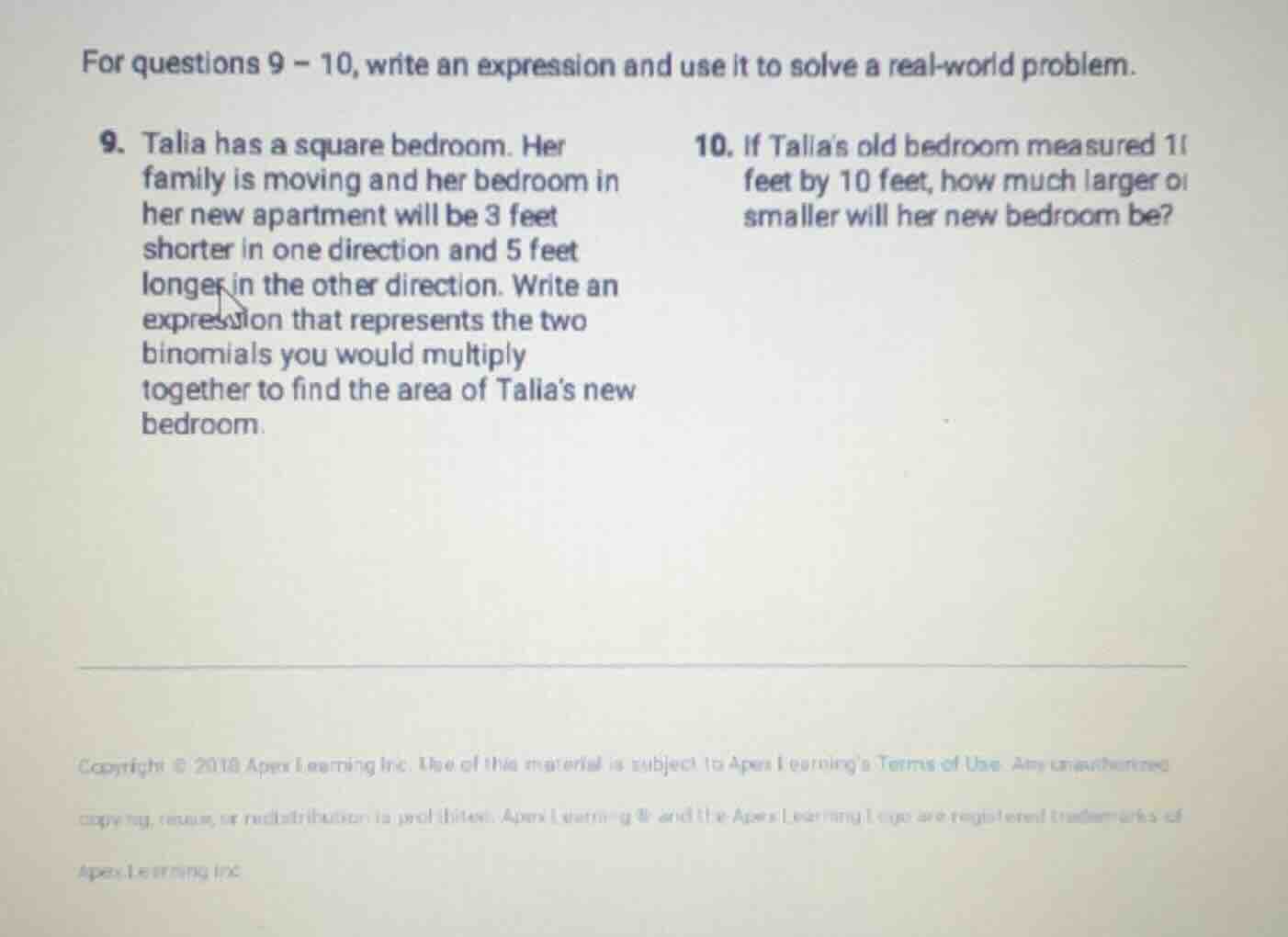
for questions 9 - 10, write an expression and use it to solve a real - world problem.
- talia has a square bedroom. her family is moving and her bedroom in her new apartment will be 3 feet shorter in one direction and 5 feet longer in the other direction. write an expression that represents the two binomials you would multiply together to find the area of talias new bedroom.
- if talias old bedroom measured 11 feet by 10 feet, how much larger or smaller will her new bedroom be?
copyright © 2018 apex learning inc. use of this material is subject to apex learnings terms of use. any unauthorized copying, reuse, or redistribution is prohibited. apex learning® and the apex learning logo are registered trademarks of apex learning inc
Question 9
Step1: Define original side length
Let the side length of Talia's original square bedroom be \( s \) feet. So, the original length and width are both \( s \) feet.
Step2: Determine new length and width
Her new bedroom is 3 feet shorter in one direction, so the length of that side becomes \( s - 3 \) feet. It is 5 feet longer in the other direction, so the length of the other side becomes \( s + 5 \) feet.
Step3: Write the expression for area
The area of a rectangle (her new bedroom is a rectangle) is given by the product of its length and width. So, the expression to find the area of the new bedroom is the product of the two binomials \((s - 3)\) and \((s + 5)\), which is \((s - 3)(s + 5)\).
Step1: Find area of old bedroom
The area of the old square bedroom (if side length \( s = 11 \) feet) is \( A_{old}=s\times s = 11\times11 = 121\) square feet.
Step2: Find area of new bedroom
From question 9, the dimensions of the new bedroom are \( s - 3 \) and \( s + 5 \). Substituting \( s = 11 \), we get length \( 11 - 3=8 \) feet and width \( 11 + 5 = 16 \) feet. So, the area of the new bedroom is \( A_{new}=8\times16 = 128\) square feet.
Step3: Find the difference
Now, find how much larger or smaller the new bedroom is compared to the old one. \( A_{new}-A_{old}=128 - 121 = 7\) square feet. Wait, but if the old bedroom is 11 feet by 10 feet (not square), then:
Step1: Area of old (non - square) bedroom
If old bedroom is 11 feet by 10 feet, then \( A_{old}=11\times10 = 110\) square feet.
Step2: Area of new bedroom (using \( s \) from square? No, there is a contradiction. Maybe the original square bedroom has side length such that when we consider the old bedroom in question 10, it's a mistake. Assuming the original square bedroom has side length \( s \), and from question 10, maybe the old bedroom (before moving) was square with side length, let's say, if we take the new bedroom dimensions from question 9: if we assume the original square bedroom was, for example, let's re - evaluate.
Wait, maybe the problem is that in question 10, "old bedroom" is the square one, and there's a typo, and it should be 11 feet by 11 feet. Then:
Step1: Area of old square bedroom
\( A_{old}=11\times11 = 121\)
Step2: Area of new bedroom (from question 9: \((11 - 3)(11 + 5)=8\times16 = 128\))
Step3: Difference
\( 128-121 = 7\), so the new bedroom is 7 square feet larger.
If we take the old bedroom as 11 feet by 10 feet (non - square), then:
Step1: Area of old bedroom
\( A_{old}=11\times10 = 110\)
Step2: Area of new bedroom (assuming original square side length \( s \), but this is inconsistent. The problem might have a typo. Assuming the original square bedroom has side length \( s = 11 \) (to match the 11 in question 10), then:
Step1: Calculate old area (square)
\( A_{old}=11\times11 = 121\)
Step2: Calculate new area
New dimensions: \( 11 - 3 = 8\), \( 11+5 = 16\), \( A_{new}=8\times16 = 128\)
Step3: Find the difference
\( 128 - 121 = 7\)

Snap & solve any problem in the app
Get step-by-step solutions on Sovi AI
Photo-based solutions with guided steps
Explore more problems and detailed explanations
\((s - 3)(s + 5)\)
Question 10
First, we need to find the side length of the original square bedroom. Wait, from question 9, we know the original bedroom is square, but in question 10, it says "old bedroom measured 11 feet by 10 feet" – there might be a typo, maybe it's 11 feet by 11 feet (since it's square). Assuming the original square bedroom has side length \( s \), and from question 10, if we assume the old (original) square bedroom was 11 feet by 11 feet (since it's square), then: