QUESTION IMAGE
Question
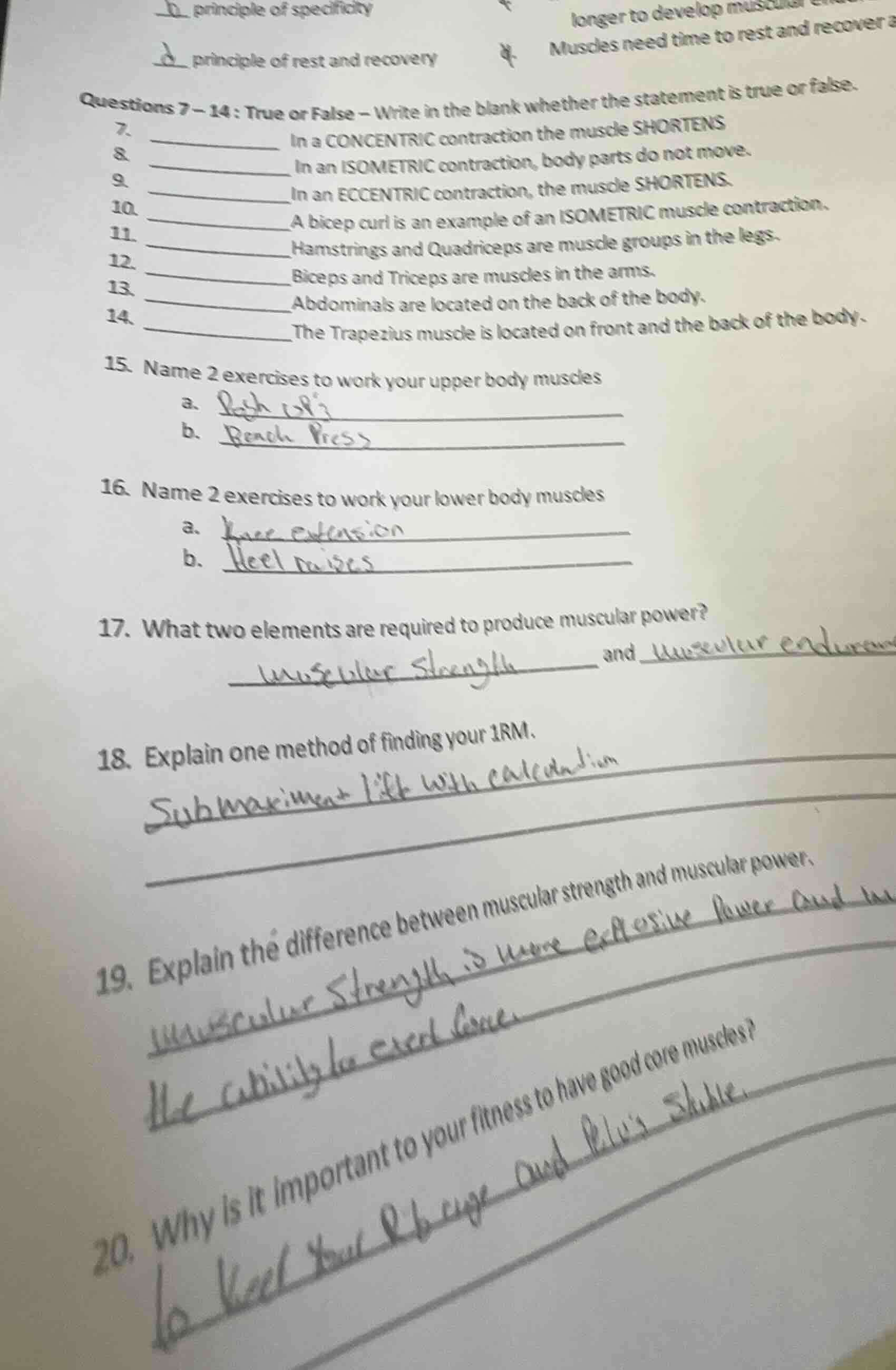
questions 7 – 14 : true or false – write in the blank whether the statement is true or false.
7.
in a concentric contraction the muscle shortens
8.
in an isometric contraction, body parts do not move.
9.
in an eccentric contraction, the muscle shortens.
10.
a bicep curl is an example of an isometric muscle contraction.
11.
hamstrings and quadriceps are muscle groups in the legs.
12.
biceps and triceps are muscles in the arms.
13.
abdominals are located on the back of the body.
14.
the trapezius muscle is located on front and the back of the body.
- name 2 exercises to work your upper body muscles
a.
b.
- name 2 exercises to work your lower body muscles
a.
b.
- what two elements are required to produce muscular power?
and
- explain one method of finding your 1rm.
- explain the difference between muscular strength and muscular power.
- why is it important to your fitness to have good core muscles?
Brief Explanations
Questions 7-14 (True/False):
- Concentric contractions involve muscle shortening as it generates force to move a load.
- Isometric contractions have muscle tension without joint/body part movement.
- Eccentric contractions involve muscle lengthening under tension, not shortening.
- A bicep curl involves joint movement, so it is concentric/eccentric, not isometric.
- Hamstrings (back of thigh) and quadriceps (front of thigh) are leg muscle groups.
- Biceps (front arm) and triceps (back arm) are arm muscles.
- Abdominals are located on the front torso, not the back.
- The trapezius is a large back/neck muscle, not located on the front of the body.
Questions 15-20:
- Push-ups and bench press are valid upper-body exercises that target chest, shoulder, and arm muscles.
- Knee extensions (target quads) and heel raises (target calves) are valid lower-body exercises.
- Muscular power combines the ability to generate force (strength) and apply it quickly (speed).
- The submaximal lift method uses a lighter, doable lift with a set number of reps, then applies a formula to estimate 1RM (one-repetition maximum, the heaviest weight you can lift once).
- Muscular strength is the maximum force a muscle can generate, while muscular power is strength combined with speed (how quickly that force can be applied).
- Strong core muscles stabilize the torso, support proper posture, reduce injury risk, and improve performance in most physical movements.

Snap & solve any problem in the app
Get step-by-step solutions on Sovi AI
Photo-based solutions with guided steps
Explore more problems and detailed explanations
- True
- True
- False
- False
- True
- True
- False
- False
- a. Push-ups
b. Bench Press
- a. Knee extension
b. Heel raises
- Muscular strength and speed
- Submaximal Lift with Calculation: Perform a set of 3-10 reps with a weight you can lift with good form, then use a standard 1RM calculation formula (e.g., Epley formula: $1RM = \text{Weight} \times (1 + \frac{\text{Reps}}{30})$) to estimate your one-repetition maximum.
- Muscular strength is the maximum amount of force a muscle or muscle group can produce. Muscular power is the combination of muscular strength and speed, measuring how quickly a muscle can exert that force.
- Good core muscles improve posture, stabilize the torso during movement, reduce the risk of injury, and enhance performance in both daily activities and athletic exercises.