QUESTION IMAGE
Question
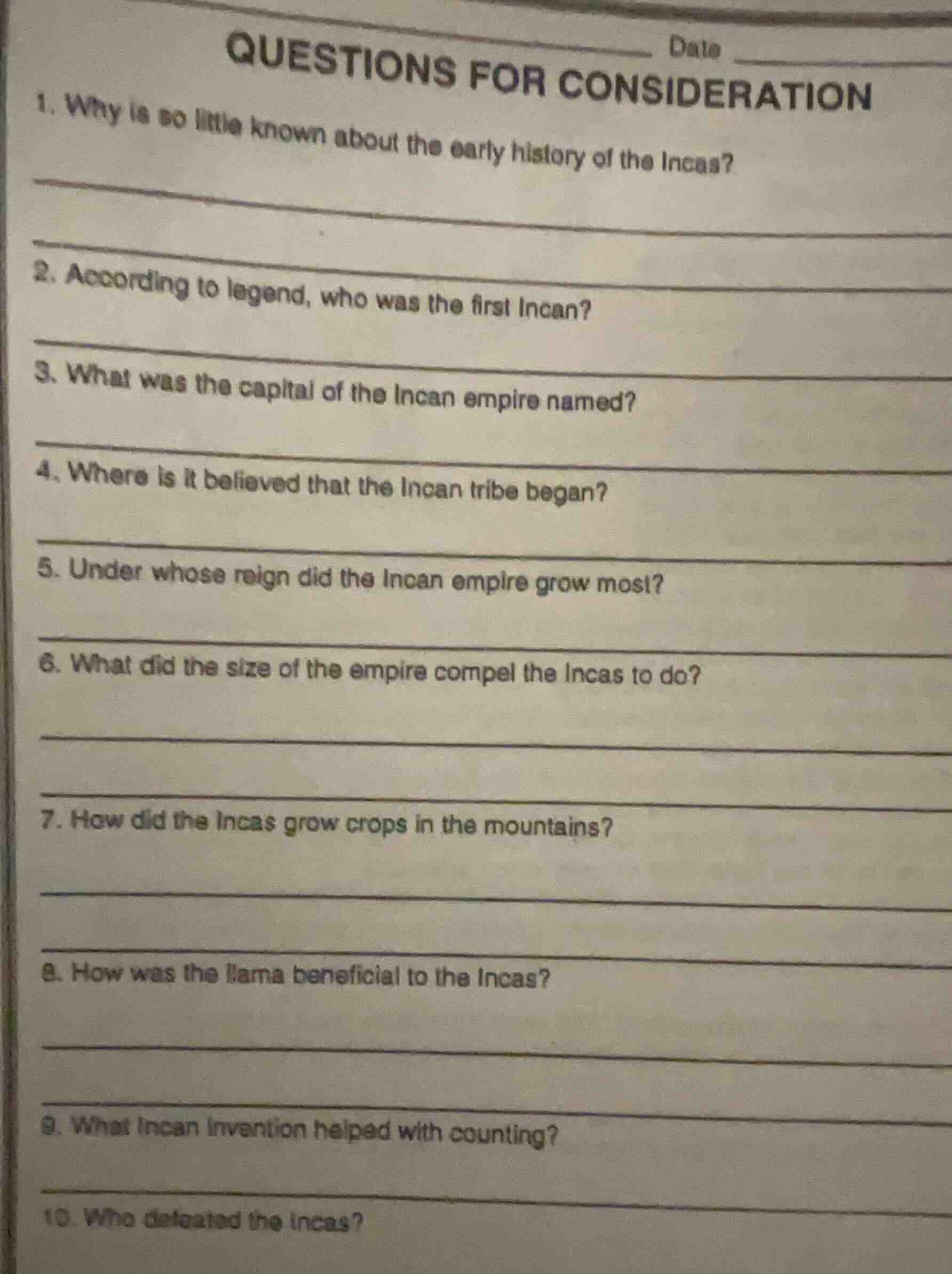
questions for consideration
- why is so little known about the early history of the incas?
- according to legend, who was the first incan?
- what was the capital of the incan empire named?
- where is it believed that the incan tribe began?
- under whose reign did the incan empire grow most?
- what did the size of the empire compel the incas to do?
- how did the incas grow crops in the mountains?
- how was the llama beneficial to the incas?
- what incan invention helped with counting?
- who defeated the incas?
Brief Explanations
- The Incas had no written system, so early history relies on oral traditions which are less consistent, and Spanish colonization disrupted and destroyed many Inca records and sites.
- Inca legend states Manco Cápac was the first ruler, sent by the sun god Inti to found the empire.
- The central administrative and ceremonial hub of the Inca Empire was this city in the Andes.
- Archaeological and oral evidence points to this highland region in Peru as the Inca's origin.
- Pachacuti launched extensive conquests and reforms that expanded the empire dramatically.
- The large, mountain-spanning empire required a unified system to manage communication, labor, and governance.
- The Incas engineered flat, stepped platforms to farm on steep mountain slopes, preserving soil and water.
- Llamas served multiple key practical roles for the Inca people in their mountain environment.
- This knotted string device was the Inca's primary tool for counting, record-keeping, and sending messages.
- Spanish conquistadors led by this figure defeated the Incas, aided by European diseases and internal conflict.

Snap & solve any problem in the app
Get step-by-step solutions on Sovi AI
Photo-based solutions with guided steps
Explore more problems and detailed explanations
- The Incas lacked a written writing system, so their early history was only passed down through oral tradition, which is prone to distortion; additionally, Spanish colonizers destroyed many Inca cultural sites and records.
- Manco Cápac
- Cusco (or Qosqo)
- The Cusco region (highlands of present-day Peru)
- Pachacuti Inca Yupanqui
- Develop a complex road system, create a centralized government, and implement the mit'a labor system to manage the large territory.
- They built terraced farmlands (andenes) to create flat, fertile land for crops, which also prevented erosion and improved water retention.
- Llamas were used as pack animals to transport goods across mountain roads, provided wool for clothing, their meat was a food source, and their dung was used as fertilizer.
- The quipu (a system of knotted strings)
- Spanish conquistadors led by Francisco Pizarro