QUESTION IMAGE
Question
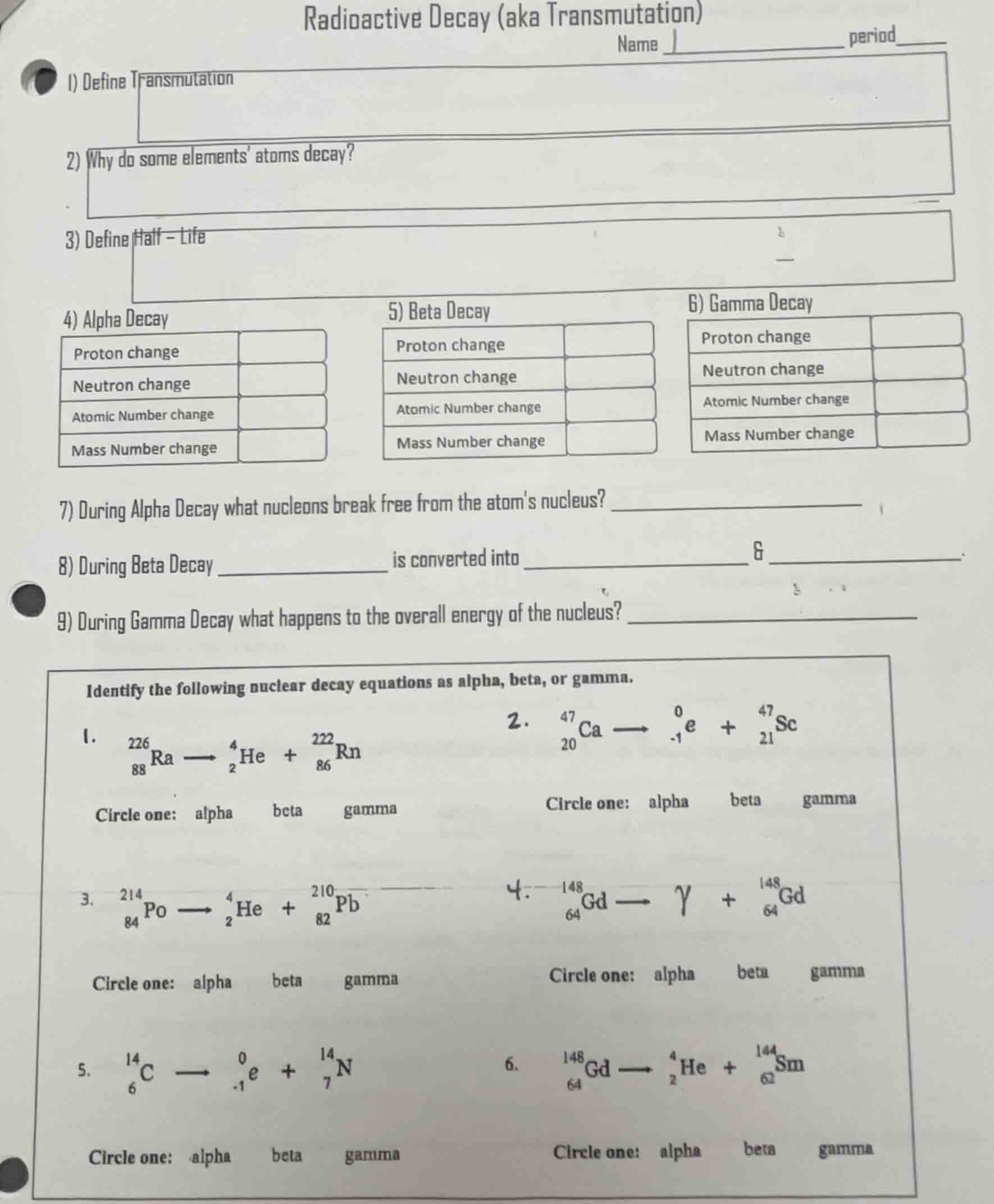
radioactive decay (aka transmutation)
name _____________ period___
- define transmutation
- why do some elements atoms decay?
- define half - life
- alpha decay
proton change
neutron change
atomic number change
mass number change
- beta decay
proton change
neutron change
atomic number change
mass number change
- gamma decay
proton change
neutron change
atomic number change
mass number change
- during alpha decay what nucleons break free from the atoms nucleus? _______________
- during beta decay _____________ is converted into ___________ & _____________.
- during gamma decay what happens to the overall energy of the nucleus? _______________
identify the following nuclear decay equations as alpha, beta, or gamma.
1.
$ce{_{88}^{226}ra -> _{2}^{4}he + _{86}^{222}rn}$
circle one: alpha beta gamma
2.
$ce{_{20}^{47}ca -> _{-1}^{0}e + _{21}^{47}sc}$
circle one: alpha beta gamma
3.
$ce{_{84}^{214}po -> _{2}^{4}he + _{82}^{210}pb}$
circle one: alpha beta gamma
4.
$ce{_{64}^{148}gd -> gamma + _{64}^{148}gd}$
circle one: alpha beta gamma
5.
$ce{_{6}^{14}c -> _{-1}^{0}e + _{7}^{14}n}$
circle one: alpha beta gamma
6.
$ce{_{64}^{148}gd -> _{2}^{4}he + _{62}^{144}sm}$
circle one: alpha beta gamma
- Transmutation describes the nuclear process that changes the identity of an atom.
- Unstable nuclei decay to reach a more stable nuclear configuration.
- Half-life is a core measure of radioactive decay rate.
- Alpha decay emits a $^4_2\text{He}$ particle, reducing protons/neutrons by 2 each, atomic number by 2, mass number by 4.
- Beta decay converts a neutron to a proton + electron, increasing protons/atomic number by 1, decreasing neutrons by 1, with no mass number change.
- Gamma decay only releases energy (no particle emission), so nuclear properties remain unchanged.
- Alpha decay's emitted particle is a helium nucleus.
- Beta decay's core reaction is neutron → proton + electron.
- Gamma decay releases excess nuclear energy, lowering the nucleus's energy state.
10.
- Equation emits $^4_2\text{He}$, the marker of alpha decay.
- Equation emits $^0_{-1}e$, the marker of beta decay.
- Equation emits $^4_2\text{He}$, the marker of alpha decay.
- Equation emits $\gamma$ (gamma radiation), the marker of gamma decay.
- Equation emits $^0_{-1}e$, the marker of beta decay.
- Equation emits $^4_2\text{He}$, the marker of alpha decay.

Snap & solve any problem in the app
Get step-by-step solutions on Sovi AI
Photo-based solutions with guided steps
Explore more problems and detailed explanations
- Transmutation is the conversion of one chemical element or isotope into another.
- Their nuclei are unstable (have too many protons/neutrons, or excess energy).
- Half-life is the time required for half of a radioactive sample's atoms to decay.
- Alpha Decay:
- Proton change: Decreases by 2
- Neutron change: Decreases by 2
- Atomic Number change: Decreases by 2
- Mass Number change: Decreases by 4
- Beta Decay:
- Proton change: Increases by 1
- Neutron change: Decreases by 1
- Atomic Number change: Increases by 1
- Mass Number change: No change
- Gamma Decay:
- Proton change: No change
- Neutron change: No change
- Atomic Number change: No change
- Mass Number change: No change
- A helium nucleus (2 protons and 2 neutrons, an alpha particle)
- A neutron; a proton; an electron (beta particle)
- The overall energy of the nucleus decreases (it releases excess energy as gamma radiation).
- Nuclear Decay Identification:
- alpha
- beta
- alpha
- gamma
- beta
- alpha