QUESTION IMAGE
Question
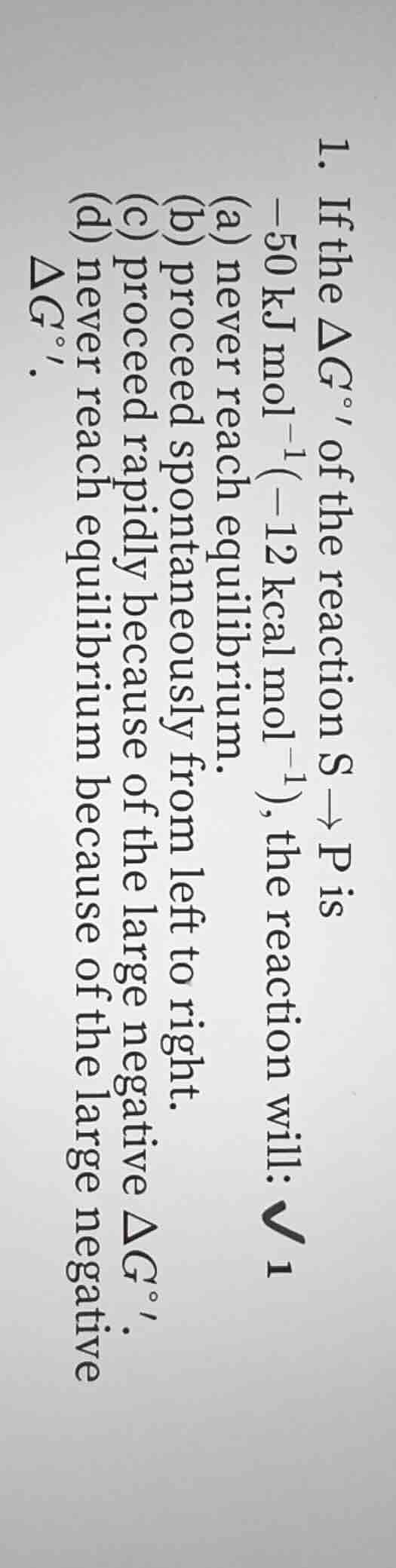
- if the $\delta g^{\circ\prime}$ of the reaction $s \
ightarrow p$ is $-50\\ \mathrm{kj\\ mol^{-1}}$ ($-12\\ \mathrm{kcal\\ mol^{-1}}$), the reaction will: \\(\boldsymbol{\vee_1}\\)
(a) never reach equilibrium.
(b) proceed spontaneously from left to right.
(c) proceed rapidly because of the large negative $\delta g^{\circ\prime}$.
(d) never reach equilibrium because of the large negative $\delta g^{\circ\prime}$.
A negative standard Gibbs free energy change ($\Delta G^\circ$) indicates a reaction is thermodynamically spontaneous in the forward direction (from reactant S to product P). $\Delta G^\circ$ does not determine reaction rate (so "rapidly" is incorrect), and even with a large negative value, reactions will still reach equilibrium where both S and P are present (just with a very high concentration of P).

Snap & solve any problem in the app
Get step-by-step solutions on Sovi AI
Photo-based solutions with guided steps
Explore more problems and detailed explanations
(b) proceed spontaneously from left to right.