QUESTION IMAGE
Question
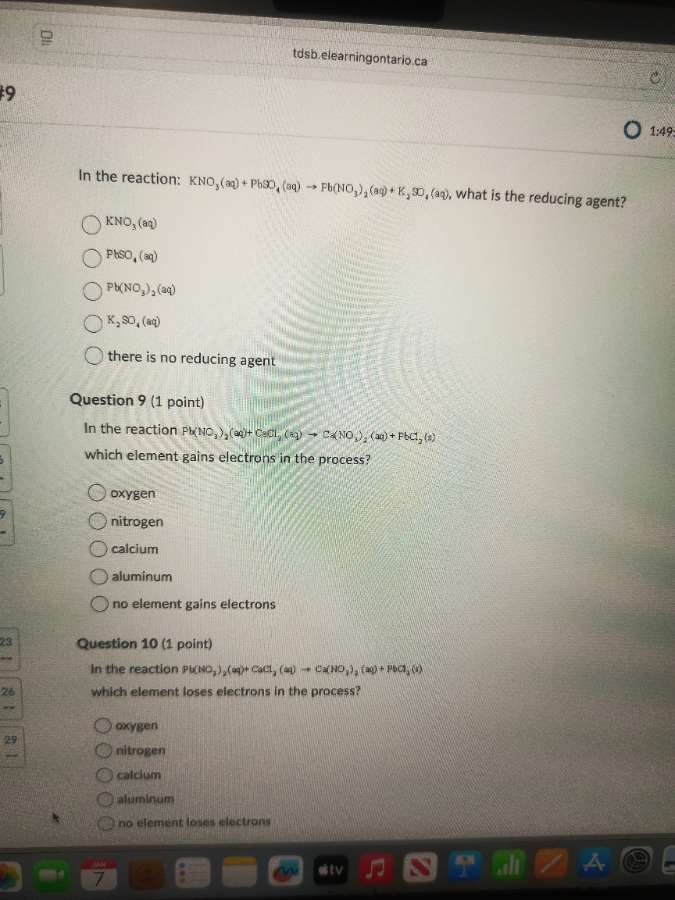
in the reaction: $kno_3(aq) + pbso_4(aq) \
ightarrow pb(no_3)_2(aq) + k_2so_4(aq)$, what is the reducing agent?
$kno_3(aq)$
$pbso_4(aq)$
$pb(no_3)_2(aq)$
$k_2so_4(aq)$
there is no reducing agent
question 9 (1 point)
in the reaction $pb(no_3)_2(aq) + cacl_2(aq) \
ightarrow ca(no_3)_2(aq) + pbcl_2(s)$
which element gains electrons in the process?
oxygen
nitrogen
calcium
aluminum
no element gains electrons
question 10 (1 point)
in the reaction $pb(no_3)_2(aq) + cacl_2(aq) \
ightarrow ca(no_3)_2(aq) + pbcl_2(s)$
which element loses electrons in the process?
oxygen
nitrogen
calcium
aluminum
no element loses electrons
Question (First reaction: $\ce{KNO_{3}(aq) + PbSO_{4}(aq) -> Pb(NO_{3})_{2}(aq) + K_{2}SO_{4}(aq)}$ - Reducing Agent)
To determine the reducing agent, we first check if the reaction is a redox reaction (involves electron transfer, i.e., change in oxidation states). Let's find the oxidation states of each element:
- In $\ce{KNO_{3}}$: $\ce{K}$ is +1, $\ce{N}$ is +5, $\ce{O}$ is -2.
- In $\ce{PbSO_{4}}$: $\ce{Pb}$ is +2, $\ce{S}$ is +6, $\ce{O}$ is -2.
- In $\ce{Pb(NO_{3})_{2}}$: $\ce{Pb}$ is +2, $\ce{N}$ is +5, $\ce{O}$ is -2.
- In $\ce{K_{2}SO_{4}}$: $\ce{K}$ is +1, $\ce{S}$ is +6, $\ce{O}$ is -2.
All oxidation states remain the same. So, this is not a redox reaction, meaning there is no reducing agent (a reducing agent is oxidized, i.e., loses electrons, in a redox reaction). But wait, let's re - check the first reaction's options. Wait, maybe I made a mistake? Wait, no, the reaction is a double - displacement reaction (ions swap: $\ce{K+}$ with $\ce{Pb^{2+}}$, $\ce{NO3-}$ with $\ce{SO4^{2 - }}$), so no redox. But the options for the first question: the options are $\ce{KNO_{3}(aq)}$, $\ce{PbSO_{4}(aq)}$, $\ce{Pb(NO_{3})_{2}(aq)}$, $\ce{K_{2}SO_{4}(aq)}$, there is no reducing agent. So the answer for the first question (the reaction $\ce{KNO_{3}(aq) + PbSO_{4}(aq) -> Pb(NO_{3})_{2}(aq) + K_{2}SO_{4}(aq)}$) is "there is no reducing agent".
Question 9 (Reaction: $\ce{Pb(NO_{3})_{2}(aq) + CaCl_{2}(aq) -> Ca(NO_{3})_{2}(aq) + PbCl_{2}(s)}$ - Element Gaining Electrons)
First, find the oxidation states of each element:
- In $\ce{Pb(NO_{3})_{2}}$: $\ce{Pb}$ is +2, $\ce{N}$ is +5, $\ce{O}$ is -2; $\ce{CaCl_{2}}$: $\ce{Ca}$ is +2, $\ce{Cl}$ is -1.
- In $\ce{Ca(NO_{3})_{2}}$: $\ce{Ca}$ is +2, $\ce{N}$ is +5, $\ce{O}$ is -2; $\ce{PbCl_{2}}$: $\ce{Pb}$ is +2, $\ce{Cl}$ is -1.
All oxidation states are the same. This is a double - displacement reaction (ions swap: $\ce{Pb^{2+}}$ with $\ce{Ca^{2+}}$, $\ce{NO3-}$ with $\ce{Cl-}$), not a redox reaction. So no element gains electrons (gaining electrons means reduction, which requires a change in oxidation state). So the answer is "no element gains electrons".
Question 10 (Reaction: $\ce{Pb(NO_{3})_{2}(aq) + CaCl_{2}(aq) -> Ca(NO_{3})_{2}(aq) + PbCl_{2}(s)}$ - Element Losing Electrons)
As in the previous question, this is a double - displacement reaction. The oxidation states of all elements:
- $\ce{Pb}$: +2 in reactants and +2 in products.
- $\ce{N}$: +5 in reactants and +5 in products.
- $\ce{O}$: -2 in reactants and -2 in products.
- $\ce{Ca}$: +2 in reactants and +2 in products.
- $\ce{Cl}$: -1 in reactants and -1 in products.
Since there is no change in oxidation states (not a redox reaction), no element loses electrons (losing electrons means oxidation, which requires a change in oxidation state). So the answer is "no element loses electrons".

Snap & solve any problem in the app
Get step-by-step solutions on Sovi AI
Photo-based solutions with guided steps
Explore more problems and detailed explanations
s:
- For the first reaction (reducing agent): there is no reducing agent
- Question 9: no element gains electrons
- Question 10: no element loses electrons