QUESTION IMAGE
Question
read each question and choose the best answer. then write the letter for the answer you have chosen in the blank at the right of each question.
objective the student, given a problem situation, will collect, analyze, display, and interpret data, using frequency distributions.
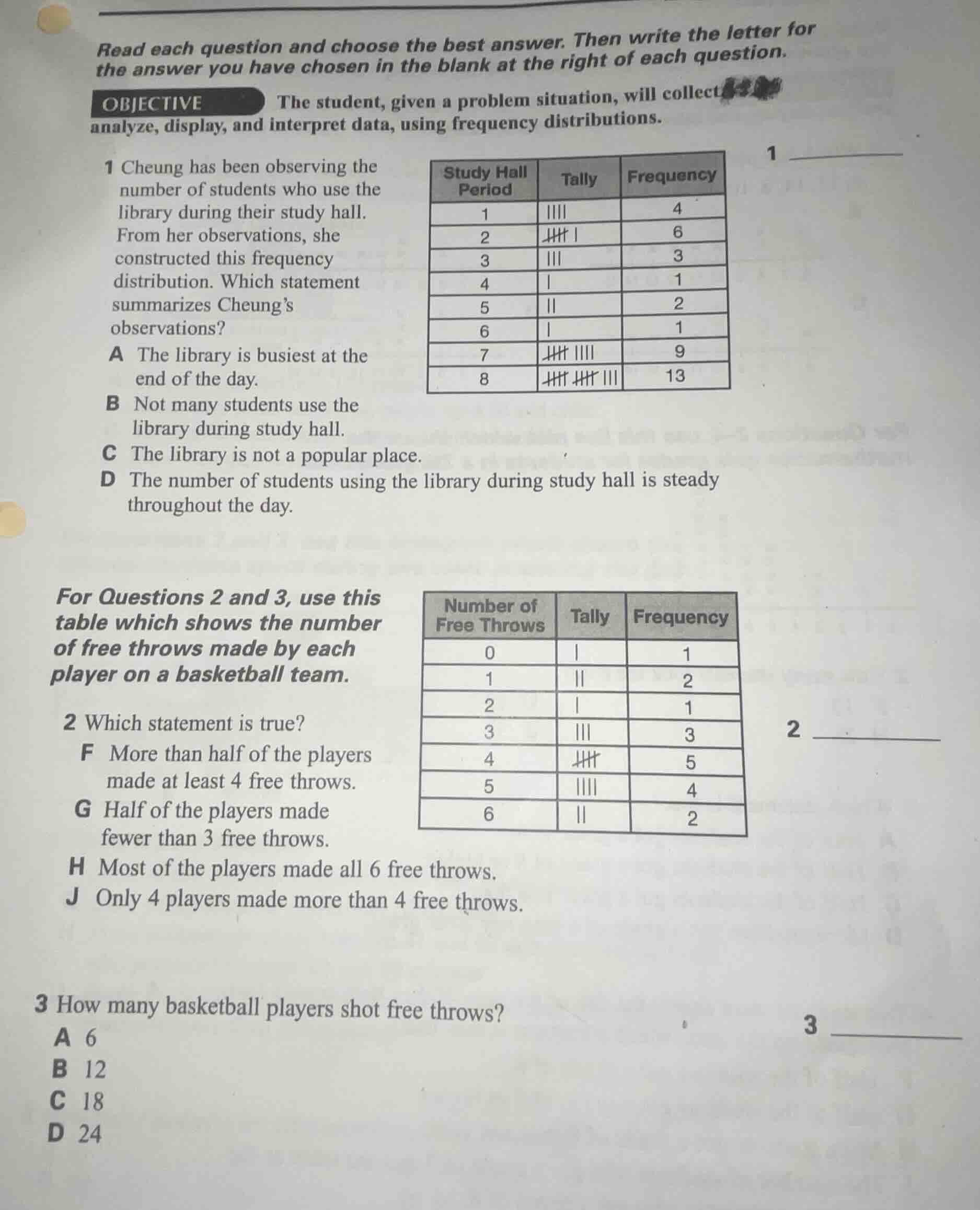
1 cheung has been observing the number of students who use the library during their study hall. from her observations, she constructed this frequency distribution. which statement summarizes cheung’s observations?
a the library is busiest at the end of the day.
b not many students use the library during study hall.
c the library is not a popular place.
d the number of students using the library during study hall is steady throughout the day.
(chart: study hall period, tally, frequency. rows: 1 - |||| - 4; 2 - |||| | - 6; 3 - ||| - 3; 4 - | - 1; 5 - || - 2; 6 - | - 1; 7 - |||| |||| - 9; 8 - |||| |||| ||| - 13)
for questions 2 and 3, use this table which shows the number of free throws made by each player on a basketball team.
2 which statement is true?
f more than half of the players made at least 4 free throws.
g half of the players made fewer than 3 free throws.
h most of the players made all 6 free throws.
j only 4 players made more than 4 free throws.
(chart: number of free throws, tally, frequency. rows: 0 - | - 1; 1 - || - 2; 2 - | - 1; 3 - ||| - 3; 4 - |||| - 5; 5 - |||| - 4; 6 - || - 2)
3 how many basketball players shot free throws?
a 6
b 12
c 18
d 24
Question 1
To solve this, we analyze the frequency distribution for study hall periods. Period 8 has a frequency of 13, period 7 has 9, which are the highest. Periods 1 - 6 have lower frequencies. Option A says the library is busiest at the end (periods 7,8 are later), which matches. Option B is wrong as period 8 has 13 students. Option C is wrong as many use it (e.g., period 8 has 13). Option D is wrong as frequencies vary (1,3,6 vs 9,13).
First, calculate total players: \(1 + 2+1 + 3+5 + 4+2=18\).
- Option F: At least 4 free throws: \(5 + 4+2 = 11\). \(\frac{11}{18}\approx0.61\), more than half (9), so F is true? Wait, no, let's recheck. Wait, "at least 4" is 4,5,6: \(5 + 4+2 = 11\). Total is 18. Half of 18 is 9. 11 > 9, so F is true? Wait, no, let's check other options.
- Option G: Fewer than 3: \(1 + 2+1 = 4\). Half of 18 is 9, 4 < 9, so G is false.
- Option H: Most made 6? 2 players, not most (5 made 4). So H false.
- Option J: More than 4: 5,6: \(4 + 2 = 6\), not 4. So J false. Wait, but earlier calculation for F: at least 4 is 5 (4) + 4 (5) + 2 (6) = 11. 11 > 9 (half of 18), so F is true? Wait, but maybe I made a mistake. Wait total players: 1 (0) + 2 (1) +1 (2) +3 (3) +5 (4) +4 (5) +2 (6) = 1+2=3, +1=4, +3=7, +5=12, +4=16, +2=18. Correct. At least 4: 4,5,6: 5+4+2=11. 11/18 ≈ 0.61, more than half (9). So F is true. Wait, but let's check again. Wait the option F says "more than half of the players made at least 4 free throws". 11 is more than 9 (half of 18), so F is true. But wait, maybe I misread. Wait, no, let's check other options again.
Wait, option J: "Only 4 players made more than 4 free throws". More than 4 is 5,6: 4 + 2 = 6, not 4. So J is false. Option G: "Half of the players made fewer than 3 free throws". Fewer than 3: 0,1,2: 1+2+1=4. Half of 18 is 9, 4 ≠ 9. So G false. Option H: "Most of the players made all 6 free throws". Only 2 players made 6, most is 5 (made 4), so H false. So F is true? Wait, but the answer might be J? Wait no, let's recalculate. Wait "more than 4" is 5 or 6: 4 (5) + 2 (6) = 6. So J says "only 4", which is wrong. So F is correct? Wait, maybe the answer is J? No, let's re-express. Wait the total is 18. At least 4: 5 (4) + 4 (5) + 2 (6) = 11. 11 is more than 9 (half of 18), so F is true. So the correct option is F? Wait, but maybe I made a mistake. Wait the problem says "which statement is true". Let's check again:
- F: More than half (9) made at least 4. 11 > 9: true.
- G: Half (9) made fewer than 3. Fewer than 3: 1+2+1=4 < 9: false.
- H: Most made 6. 2 made 6, 5 made 4: false.
- J: Only 4 made more than 4. More than 4: 5,6: 4+2=6 ≠ 4: false. So F is true.
Step1: Sum the frequencies of free throws.
The frequencies are \(1, 2, 1, 3, 5, 4, 2\).
Step2: Calculate the total.
\(1 + 2+1 + 3+5 + 4+2 = 18\).

Snap & solve any problem in the app
Get step-by-step solutions on Sovi AI
Photo-based solutions with guided steps
Explore more problems and detailed explanations
A. The library is busiest at the end of the day.