QUESTION IMAGE
Question
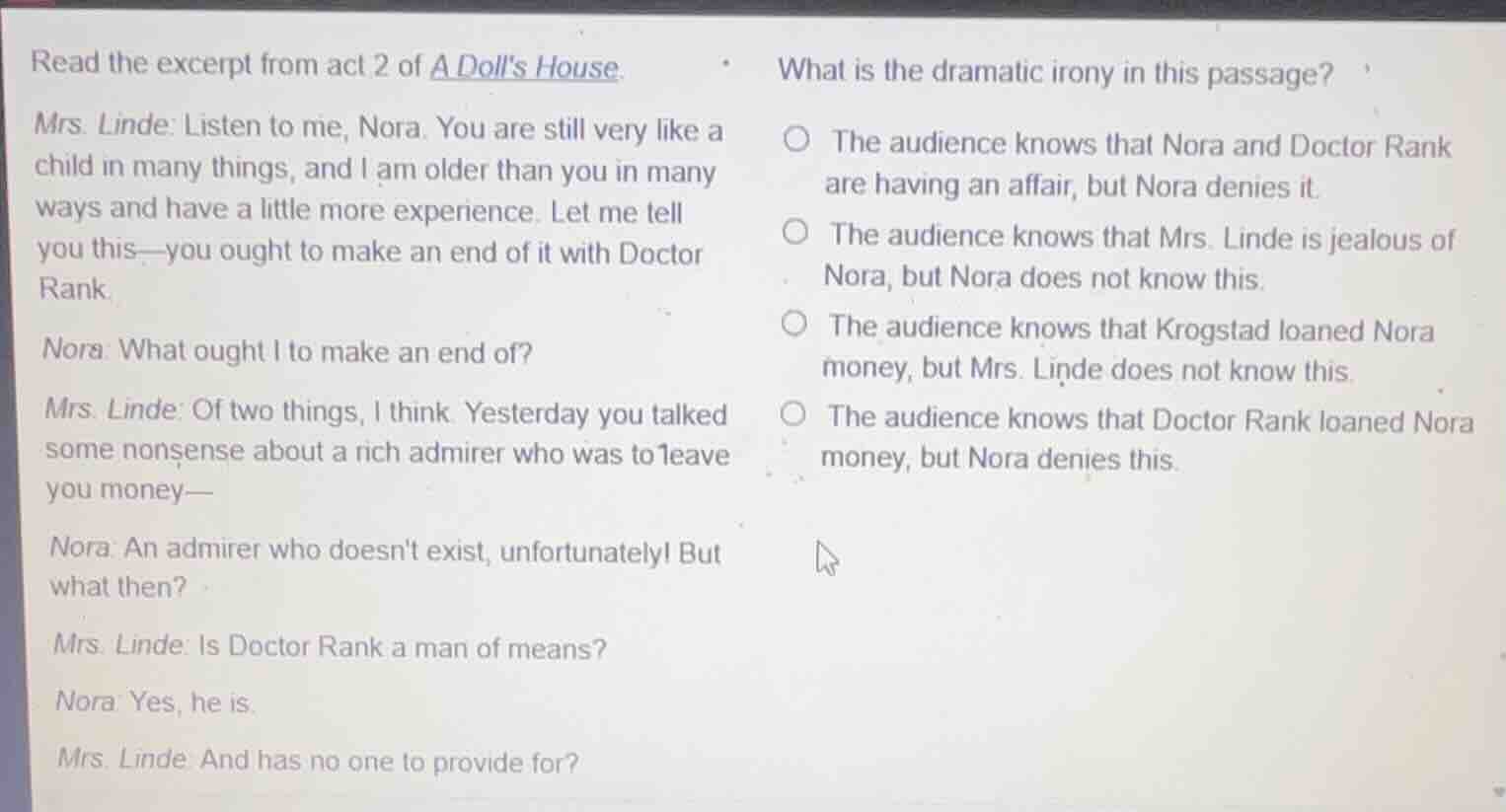
read the excerpt from act 2 of a dolls house.
mrs. linde: listen to me, nora. you are still very like a child in many things, and i am older than you in many ways and have a little more experience. let me tell you this—you ought to make an end of it with doctor rank.
nora: what ought i to make an end of?
mrs. linde: of two things, i think. yesterday you talked some nonsense about a rich admirer who was to leave you money—
nora: an admirer who doesnt exist, unfortunately! but what then?
mrs. linde: is doctor rank a man of means?
nora: yes, he is.
mrs. linde: and has no one to provide for?
what is the dramatic irony in this passage?
○ the audience knows that nora and doctor rank are having an affair, but nora denies it.
○ the audience knows that mrs. linde is jealous of nora, but nora does not know this.
○ the audience knows that krogstad loaned nora money, but mrs. linde does not know this.
○ the audience knows that doctor rank loaned nora money, but nora denies this.
Dramatic irony occurs when the audience knows key information that one or more characters in the story do not. In A Doll's House, the audience is aware that Nora borrowed money from Krogstad, not Doctor Rank, while Mrs. Linde incorrectly assumes Nora is relying on Doctor Rank for financial help and is unaware of the Krogstad loan. The other options are incorrect: Nora and Doctor Rank do not have an affair, Mrs. Linde is not jealous, and Doctor Rank did not loan Nora money.

Snap & solve any problem in the app
Get step-by-step solutions on Sovi AI
Photo-based solutions with guided steps
Explore more problems and detailed explanations
The audience knows that Krogstad loaned Nora money, but Mrs. Linde does not know this.