QUESTION IMAGE
Question
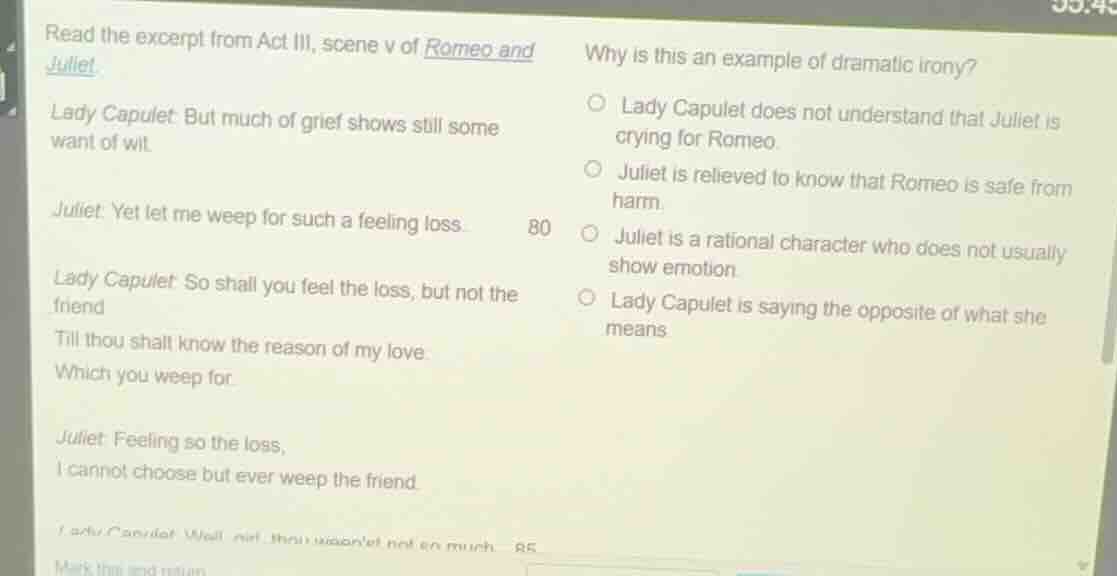
read the excerpt from act iii, scene v of romeo and juliet. lady capulet: but much of grief shows still some want of wit. juliet: yet let me weep for such a feeling loss. lady capulet: so shall you feel the loss, but not the friend till thou shall know the reason of my love which you weep for. juliet: feeling so the loss, i cannot choose but ever weep the friend. why is this an example of dramatic irony? lady capulet does not understand that juliet is crying for romeo. juliet is relieved to know that romeo is safe from harm. juliet is a rational character who does not usually show emotion. lady capulet is saying the opposite of what she means
Dramatic irony occurs when the audience knows something a character doesn't. Here, Lady Capulet thinks Juliet is weeping for Tybalt (or some other loss), but the audience knows Juliet is crying for Romeo (her forbidden love, and also because of Tybalt's death related to Romeo). The first option states Lady Capulet doesn't understand Juliet's true grief source (crying for Romeo), which fits dramatic irony. The second option is incorrect as Juliet's relief about Romeo's safety isn't the focus here. The third is wrong because Juliet is emotional. The fourth is incorrect as Lady Capulet isn't being ironic in her wording but is ignorant of Juliet's true feelings.

Snap & solve any problem in the app
Get step-by-step solutions on Sovi AI
Photo-based solutions with guided steps
Explore more problems and detailed explanations
A. Lady Capulet does not understand that Juliet is crying for Romeo