QUESTION IMAGE
Question
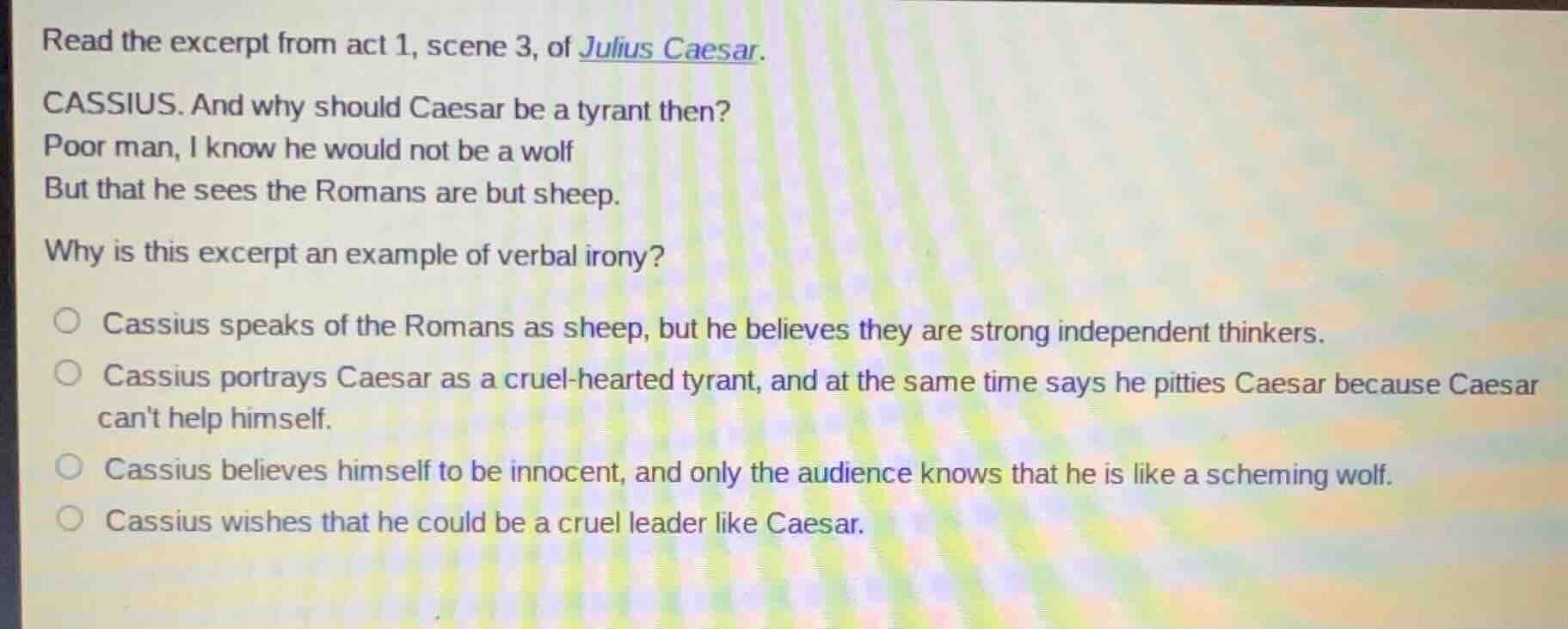
read the excerpt from act 1, scene 3, of julius caesar.
cassius. and why should caesar be a tyrant then?
poor man, i know he would not be a wolf
but that he sees the romans are but sheep.
why is this excerpt an example of verbal irony?
○ cassius speaks of the romans as sheep, but he believes they are strong independent thinkers.
○ cassius portrays caesar as a cruel - hearted tyrant, and at the same time says he pities caesar because caesar cant help himself.
○ cassius believes himself to be innocent, and only the audience knows that he is like a scheming wolf.
○ cassius wishes that he could be a cruel leader like caesar.
To determine the correct answer, we analyze each option:
- Option 1: Cassius calls Romans "sheep" (implying they are followers), but if he believed they were strong independent thinkers, this contrast (saying one thing, believing another) is verbal irony. Let's check others.
- Option 2: The excerpt doesn't show Cassius pitying Caesar for being a tyrant; he's explaining why Caesar is a tyrant (because Romans are sheep), so this is incorrect.
- Option 3: The excerpt doesn't focus on Cassius's self - perception as innocent or the audience's knowledge of him as a wolf; it's about Caesar and Romans, so this is out.
- Option 4: The excerpt shows Cassius questioning Caesar's tyranny, not wanting to be like him, so this is wrong.
So the correct option is the one where Cassius's words (Romans as sheep) contrast with his belief (Romans as strong independent thinkers).

Snap & solve any problem in the app
Get step-by-step solutions on Sovi AI
Photo-based solutions with guided steps
Explore more problems and detailed explanations
B. Cassius portrays Caesar as a cruel - hearted tyrant, and at the same time says he pities Caesar because Caesar can't help himself. (Wait, no, re - checking: The correct option is the first one? Wait, no, let's re - analyze. Verbal irony is when someone says something but means the opposite or there's a contrast between what's said and what's meant/believed.
Wait, the first option: Cassius says Romans are sheep (implying they are docile, followers), but he believes they are strong independent thinkers. So his words (sheep) and his belief (strong independent) are in contrast, which is verbal irony.
The second option: Cassius says "poor man" about Caesar (pitying) but also says he's a tyrant. Wait, the excerpt: "And why should Caesar be a tyrant then? Poor man, I know he would not be a wolf But that he sees the Romans are but sheep." So Cassius is saying that Caesar is a tyrant (wolf) only because Romans are sheep (followers). So he portrays Caesar as a tyrant (wolf) but also pities him (poor man) because Caesar's tyranny is due to Romans' docility. So in this case, he says he pities Caesar (poor man) while also portraying him as a tyrant (wolf), which is a contrast.
Wait, maybe I made a mistake earlier. Let's re - examine the options:
Option A: Cassius speaks of the Romans as sheep, but he believes they are strong independent thinkers. But in the play, Cassius is trying to rouse the Romans against Caesar, so he would think Romans are capable of being strong, but in his words here, he calls them sheep. So his words (sheep) and his belief (strong) are ironic.
Option B: Cassius portrays Caesar as a cruel - hearted tyrant, and at the same time says he pities Caesar because Caesar can't help himself. The line "Poor man, I know he would not be a wolf But that he sees the Romans are but sheep" shows that Cassius thinks Caesar is a tyrant (wolf) but pities him because Caesar's tyranny is caused by Romans being sheep (so Caesar can't help it). So his portrayal of Caesar as a tyrant and his pity for Caesar (saying he's a poor man) is a contrast, which is verbal irony.
Wait, now I'm confused. Let's check the definition of verbal irony: a figure of speech in which a speaker says the opposite of what they really feel or mean.
In the excerpt, Cassius says "why should Caesar be a tyrant then? Poor man, I know he would not be a wolf But that he sees the Romans are but sheep." So he is saying that Caesar is a tyrant (wolf) but also that he pities Caesar (poor man) because Caesar's actions are due to the Romans' nature. So there's a contrast between portraying Caesar as a tyrant and pitying him, which is verbal irony. So option B is correct.
Wait, no, the first option: if Cassius believes Romans are strong independent thinkers, then calling them sheep is ironic. But in the play, Cassius is trying to get the Romans to rebel, so he would think they are capable. But the excerpt's context: Cassius is talking about why Caesar is a tyrant. So he says Caesar is a tyrant (wolf) because Romans are sheep (followers). So in his view, Caesar's tyranny is enabled by Romans' docility. So when he says "poor man" (pitying Caesar), while also saying he's a tyrant, that's a contrast. So option B is the correct one.
So the correct answer is B. Cassius portrays Caesar as a cruel - hearted tyrant, and at the same time says he pities Caesar because Caesar can't help himself.