QUESTION IMAGE
Question
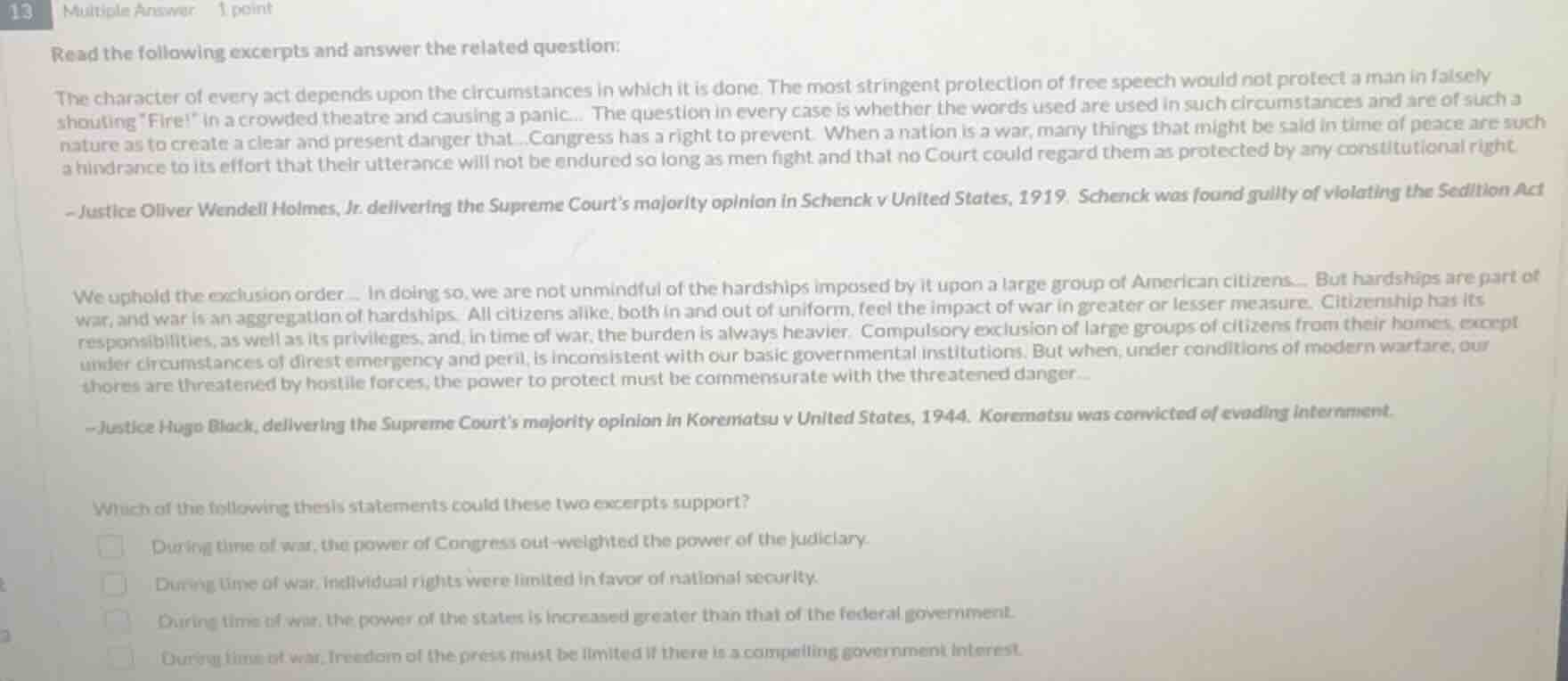
read the following excerpts and answer the related question:
the character of every act depends upon the circumstances in which it is done. the most stringent protection of free speech would not protect a man in falsely shouting fire! in a crowded theatre and causing a panic... the question in every case is whether the words used are used in such circumstances and are of such a nature as to create a clear and present danger that...congress has a right to prevent. when a nation is a war, many things that might be said in time of peace are such a hindrance to its effort that their utterance will not be endured so long as men fight, and that no court could regard them as protected by any constitutional right.
- justice oliver wendell holmes, jr. delivering the supreme court’s majority opinion in schenck v united states, 1919. schenck was found guilty of violating the sedition act
we uphold the exclusion order... in doing so, we are not unmindful of the hardships imposed by it upon a large group of american citizens... but hardships are part of war, and war is an aggregation of hardships. all citizens alike, both in and out of uniform, feel the impact of war in greater or lesser measure. citizenship has its responsibilities, as well as its privileges, and, in time of war, the burden is always heavier. compulsory exclusion of large groups of citizens from their homes, except under circumstances of direst emergency and peril, is inconsistent with our basic governmental institutions. but when, under conditions of modern warfare, our shores are threatened by hostile forces, the power to protect must be commensurate with the threatened danger...
- justice hugo black, delivering the supreme court’s majority opinion in korematsu v united states, 1944. korematsu was convicted of evading internment.
which of the following thesis statements could these two excerpts support?
□ during time of war, the power of congress out - weighted the power of the judiciary.
□ during time of war, individual rights were limited in favor of national security.
□ during time of war, the power of the states is increased greater than that of the federal government.
□ during time of war, freedom of the press must be limited if there is a compelling government interest.
- In Schenck v United States, the Court ruled that speech creating a "clear and present danger" (especially during war) is not protected by the First Amendment, limiting individual free speech rights for national security.
- In Korematsu v United States, the Court upheld the exclusion (internment) of Japanese American citizens during WWII, prioritizing national security over the individual right to remain in their homes.
- Both cases center on the limitation of individual civil rights during wartime in the name of national security. The other options are incorrect: the first focuses on Congress vs judiciary power (not the focus of either case), the third focuses on state vs federal power (not relevant here), and the fourth only addresses press freedom (too narrow, as Korematsu does not involve press rights).

Snap & solve any problem in the app
Get step-by-step solutions on Sovi AI
Photo-based solutions with guided steps
Explore more problems and detailed explanations
During time of war, individual rights were limited in favor of national security.