QUESTION IMAGE
Question
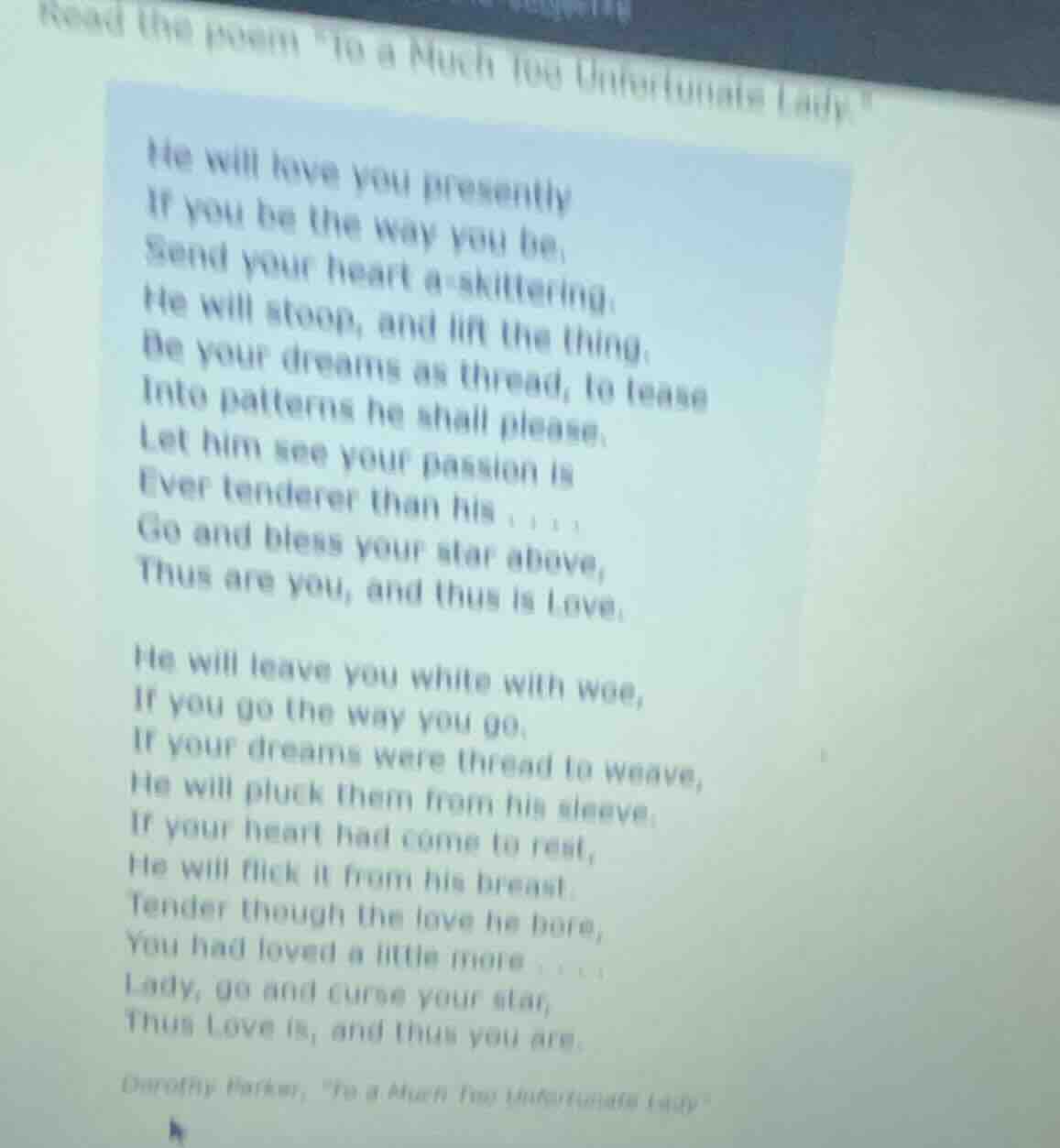
read the poem \to a much too unfortunate lady.\
he will love you presently
if you be the way you be;
send your heart a - skittering;
he will stoop, and lift the thing;
be your dreams as thread, to tease
into patterns he shall please.
let him see your passion is
ever tenderer than his...
go and bless your star above,
thus are you, and thus is love.
he will leave you white with woe,
if you go the way you go,
if your dreams were thread to weave,
he will pluck them from his sleeve;
if your heart had come to rest,
he will flick it from his breast.
tender though the love he bore,
you had loved a little more...
lady, go and curse your star,
thus love is, and thus you are.
dorothy parker, \to a much too unfortunate lady\
Since no specific question is provided about the poem, it's not possible to give a targeted answer. If you want to analyze the poem's themes (like love's duality, the impact of one's behavior on love), its literary devices (metaphors, rhyme scheme), or something else, please clarify your question. For example, if you ask about the rhyme scheme:
The poem has a consistent rhyme scheme. Let's check the end - words of each line. In the first stanza, "presently" (1st line) rhymes with "be" (2nd? No, wait, "presently" and "skittering" don't. Wait, let's list the end - words of each line in the first stanza: line 1: "presently", line 2: "be", line 3: "skittering", line 4: "thing", line 5: "tease", line 6: "please", line 7: "is", line 8: "his", line 9: "above", line 10: "Love". Wait, maybe a better way: looking at the first two stanzas, in the first stanza, line 1: "presently", line 2: "be" – no. Wait, line 1: "presently", line 3: "skittering" – no. Wait, line 2: "be", line 4: "thing" – no. Wait, line 5: "tease", line 6: "please" – they rhyme (slant rhyme or exact? "tease" and "please" have the same ending sound). Line 7: "is", line 8: "his" – rhyme. Line 9: "above", line 10: "Love" – rhyme? "above" and "Love" – no, "above" is /əˈbʌv/, "Love" is /lʌv/. Wait, maybe it's a ABAB or other scheme. Alternatively, if the question is about the theme: the poem explores the dual nature of love, showing how love can be kind or cruel depending on one's actions and the nature of one's dreams and heart.

Snap & solve any problem in the app
Get step-by-step solutions on Sovi AI
Photo-based solutions with guided steps
Explore more problems and detailed explanations
Please clarify your question about the poem (e.g., theme, literary devices, rhyme scheme) to get a specific answer.