QUESTION IMAGE
Question
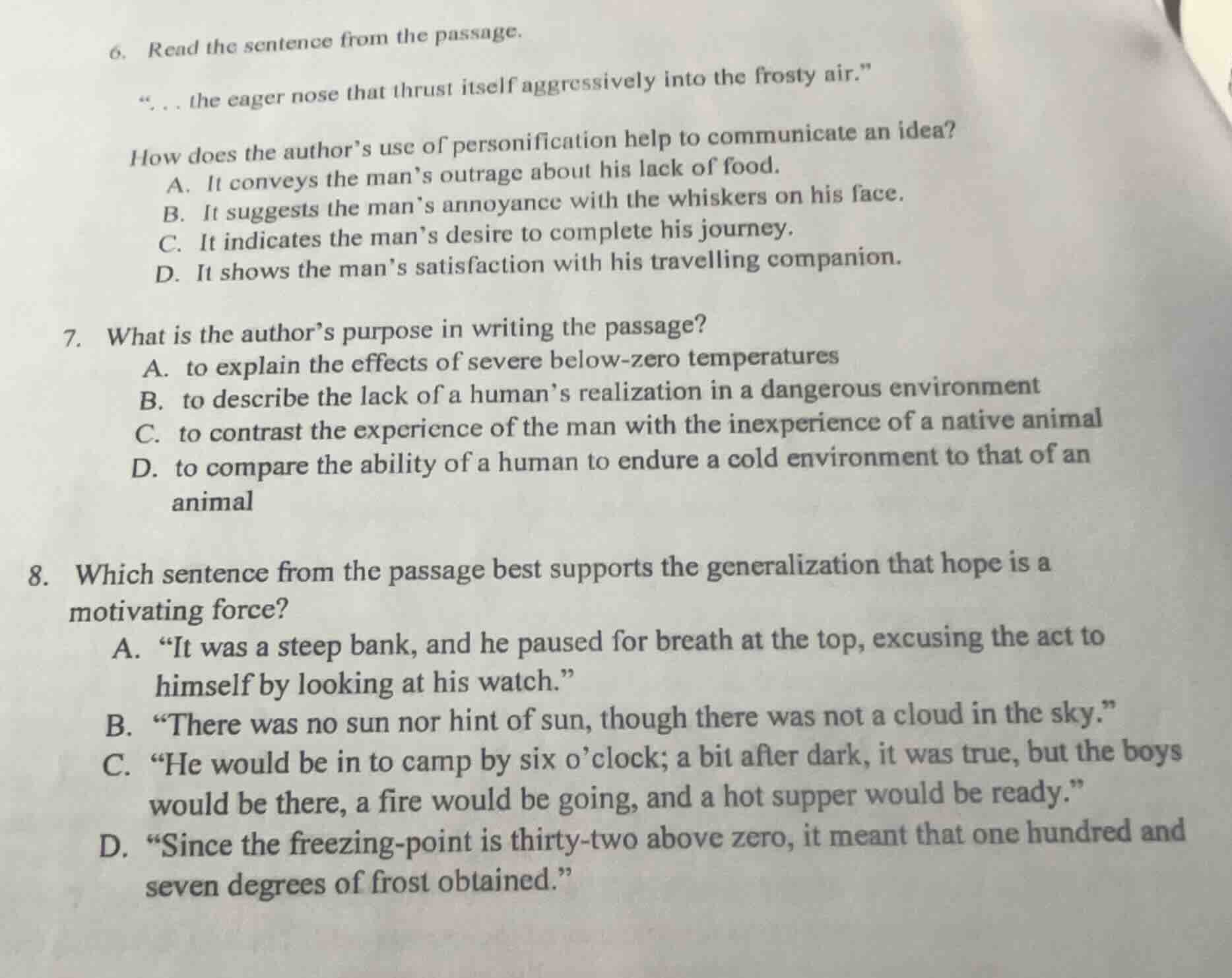
- read the sentence from the passage.
\... the eager nose that thrust itself aggressively into the frosty air.\
how does the authors use of personification help to communicate an idea?
a. it conveys the mans outrage about his lack of food.
b. it suggests the mans annoyance with the whiskers on his face.
c. it indicates the mans desire to complete his journey.
d. it shows the mans satisfaction with his travelling companion.
- what is the authors purpose in writing the passage?
a. to explain the effects of severe below-zero temperatures
b. to describe the lack of a humans realization in a dangerous environment
c. to contrast the experience of the man with the inexperience of a native animal
d. to compare the ability of a human to endure a cold environment to that of an animal
- which sentence from the passage best supports the generalization that hope is a motivating force?
a. \it was a steep bank, and he paused for breath at the top, excusing the act to himself by looking at his watch.\
b. \there was no sun nor hint of sun, though there was not a cloud in the sky.\
c. \he would be in to camp by six oclock; a bit after dark, it was true, but the boys would be there, a fire would be going, and a hot supper would be ready.\
d. \since the freezing-point is thirty-two above zero, it meant that one hundred and seven degrees of frost obtained.\
For Question 6:
The personification of the nose as "eager" and "aggressively" thrusting into cold air reflects the man's urgent drive to keep moving toward his destination. Options A, B, and D are unrelated to the imagery of pushing through frosty air.
For Question 7:
This question refers to Jack London's To Build a Fire, where the core theme is the man's failure to recognize the deadly danger of the Yukon cold, prioritizing his journey over respect for the environment. Option B matches this central idea; other options are either secondary or incorrect.
For Question 8:
The man's vision of reaching camp by six, with a fire and hot supper waiting, is his hopeful motivation to keep traveling through the harsh cold. This directly supports that hope drives his actions, while other options describe physical details or unrelated moments.

Snap & solve any problem in the app
Get step-by-step solutions on Sovi AI
Photo-based solutions with guided steps
Explore more problems and detailed explanations
- C. It indicates the man's desire to complete his journey.
- B. to describe the lack of a human's realization in a dangerous environment
- C. “He would be in to camp by six o’clock; a bit after dark, it was true, but the boys would be there, a fire would be going, and a hot supper would be ready.”