QUESTION IMAGE
Question
read this!
when humans use measuring instruments, variation is expected. everyone will estimate differently between marks on the instrument. on the other hand, digits that are certain (based on marks on the instrument) should not vary from person to person.
model 4 – valid measurements
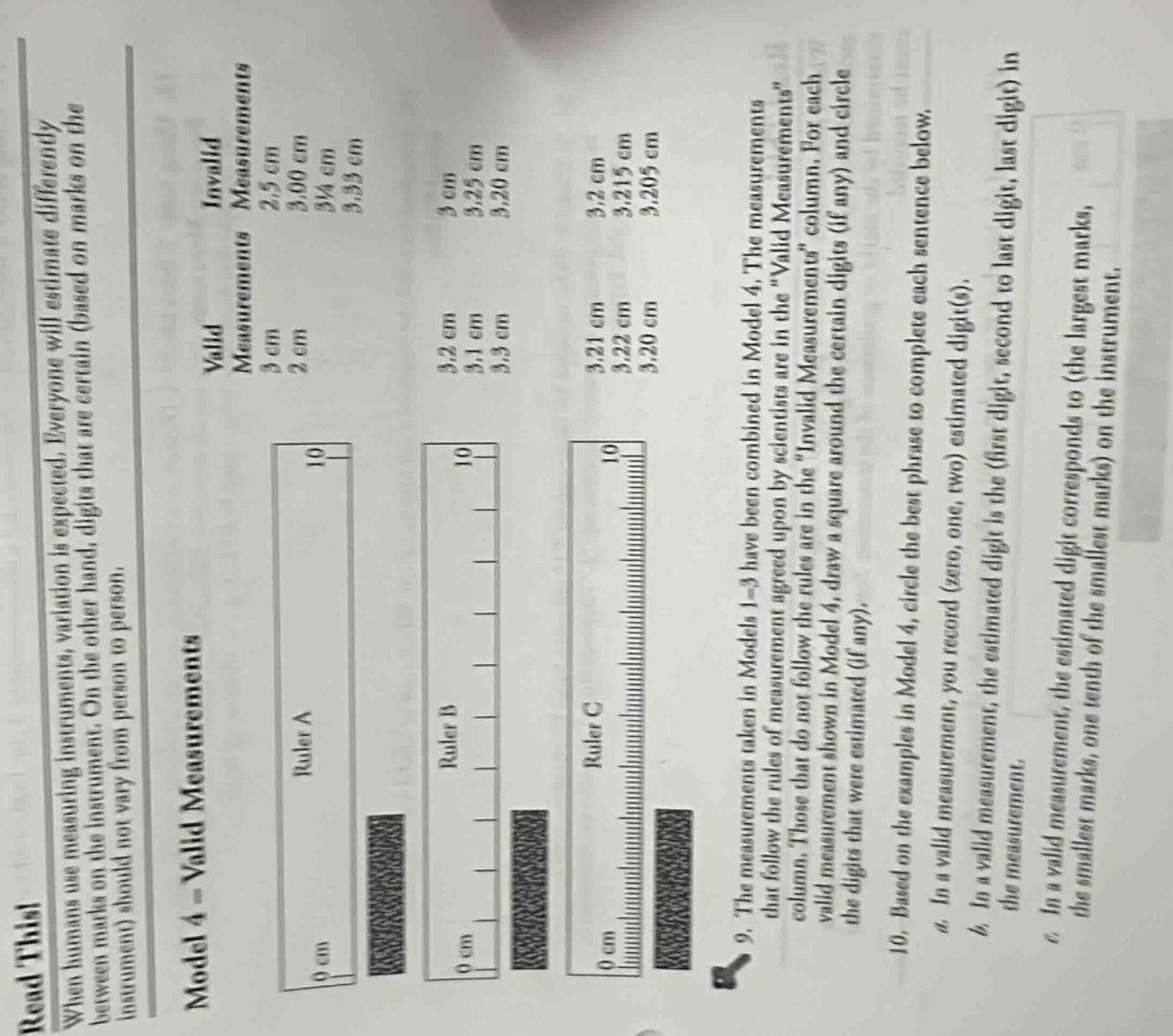
- the measurements taken in models 1–3 have been combined in model 4. the measurements that follow the rules of measurement agreed upon by scientists are in the “valid measurements” column. those that do not follow the rules are in the “invalid measurements” column. for each valid measurement shown in model 4, draw a square around the certain digits (if any) and circle the digits that were estimated (if any).
- based on the examples in model 4, circle the best phrase to complete each sentence below.
a. in a valid measurement, you record (zero, one, two) estimated digit(s).
b. in a valid measurement, the estimated digit is the (first digit, second to last digit, last digit) in the measurement.
c. in a valid measurement, the estimated digit corresponds to (the largest marks, the smallest marks, one tenth of the smallest marks) on the instrument.
Question 10 Analysis (assuming we are answering part a, b, c as a set)
Part a: In a valid measurement, you record (zero, one, two) estimated digit(s).
To determine this, we analyze the valid measurements from the models. For example, in Ruler C (with more precise markings), valid measurements like 3.21 cm, 3.22 cm, 3.20 cm have one estimated digit (the last digit). Ruler B with less precision (e.g., 3.2 cm, 3.1 cm, 3.3 cm) also has one estimated digit. Ruler A (coarse markings) has valid measurements like 3 cm, 2 cm, which have zero estimated digits? Wait, no—wait, the key is that in a valid measurement, the number of estimated digits: typically, in measurements, you estimate one digit beyond the smallest mark. But looking at the valid measurements: for Ruler A (marks at 0, 10? Wait, no, Ruler A has 0 cm and 10 cm? Wait, no, the first ruler (Ruler A) has 0 cm and 10 cm, with the object's length. Wait, the valid measurements for Ruler A are 3 cm, 2 cm—these are whole numbers, so maybe zero estimated digits? But Ruler B: marks are at 0, and then each mark is 1 cm? Wait, Ruler B has 0 cm, then marks at 1,2,3,...10? Wait, no, the second ruler (Ruler B) has 0 cm, and then each mark is 1 cm? Wait, the valid measurements for Ruler B are 3.2 cm, 3.1 cm, 3.3 cm—here, the smallest mark is 1 cm, so you estimate one digit (the tenths place). For Ruler C, the smallest mark is 0.1 cm (since it's a millimeter ruler), so valid measurements have one estimated digit (the hundredths place). Wait, but the question is "In a valid measurement, you record (zero, one, two) estimated digit(s)." Wait, maybe the answer is one. Wait, let's check the problem again.
Wait, the problem says: "In a valid measurement, you record (zero, one, two) estimated digit(s)." Let's look at the valid measurements:
- Ruler A (coarse, maybe marks at 0 and 10 cm? No, the first ruler has 0 cm and 10 cm, with the object's length. Valid measurements: 3 cm, 2 cm—these are whole numbers, so maybe zero estimated digits? But Ruler B: marks at 0, 1, 2,...10 cm? No, the second ruler (Ruler B) has 0 cm, and then each mark is 1 cm? Wait, the valid measurements for Ruler B are 3.2 cm, 3.1 cm, 3.3 cm—here, the smallest mark is 1 cm, so you estimate one digit (the tenths place). For Ruler C, smallest mark is 0.1 cm (millimeter), so valid measurements have one estimated digit (hundredths place). Wait, but the options are zero, one, two. Wait, maybe the answer is one. Because in most measurements, you estimate one digit beyond the smallest mark. So the answer is one.
Part b: In a valid measurement, the estimated digit is the (first digit, second to last digit, last digit) in the measurement.
Looking at the valid measurements:
- Ruler B: 3.2 cm (estimated digit is 2, last digit)
- Ruler C: 3.21 cm (estimated digit is 1, last digit)
- Ruler A: 3 cm (no estimated digit? But if it's 3.0 cm, but valid is 3 cm. Wait, maybe the estimated digit is the last digit. For example, 3.2 cm: the 2 is estimated (since the smallest mark is 1 cm, so you estimate the tenths place). 3.21 cm: the 1 is estimated (smallest mark 0.1 cm, estimate hundredths). So the estimated digit is the last digit.
Part c: In a valid measurement, the estimated digit corresponds to (the largest marks, the smallest marks, one tenth of the smallest marks) on the instrument.
The estimated digit is one tenth of the smallest mark. Wait, no: the smallest mark is the precision. For example, if the smallest mark is 1 cm (Ruler B), you estimate to the tenths place (0.1 cm), which is one tenth of the smallest mark (1 cm).…

Snap & solve any problem in the app
Get step-by-step solutions on Sovi AI
Photo-based solutions with guided steps
Explore more problems and detailed explanations
Question 10 Analysis (assuming we are answering part a, b, c as a set)
Part a: In a valid measurement, you record (zero, one, two) estimated digit(s).
To determine this, we analyze the valid measurements from the models. For example, in Ruler C (with more precise markings), valid measurements like 3.21 cm, 3.22 cm, 3.20 cm have one estimated digit (the last digit). Ruler B with less precision (e.g., 3.2 cm, 3.1 cm, 3.3 cm) also has one estimated digit. Ruler A (coarse markings) has valid measurements like 3 cm, 2 cm, which have zero estimated digits? Wait, no—wait, the key is that in a valid measurement, the number of estimated digits: typically, in measurements, you estimate one digit beyond the smallest mark. But looking at the valid measurements: for Ruler A (marks at 0, 10? Wait, no, Ruler A has 0 cm and 10 cm? Wait, no, the first ruler (Ruler A) has 0 cm and 10 cm, with the object's length. Wait, the valid measurements for Ruler A are 3 cm, 2 cm—these are whole numbers, so maybe zero estimated digits? But Ruler B: marks are at 0, and then each mark is 1 cm? Wait, Ruler B has 0 cm, then marks at 1,2,3,...10? Wait, no, the second ruler (Ruler B) has 0 cm, and then each mark is 1 cm? Wait, the valid measurements for Ruler B are 3.2 cm, 3.1 cm, 3.3 cm—here, the smallest mark is 1 cm, so you estimate one digit (the tenths place). For Ruler C, the smallest mark is 0.1 cm (since it's a millimeter ruler), so valid measurements have one estimated digit (the hundredths place). Wait, but the question is "In a valid measurement, you record (zero, one, two) estimated digit(s)." Wait, maybe the answer is one. Wait, let's check the problem again.
Wait, the problem says: "In a valid measurement, you record (zero, one, two) estimated digit(s)." Let's look at the valid measurements:
- Ruler A (coarse, maybe marks at 0 and 10 cm? No, the first ruler has 0 cm and 10 cm, with the object's length. Valid measurements: 3 cm, 2 cm—these are whole numbers, so maybe zero estimated digits? But Ruler B: marks at 0, 1, 2,...10 cm? No, the second ruler (Ruler B) has 0 cm, and then each mark is 1 cm? Wait, the valid measurements for Ruler B are 3.2 cm, 3.1 cm, 3.3 cm—here, the smallest mark is 1 cm, so you estimate one digit (the tenths place). For Ruler C, smallest mark is 0.1 cm (millimeter), so valid measurements have one estimated digit (hundredths place). Wait, but the options are zero, one, two. Wait, maybe the answer is one. Because in most measurements, you estimate one digit beyond the smallest mark. So the answer is one.
Part b: In a valid measurement, the estimated digit is the (first digit, second to last digit, last digit) in the measurement.
Looking at the valid measurements:
- Ruler B: 3.2 cm (estimated digit is 2, last digit)
- Ruler C: 3.21 cm (estimated digit is 1, last digit)
- Ruler A: 3 cm (no estimated digit? But if it's 3.0 cm, but valid is 3 cm. Wait, maybe the estimated digit is the last digit. For example, 3.2 cm: the 2 is estimated (since the smallest mark is 1 cm, so you estimate the tenths place). 3.21 cm: the 1 is estimated (smallest mark 0.1 cm, estimate hundredths). So the estimated digit is the last digit.
Part c: In a valid measurement, the estimated digit corresponds to (the largest marks, the smallest marks, one tenth of the smallest marks) on the instrument.
The estimated digit is one tenth of the smallest mark. Wait, no: the smallest mark is the precision. For example, if the smallest mark is 1 cm (Ruler B), you estimate to the tenths place (0.1 cm), which is one tenth of the smallest mark (1 cm). If the smallest mark is 0.1 cm (Ruler C), you estimate to the hundredths place (0.01 cm), which is one tenth of the smallest mark (0.1 cm). So the estimated digit corresponds to one tenth of the smallest marks on the instrument.
Now, let's answer each part:
Part a:
In a valid measurement, you record one estimated digit. Because you estimate one digit beyond the smallest mark (e.g., if smallest mark is 1 cm, estimate to tenths; if 0.1 cm, estimate to hundredths). So the answer is one.
Part b:
In a valid measurement, the estimated digit is the last digit in the measurement. For example, 3.2 cm (2 is estimated), 3.21 cm (1 is estimated). So the answer is last digit.
Part c:
In a valid measurement, the estimated digit corresponds to one tenth of the smallest marks on the instrument. Because you estimate to the next decimal place, which is one tenth of the smallest mark (e.g., smallest mark 1 cm → estimate 0.1 cm; smallest mark 0.1 cm → estimate 0.01 cm). So the answer is one tenth of the smallest marks.
Final Answers:
a. one
b. last digit
c. one tenth of the smallest marks