QUESTION IMAGE
Question
reading & summary
the persian wars
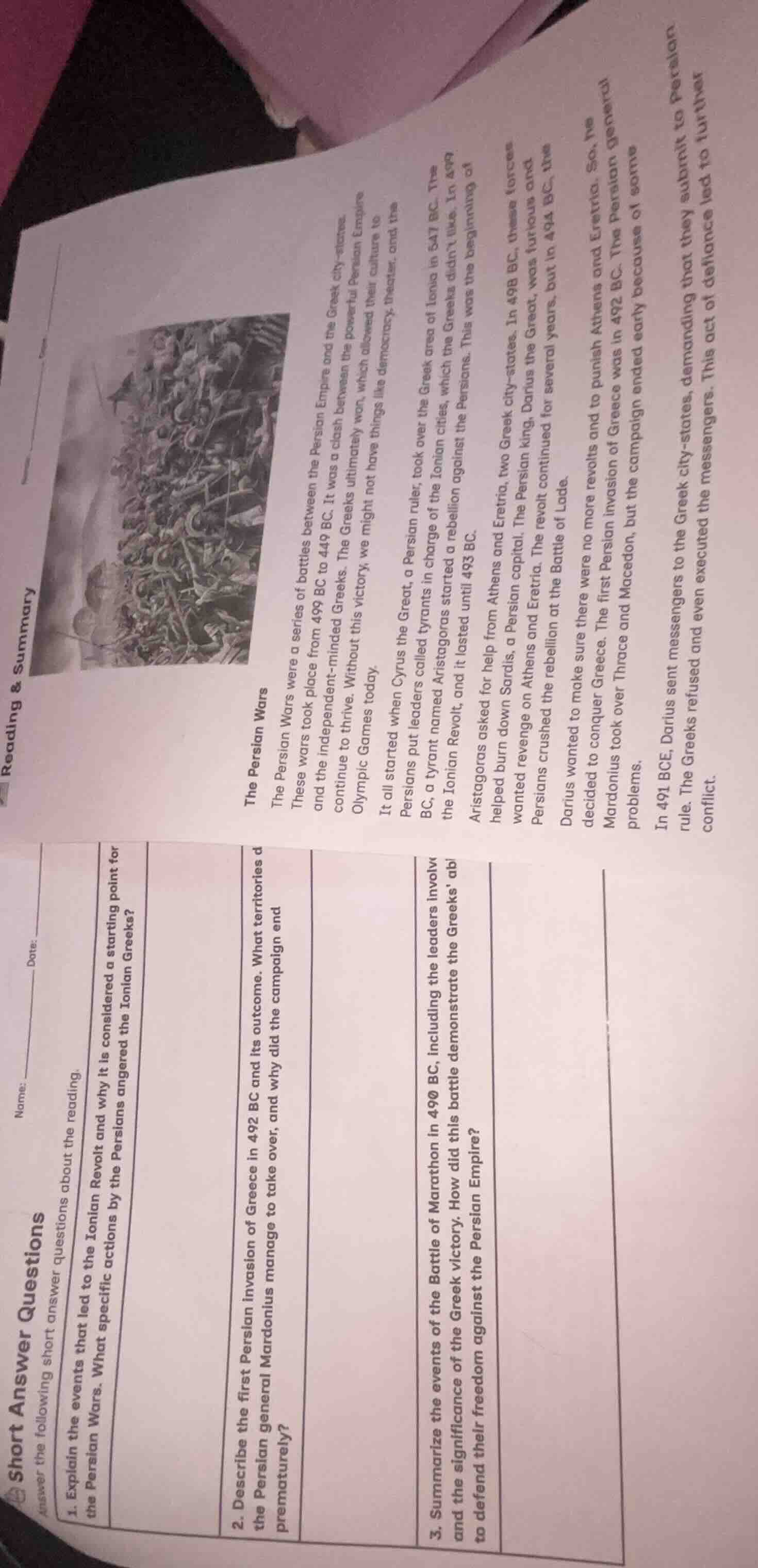
the persian wars were a series of battles between the persian empire and the greek city - states. these wars took place from 499 bc to 449 bc. it was a clash between the powerful persian empire and the independent - minded greeks. the greeks ultimately won, which allowed their culture to continue to thrive. without this victory, we might not have things like democracy, theater, and the olympic games today.
it all started when cyrus the great, a persian ruler, took over the greek area of ionia in 547 bc. the persians put leaders called tyrants in charge of the ionian cities, which the greeks didnt like. in 499 bc, a tyrant named aristagoras started a rebellion against the persians. this was the beginning of the ionian revolt, and it lasted until 493 bc.
aristagoras asked for help from athens and eretria, two greek city - states. in 498 bc, these forces helped burn down sardis, a persian capital. the persian king, darius the great, was furious and wanted revenge on athens and eretria. the revolt continued for several years - but in 494 bc, the persians crushed the rebellion at the battle of lade.
darius wanted to make sure there were no more revolts and to punish athens and eretria. so, he decided to conquer greece. the first persian invasion was in 492 bc. the persian general mardonius took over thrace and macedon, but the campaign ended early because of some problems.
in 491 bce, darius sent messengers to the greek city - states, demanding that they submit to persian rule. the greeks refused and even executed the messengers. this act of defiance led to further conflict.
short answer questions
answer the following short answer questions about the reading.
- explain the events that led to the ionian revolt and why it is considered a starting point for the persian wars. what specific actions by the persians angered the ionian greeks?
- describe the first persian invasion of greece in 492 bc and its outcome. what territories did the persian general mardonius manage to take over, and why did the campaign end prematurely?
- summarize the events of the battle of marathon in 490 bc, including the leaders involved and the significance of the greek victory. how did this battle demonstrate the greeks ability to defend their freedom against the persian empire?
- Drawn from the text's timeline: Persian conquest of Ionia, installation of tyrants, Aristagoras' revolt, Greek city-state support for burning Sardis, and Darius' resulting anger as the trigger for the Persian Wars.
- Based on the text's details of the 492 BC invasion: Mardonius' territorial gains, the campaign's early end due to operational issues.
- Summarizes the core event of the Battle of Marathon, and ties the Greek strategic victory to their ability to defend self-rule against the Persian Empire, as implied by the text's focus on Greek defiance of Persian control.

Snap & solve any problem in the app
Get step-by-step solutions on Sovi AI
Photo-based solutions with guided steps
Explore more problems and detailed explanations
- The Ionian Revolt began when Cyrus the Great conquered Ionia (547 BC) and installed tyrants, which Greeks resented. In 499 BC, tyrant Aristagoras launched a rebellion against Persia. Athens and Eretria helped burn the Persian capital Sardis in 498 BC; this act enraged Persian king Darius the Great, who sought revenge, sparking the Persian Wars.
- In 492 BC, Persian general Mardonius invaded Greece to punish Athens/Eretria and conquer Greece. He took control of Thrace and Macedonia, but the campaign ended early due to unspecified operational problems.
- In 490 BC, Darius sent forces to Marathon to punish Athens. Outnumbered Greek forces, led by Miltiades, used a strategic flanking maneuver to defeat the Persians. This victory demonstrated the Greeks' ability to coordinate military strategy and defend their city-state autonomy, proving they could repel the large Persian Empire and preserve their democratic and independent way of life.