QUESTION IMAGE
Question
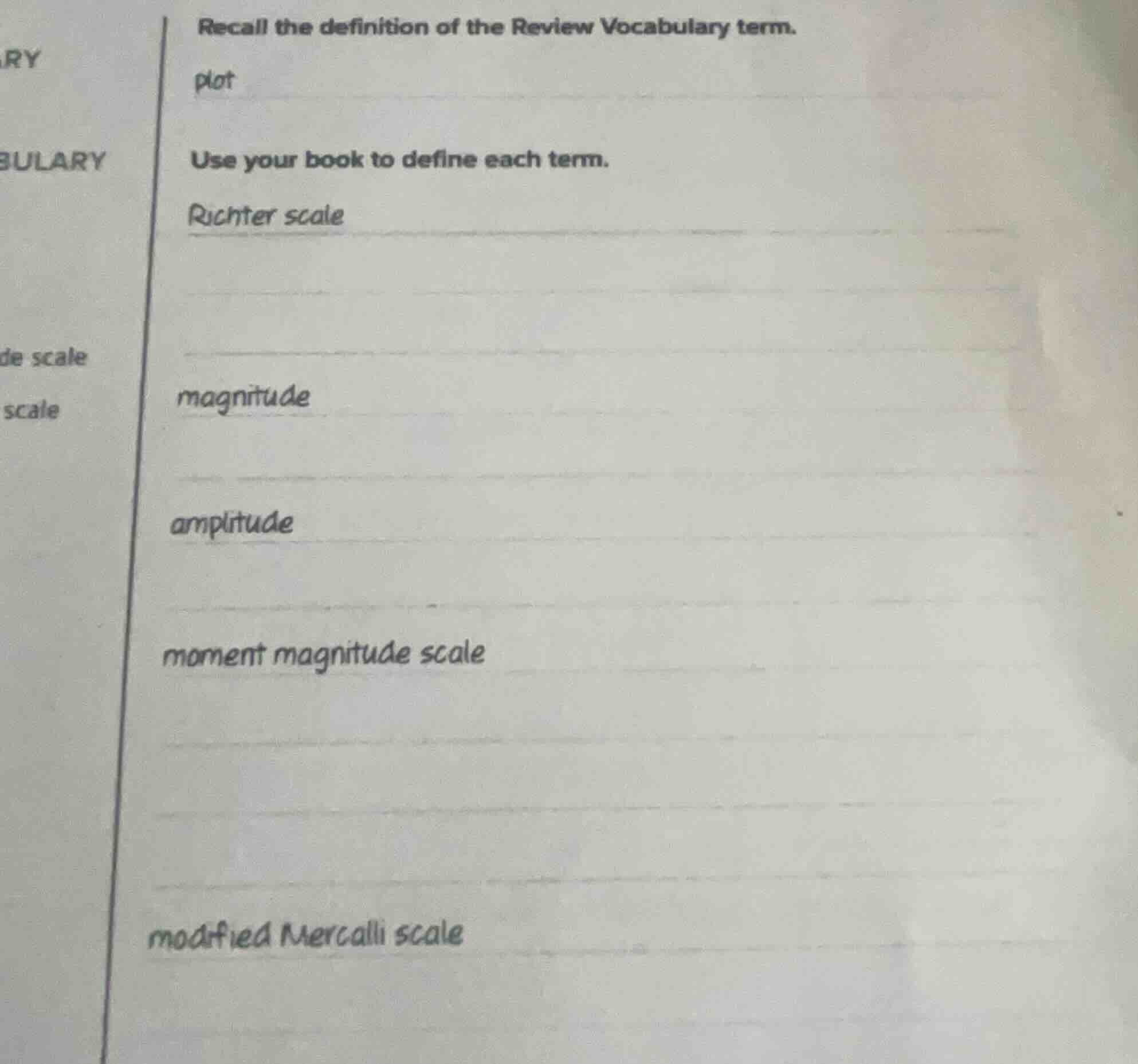
recall the definition of the review vocabulary term.
plot
use your book to define each term.
richter scale
magnitude
amplitude
moment magnitude scale
modified mercalli scale
Brief Explanations
- plot: In the context of seismology (a subfield of Earth Science, part of Natural Science), a plot can refer to a graphical representation (like a seismogram plot) showing data such as ground motion over time. In literature (Arts - Literature), it's the sequence of events in a story. Given the other terms (Richter scale, magnitude, etc.) are seismology - related, here it likely refers to a graphical representation of seismic data (e.g., plotting earthquake - related measurements).
- Richter scale: A logarithmic scale developed by Charles F. Richter to measure the magnitude of an earthquake. It quantifies the amount of energy released by an earthquake based on the amplitude of seismic waves recorded by seismographs.
- magnitude: In seismology, it is a measure of the size or strength of an earthquake. It represents the amount of energy released at the earthquake's source. There are different scales to measure magnitude, like the Richter scale and moment magnitude scale.
- amplitude: In the context of seismology, it is the maximum displacement of a seismic wave from its rest position. It is related to the energy of the seismic wave and is used in calculating the magnitude of an earthquake (e.g., in the Richter scale formula, the magnitude is related to the logarithm of the amplitude of the seismic wave).
- moment magnitude scale: A scale used to measure the magnitude of an earthquake. It is based on the seismic moment of the earthquake, which takes into account the area of the fault that slipped, the average amount of slip, and the rigidity of the rock. It provides a more accurate measure of the size of large earthquakes compared to the Richter scale.
- modified Mercalli scale: A scale used to measure the intensity of an earthquake. It is based on the observed effects of the earthquake on the Earth's surface, buildings, and people. It uses Roman numerals (I to XII) to describe the intensity, with I being barely felt and XII being total destruction.

Snap & solve any problem in the app
Get step-by-step solutions on Sovi AI
Photo-based solutions with guided steps
Explore more problems and detailed explanations
- plot: (In seismology context) A graphical representation of seismic data (e.g., seismogram plot showing ground motion over time) or (in literature context) the sequence of events in a story (but here likely seismic - related plot).
- Richter scale: A logarithmic scale to measure earthquake magnitude based on seismic wave amplitude.
- magnitude: Measure of an earthquake's size/energy released at its source.
- amplitude: Maximum displacement of a seismic wave from rest position, related to earthquake energy.
- moment magnitude scale: Earthquake magnitude scale based on seismic moment (fault area, slip, rock rigidity).
- modified Mercalli scale: Scale to measure earthquake intensity based on observed effects (I - XII).