QUESTION IMAGE
Question
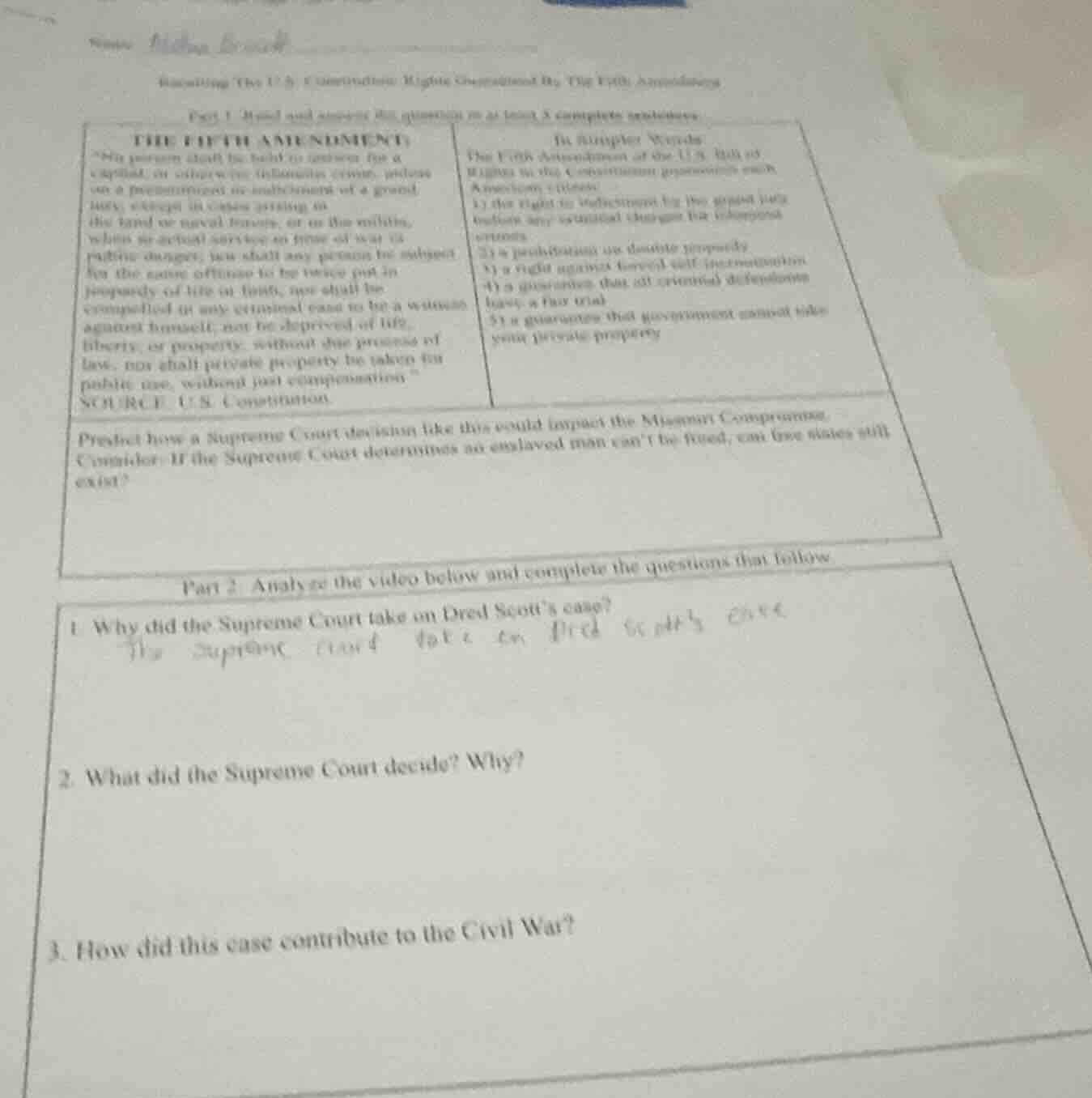
recalling the u.s constitution: rights guaranteed by the fifth amendment
part 1 read and answer the question in at least 5 complete sentences
the fifth amendment
o person shall be held to answer for a capital, or otherwise infamous crime, unless on a presentment or indictment of a grand jury, except in cases arising in the land or naval forces, or in the militia, when in actual service in time of war or public danger; nor shall any person be subject for the same offense to be twice put in jeopardy of life or limb; nor shall be compelled in any criminal case to be a witness against himself, nor be deprived of life, liberty, or property, without due process of law; nor shall private property be taken for public use, without just compensation.\
source: u.s. constitution
in simpler words
the fifth amendment of the u.s. bill of rights (in the constitution) guarantees each american citizen:
- the right to indictment by the grand jury before any criminal charges for felonious crimes
- a prohibition on double jeopardy
- a right against forced self-incrimination
- a guarantee that all criminal defendants have a fair trial
- a guarantee that government cannot take your private property
predict how a supreme court decision like this would impact the missouri compromise.
consider: if the supreme court determines an enslaved man can’t be freed, can free states still exist?
part 2 analyze the video below and complete the questions that follow
1 why did the supreme court take on dred scott’s case?
the supreme court took on dred scott’s case
2 what did the supreme court decide? why?
3 how did this case contribute to the civil war?
- The Supreme Court took Dred Scott's case because the dispute centered on whether an enslaved person who lived in free territories could gain freedom, and it raised critical constitutional questions about enslavement, citizenship, and federal power over slavery in new states, which had split the nation legally and socially.
- The Supreme Court decided that enslaved people (and their descendants) were not U.S. citizens, so they could not sue in federal court. It also ruled that Congress had no constitutional authority to ban slavery in U.S. territories, and that the Missouri Compromise was unconstitutional. The justices based this on the Fifth Amendment's "due process" clause, arguing that banning slavery in territories deprived enslavers of their "property" (enslaved people) without legal process.
- This case escalated tensions that led to the Civil War by invalidating the Missouri Compromise, which had maintained a fragile balance between free and slave states. It opened all federal territories to slavery, enraging abolitionists and Northern free states who saw it as a step toward nationalizing slavery. It also strengthened the sectional divide, making political compromise over slavery nearly impossible and pushing the nation closer to armed conflict.

Snap & solve any problem in the app
Get step-by-step solutions on Sovi AI
Photo-based solutions with guided steps
Explore more problems and detailed explanations
- The Supreme Court took Dred Scott's case because it raised urgent, nation-splitting constitutional questions: whether an enslaved person who resided in free territories could become free, whether enslaved people qualified as U.S. citizens with access to federal courts, and whether Congress had the power to restrict slavery in new federal territories. These issues had created deep legal and social rifts between Northern free states and Southern slave states, making a definitive Supreme Court ruling seem necessary to resolve the conflict.
- The Supreme Court ruled three key points:
- Enslaved people and their descendants were not U.S. citizens, so they had no right to file lawsuits in federal court.
- Congress did not have the constitutional authority to ban slavery in federal territories, meaning the Missouri Compromise (which restricted slavery in northern territories) was unconstitutional.
- The Court justified this using the Fifth Amendment's due process clause, claiming that banning slavery in territories deprived enslavers of their "property" (enslaved people) without proper legal process.
- The Dred Scott decision was a major catalyst for the Civil War because it destroyed the fragile sectional balance maintained by the Missouri Compromise. By allowing slavery in all federal territories, it infuriated abolitionists and Northern free states, who viewed it as a power grab by Southern slaveholders to nationalize slavery. It also weakened faith in the federal government's ability to mediate slavery disputes, pushed anti-slavery politicians (like the newly formed Republican Party) to take harder lines, and eliminated remaining political compromises, making armed conflict between the North and South increasingly inevitable.