QUESTION IMAGE
Question
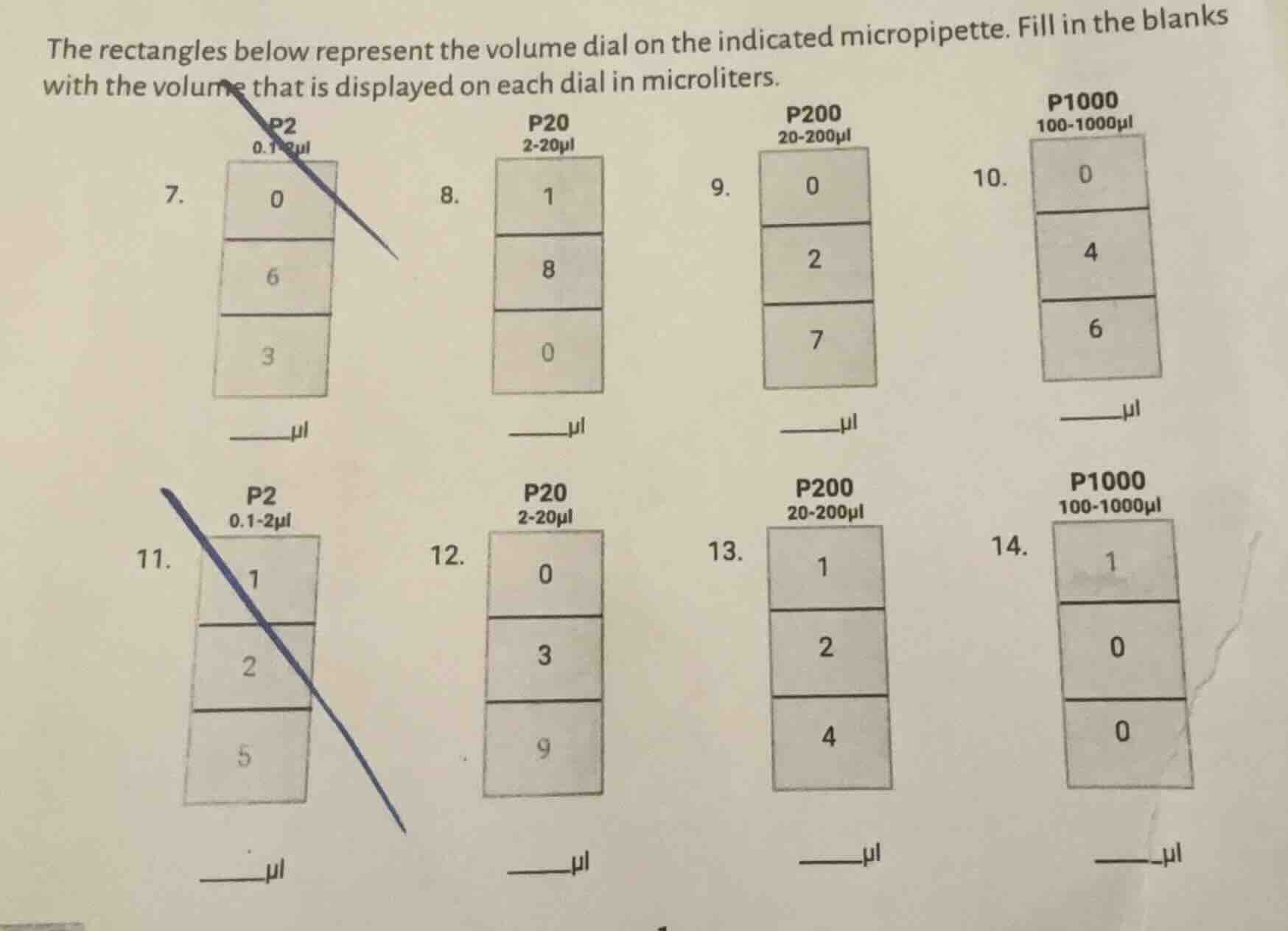
the rectangles below represent the volume dial on the indicated micropipette. fill in the blanks with the volume that is displayed on each dial in microliters.
- p2 0.1 - 2μl
0
6
3
____μl
- p20 2 - 20μl
1
8
0
____μl
- p200 20 - 200μl
0
2
7
____μl
- p1000 100 - 1000μl
0
4
6
____μl
- p2 0.1 - 2μl
1
2
5
____μl
- p20 2 - 20μl
0
3
9
____μl
- p200 20 - 200μl
1
2
4
____μl
- p1000 100 - 1000μl
1
0
0
____μl
7. P2 (0.1 - 2 μl)
Step1: Identify digit positions
For P2, the top digit is the first decimal, middle is the first digit, bottom is the second decimal? Wait, no, P2 range is 0.1 - 2 μl. The dial has three parts: top (0), middle (6), bottom (3). Wait, maybe the format is: for P2, the volume is calculated as (top digit) + (middle digit)0.1 + (bottom digit)0.01? Wait, no, let's recall micropipette dials. For P2 (0.1 - 2 μl), the digits are: the top is the tens place? No, wait, P2 is 0.1 to 2 μl, so the first digit (top) is 0, middle is 6 (tenths place), bottom is 3 (hundredths? No, maybe the volume is 0.63 μl? Wait, no, let's check the structure. Wait, maybe for P2, the volume is (middle digit) + (bottom digit)0.1? No, the range is 0.1 - 2, so the digits are: top (0), middle (6), bottom (3). So 0.63 μl? Wait, no, maybe the correct way is: for P2, the volume is (top digit) + (middle digit)0.1 + (bottom digit)*0.01? Wait, no, let's see the example. Wait, maybe I got it wrong. Wait, the P2 dial: the first digit (top) is 0, middle is 6, bottom is 3. So the volume is 0.63 μl? Wait, no, maybe the P2 is 0.1 - 2 μl, so the digits are: the top is the integer part (0), middle is the tenths (6), bottom is the hundredths (3). So 0.63 μl.
Step2: Calculate
So 0 + 60.1 + 30.01 = 0.6 + 0.03 = 0.63 μl.
Step1: Identify digit positions
P20 range is 2 - 20 μl. The dial has top (1), middle (8), bottom (0). For P20, the volume is calculated as (top digit)10 + (middle digit)1 + (bottom digit)*0.1? No, wait, P20 is 2 - 20 μl, so the digits are: top (1), middle (8), bottom (0). So 18.0 μl? Wait, no, the range is 2 - 20, so the top digit is the tens place (1), middle is the ones (8), bottom is the tenths (0). So 18.0 μl, which is 18 μl.
Step2: Calculate
110 + 81 + 0*0.1 = 10 + 8 + 0 = 18 μl.
Step1: Identify digit positions
P200 range is 20 - 200 μl. The dial has top (0), middle (2), bottom (7). For P200, the volume is (top digit)100 + (middle digit)10 + (bottom digit)1? Wait, no, 20 - 200, so top is tens? No, wait, P200: the first digit (top) is 0 (hundreds place), middle (2) is tens, bottom (7) is ones. So 0100 + 210 + 71 = 27? No, wait, 20 - 200, so the minimum is 20, so the digits are: top (0), middle (2), bottom (7). So 27 μl? No, that's too low. Wait, no, P200 is 20 - 200 μl, so the volume is (top digit)10 + (middle digit)1 + (bottom digit)0.1? No, that can't be. Wait, no, the correct way for P200 (20 - 200 μl) is: the top digit is the hundreds place (0), middle is the tens (2), bottom is the ones (7). So 0100 + 210 + 71 = 27? No, that's 27, but P200 starts at 20. Wait, maybe I messed up. Wait, P200: the range is 20 - 200, so the digits are: top (0), middle (2), bottom (7). So 27 μl? No, that's within 20 - 200. Wait, no, 20 - 200, so the volume is 27 μl? Wait, no, maybe the top is 0 (tens place), middle is 2 (ones), bottom is 7 (tenths)? No, that would be 2.7, which is too low. Wait, I think I made a mistake. Let's recall: P20 (2 - 20 μl) has top (1), middle (8), bottom (0) → 18 μl (which is 2 - 20, correct). So P200 (20 - 200 μl) should have top (0), middle (2), bottom (7) → 27 μl? Wait, no, 20 - 200, so 27 is within range. Wait, but 20 - 200, so the digits are: top (0) (tens place), middle (2) (ones), bottom (7) (tenths)? No, that would be 2.7, which is wrong. Wait, no, the P200 dial: the first digit (top) is the hundreds place (0), middle is the tens (2), bottom is the ones (7). So 0100 + 210 + 7*1 = 27 μl. Yes, that makes sense, as 27 is between 20 and 200.
Step2: Calculate
0100 + 210 + 7*1 = 0 + 20 + 7 = 27 μl.

Snap & solve any problem in the app
Get step-by-step solutions on Sovi AI
Photo-based solutions with guided steps
Explore more problems and detailed explanations
0.63