QUESTION IMAGE
Question
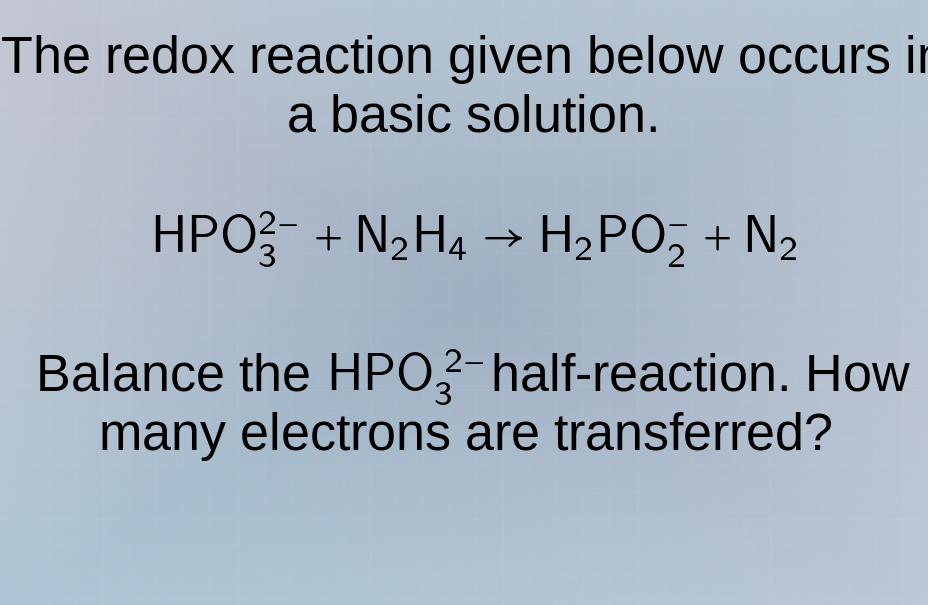
the redox reaction given below occurs in a basic solution. $\ce{hpo^{2-}_{3} + n_{2}h_{4} -> h_{2}po^{-}_{2} + n_{2}}$ balance the $\ce{hpo^{2-}_{3}}$ half - reaction. how many electrons are transferred?
Step1: Balance atoms other than O and H
The half - reaction starts with $\ce{HPO_3^{2-}}
ightarrow \ce{H_2PO_2^{-}}$. The P atoms are already balanced (1 P on each side).
Step2: Balance O atoms with $\ce{H_2O}$
On the left side, we have 3 O atoms in $\ce{HPO_3^{2-}}$, and on the right side, we have 2 O atoms in $\ce{H_2PO_2^{-}}$. So we add 1 $\ce{H_2O}$ to the right side to balance O:
$\ce{HPO_3^{2-}}
ightarrow \ce{H_2PO_2^{-}} + \ce{H_2O}$
Step3: Balance H atoms with $\ce{H^+}$ (then convert to basic solution)
Now, let's balance H. On the left side, we have 1 H in $\ce{HPO_3^{2-}}$, and on the right side, we have $2 + 2=4$ H (from $\ce{H_2PO_2^{-}}$ and $\ce{H_2O}$). So we add 3 $\ce{H^+}$ to the left side:
$\ce{HPO_3^{2-}} + 3\ce{H^+}
ightarrow \ce{H_2PO_2^{-}} + \ce{H_2O}$
Since the solution is basic, we add 3 $\ce{OH^-}$ to both sides to neutralize $\ce{H^+}$ (they combine to form $\ce{H_2O}$):
$\ce{HPO_3^{2-}} + 3\ce{H^+}+ 3\ce{OH^-}
ightarrow \ce{H_2PO_2^{-}} + \ce{H_2O}+ 3\ce{OH^-}$
The $3\ce{H^+}$ and $3\ce{OH^-}$ on the left form $3\ce{H_2O}$, so:
$\ce{HPO_3^{2-}} + 3\ce{H_2O}
ightarrow \ce{H_2PO_2^{-}} + \ce{H_2O}+ 3\ce{OH^-}$
Simplify the $\ce{H_2O}$ terms (subtract 1 $\ce{H_2O}$ from both sides):
$\ce{HPO_3^{2-}} + 2\ce{H_2O}
ightarrow \ce{H_2PO_2^{-}} + \ce{H_2O}+ 3\ce{OH^-}$ (wait, correction: when we add $3\ce{OH^-}$ to both sides, the left side has $3\ce{H_2O}$ (from $3\ce{H^+}+3\ce{OH^-}$) and the right side has 1 $\ce{H_2O}$ (original) and $3\ce{OH^-}$. Let's redo the basic - solution balancing properly.
After balancing H with $\ce{H^+}$: $\ce{HPO_3^{2-}} + 3\ce{H^+}
ightarrow \ce{H_2PO_2^{-}} + \ce{H_2O}$
Now, for basic solution, add the same number of $\ce{OH^-}$ as $\ce{H^+}$ to both sides:
$\ce{HPO_3^{2-}} + 3\ce{H^+}+ 3\ce{OH^-}
ightarrow \ce{H_2PO_2^{-}} + \ce{H_2O}+ 3\ce{OH^-}$
Left side: $3\ce{H^+}+3\ce{OH^-}=3\ce{H_2O}$, so:
$\ce{HPO_3^{2-}} + 3\ce{H_2O}
ightarrow \ce{H_2PO_2^{-}} + \ce{H_2O}+ 3\ce{OH^-}$
Subtract $\ce{H_2O}$ from both sides:
$\ce{HPO_3^{2-}} + 2\ce{H_2O}
ightarrow \ce{H_2PO_2^{-}} + 3\ce{OH^-}$
Step4: Balance charge with electrons
Now, let's find the charge on each side.
Left side: Charge of $\ce{HPO_3^{2-}}$ is - 2, and $2\ce{H_2O}$ is neutral, so total charge is - 2.
Right side: Charge of $\ce{H_2PO_2^{-}}$ is - 1, and charge of $3\ce{OH^-}$ is $3\times(- 1)=-3$. So total charge on the right is $-1+( - 3)=-4$.
Let the number of electrons be $n$. Electrons have a charge of - 1. So we need to find $n$ such that:
Charge on left + charge from electrons (since electrons are added to the side with more positive charge, or removed from the side with more negative charge; here, left charge is - 2, right is - 4, so we need to add electrons to the left? Wait, no. Let's calculate the oxidation state of P.
In $\ce{HPO_3^{2-}}$: Let the oxidation state of P be $x$. We know that $H = + 1$, $O=-2$. So $1 + x+3\times(-2)=-2$. So $1 + x - 6=-2$, $x=+3$.
In $\ce{H_2PO_2^{-}}$: Let the oxidation state of P be $y$. $2\times(+1)+y + 2\times(-2)=-1$. So $2 + y-4=-1$, $y = + 1$.
So P is reduced (oxidation state decreases from + 3 to + 1), so electrons are gained. The change in oxidation state per P atom is $3 - 1 = 2$? Wait, no. Wait, the oxidation state of P in $\ce{HPO_3^{2-}}$: $H(+1)+P(x)+3O(-2)= - 2\Rightarrow1 + x-6=-2\Rightarrow x = + 3$. In $\ce{H_2PO_2^{-}}$: $2H(+1)+P(y)+2O(-2)=-1\Rightarrow2 + y-4=-1\Rightarrow y = + 1$. So the change in oxidation state for P is $3-1 = 2$ (reduction, so gain of 2 electrons per P atom). Since there is 1 P atom on each side, the number of…

Snap & solve any problem in the app
Get step-by-step solutions on Sovi AI
Photo-based solutions with guided steps
Explore more problems and detailed explanations
The number of electrons transferred in the $\ce{HPO_3^{2-}}$ half - reaction is 2.