QUESTION IMAGE
Question
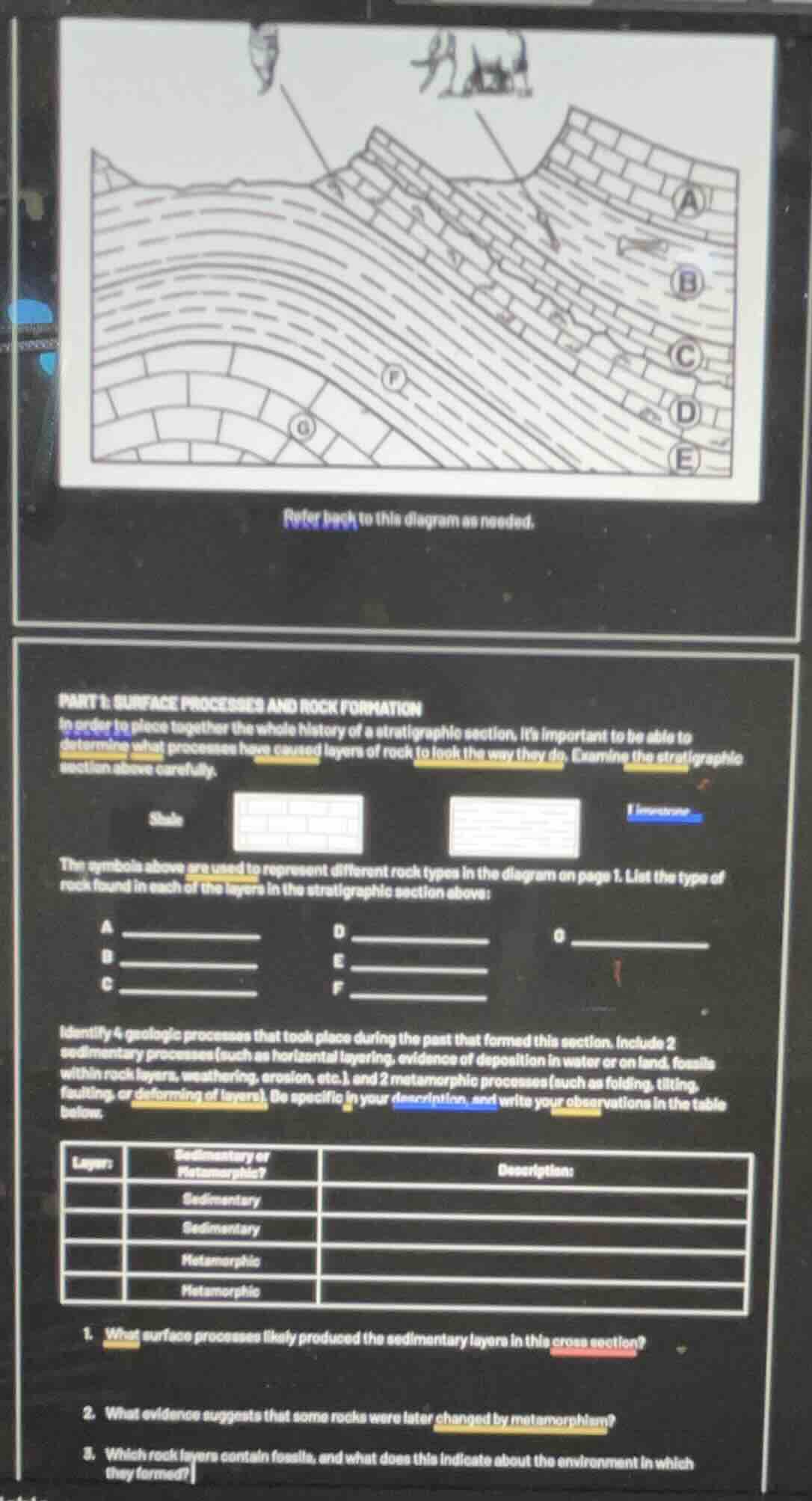
refer back to this diagram as needed.part 1: surface processes and rock formationin order to piece together the whole history of a stratigraphic section, its important to be able to determine what processes have caused layers of rock to look the way they do. examine the stratigraphic section above carefully.shalelimestonethe symbols above are used to represent different rock types in the diagram on page 1. list the type of rock found in each of the layers in the stratigraphic section above:a __________b ________c ________d ________e ________f ________g __________identify 4 geologic processes that took place during the past that formed this section. include 2 sedimentary processes such as horizontal layering, evidence of deposition in water or on land, fossils within rock layers, weathering, erosion, etc. and 2 metamorphic processes such as folding, tilting, faulting, or deforming of layers. be specific in your description, and write your observations in the table below.| layer: | sedimentary or metamorphic? | description: || ---- | ---- | ---- || | sedimentary | || | sedimentary | || | metamorphic | || | metamorphic | |1. what surface processes likely produced the sedimentary layers in this cross section?2. what evidence suggests that some rocks were later changed by metamorphism?3. which rock layers contain fossils, and what does this indicate about the environment in which they formed?
Rock Layer Identification
Match the diagram's rock symbols to the given keys: the brick symbol is shale, the line symbol is limestone.
- Layer A has the brick symbol → Shale
- Layer B has the line symbol → Limestone
- Layer C has the line symbol → Limestone
- Layer D has the line symbol → Limestone
- Layer E has the line symbol → Limestone
- Layer F has the line symbol → Limestone
- Layer G has the brick symbol → Shale
Geologic Processes Table
- Sedimentary Process 1: Fossil deposition is observed in upper layers (A/B), showing ancient organisms were buried in sediment.
- Sedimentary Process 2: Horizontal deposition is the original formation of all flat, layered rocks before deformation.
- Metamorphic Process 1: Folding of lower layers (F/G) shows rock was compressed and bent.
- Metamorphic Process 2: Tilting of upper layers (A-E) shows rock layers were shifted from their original horizontal position.
Sub-Questions
- Sedimentary layers form from weathering of pre-existing rocks, erosion of those sediments, transportation to a depositional area, deposition of sediments in flat layers, and lithification (compaction/cementation) into solid rock.
- The folding and tilting of the rock layers is evidence of metamorphism; these deformations require intense heat/pressure that alters the rock structure.
- Layers A and B contain fossils. This indicates the environment was a low-energy, water-covered setting (like a lake or ocean floor), where sediment could accumulate and bury organisms before they decomposed.

Snap & solve any problem in the app
Get step-by-step solutions on Sovi AI
Photo-based solutions with guided steps
Explore more problems and detailed explanations
Rock Type per Layer
A. Shale
B. Limestone
C. Limestone
D. Limestone
E. Limestone
F. Limestone
G. Shale
Geologic Processes Table
| Layer: | Sedimentary or Metamorphic? | Description: |
|---|---|---|
| All initial layers | Sedimentary | Horizontal deposition of flat layers |
| F/G | Metamorphic | Folding of lower rock layers |
| A-E | Metamorphic | Tilting of upper rock layers |
Sub-Question Answers
- Weathering, erosion, transportation, deposition of sediments, and lithification (compaction/cementation) formed the sedimentary layers.
- The folding of lower layers and tilting of upper layers, which require intense heat and pressure, indicate metamorphic alteration.
- Layers A and B contain fossils. This indicates the environment was a quiet, water-based setting (e.g., ocean floor, lake) where organisms could be buried and preserved in sediment.