QUESTION IMAGE
Question
reflect
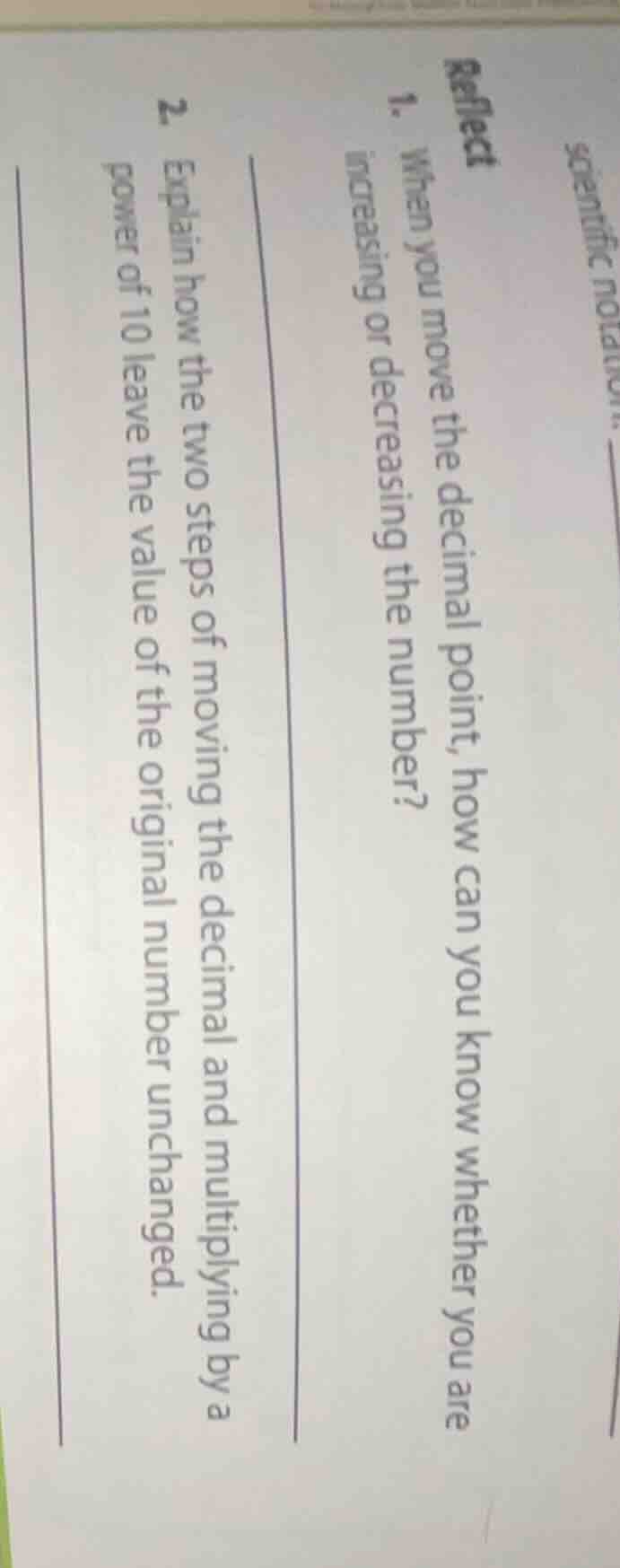
- when you move the decimal point, how can you know whether you are increasing or decreasing the number?
- explain how the two steps of moving the decimal and multiplying by a power of 10 leave the value of the original number unchanged.
Question 1
Step 1: Understand decimal movement direction
If moving the decimal point to the right, the number of places moved is \( n \), the number is multiplied by \( 10^n \), so it increases. If moving left, multiplied by \( 10^{-n} \) (or divided by \( 10^n \)), so it decreases.
Step 2: Relate to number change
For example, take \( 5.6 \). Move decimal right 2 places: \( 560 = 5.6\times10^2 \) (increase). Move left 2 places: \( 0.056 = 5.6\times10^{-2} \) (decrease).
Step 1: Analyze decimal movement
Moving the decimal point \( n \) places is equivalent to multiplying (or dividing) by \( 10^n \) (or \( 10^{-n} \)).
Step 2: Analyze power of 10 multiplication
Multiplying by \( 10^k \) scales the number by \( 10^k \). To keep the value unchanged, the two steps must be inverses:
- If you move the decimal \( n \) places right (multiply by \( 10^n \)), you must multiply by \( 10^{-n} \) (or divide by \( 10^n \)) to cancel it.
- If you move the decimal \( n \) places left (multiply by \( 10^{-n} \)), you must multiply by \( 10^n \) to cancel it.
Mathematically: Let original number be \( x \). Move decimal \( n \) places right: \( x\times10^n \). Then multiply by \( 10^{-n} \): \( (x\times10^n)\times10^{-n} = x \). Similarly for left movement.

Snap & solve any problem in the app
Get step-by-step solutions on Sovi AI
Photo-based solutions with guided steps
Explore more problems and detailed explanations
- Moving decimal right: Number increases (multiplied by \( 10^n \), \( n \) = places moved).
- Moving decimal left: Number decreases (multiplied by \( 10^{-n} \), or divided by \( 10^n \)).