QUESTION IMAGE
Question
religious syncretism
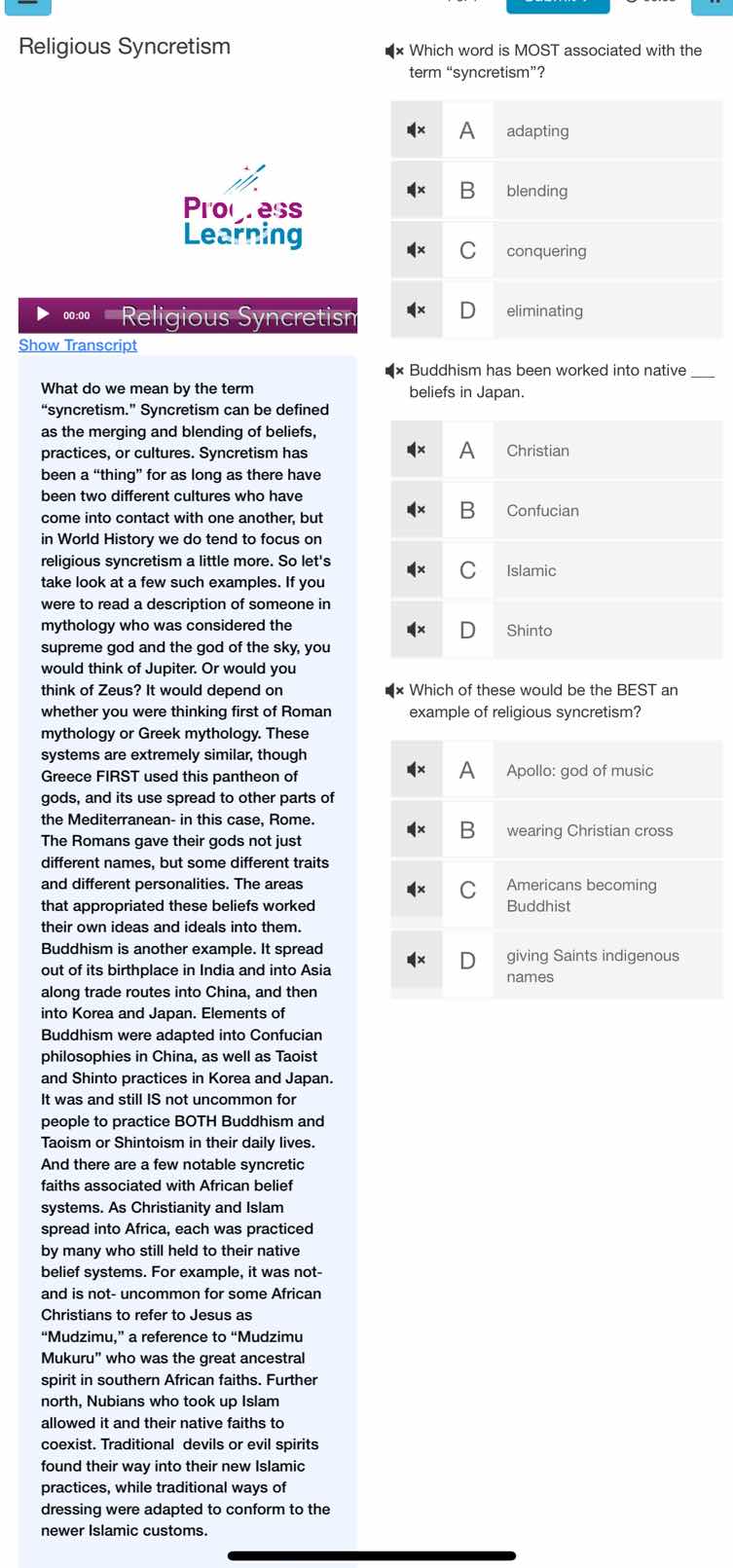
what do we mean by the term “syncretism.” syncretism can be defined as the merging and blending of beliefs, practices, or cultures. syncretism has been a “thing” for as long as there have been two different cultures who have come into contact with one another, but in world history we do tend to focus on religious syncretism a little more. so let’s take look at a few such examples. if you were to read a description of someone in mythology who was considered the supreme god and the god of the sky, you would think of jupiter. or would you think of zeus? it would depend on whether you were thinking first of roman mythology or greek mythology. these systems are extremely similar, though greece first used this pantheon of gods, and its use spread to other parts of the mediterranean- in this case, rome. the romans gave their gods not just different names, but some different traits and different personalities. the areas that appropriated these beliefs worked their own ideas and ideals into them. buddhism is another example. it spread out of its birthplace in india and into asia along trade routes into china, and then into korea and japan. elements of buddhism were adapted into confucian philosophies in china, as well as taoist and shinto practices in korea and japan. it was and still is not uncommon for people to practice both buddhism and taoism or shintoism in their daily lives. and there are a few notable syncretic faiths associated with african belief systems. as christianity and islam spread into africa, each was practiced by many who still held to their native belief systems. for example, it was not- and is not- uncommon for some african christians to refer to jesus as “mudzimu,” a reference to “mudzimu mukuru” who was the great ancestral spirit in southern african faiths. further north, nubians who took up islam allowed it and their native faiths to coexist. traditional devils or evil spirits found their way into their new islamic practices, while traditional ways of dressing were adapted to conform to the newer islamic customs.
which word is most associated with the term “syncretism”?
a adapting
b blending
c conquering
d eliminating
buddhism has been worked into native ___ beliefs in japan.
a christian
b confucian
c islamic
d shinto
which of these would be the best an example of religious syncretism?
a apollo: god of music
b wearing christian cross
c americans becoming buddhist
d giving saints indigenous names
First Question:
The passage defines syncretism as the merging and blending of beliefs, practices, or cultures. Among the options, "blending" directly matches this definition. "Adapting" is not the core meaning, "conquering" and "eliminating" are opposite to the idea of merging.
The passage states that Buddhism spread into Japan and was adapted into Shinto practices. Christian, Confucian (more associated with China), and Islamic are not native Japanese beliefs in the context of Buddhism's integration. Shinto is the native belief system of Japan where Buddhism was worked into.
- Option A: Apollo being the god of music is just a description of a deity, not syncretism.
- Option B: Wearing a Christian cross is a symbol, not a merging of beliefs.
- Option C: Americans becoming Buddhist is conversion, not blending of beliefs.
- Option D: Giving Saints indigenous names merges Christian (Saints) and indigenous beliefs, fitting syncretism's definition of merging beliefs.

Snap & solve any problem in the app
Get step-by-step solutions on Sovi AI
Photo-based solutions with guided steps
Explore more problems and detailed explanations
B. blending