QUESTION IMAGE
Question
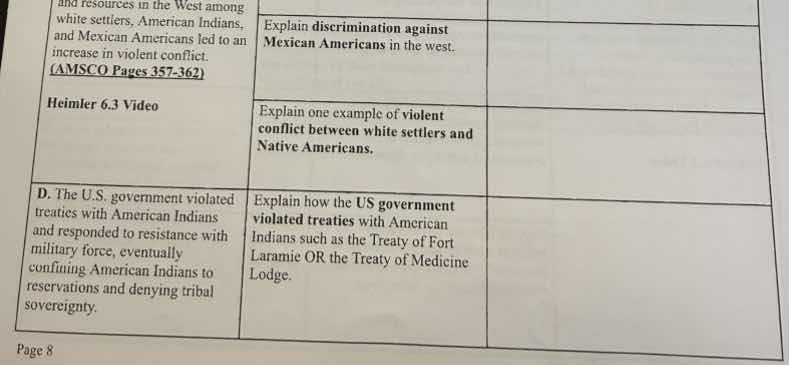
and resources in the west among white settlers, american indians, and mexican americans led to an increase in violent conflict. (amsco pages 357-362) heimler 6.3 video d. the u.s. government violated treaties with american indians and responded to resistance with military force, eventually confining american indians to reservations and denying tribal sovereignty. explain discrimination against mexican americans in the west. explain one example of violent conflict between white settlers and native americans. explain how the us government violated treaties with american indians such as the treaty of fort laramie or the treaty of medicine lodge.
- This reflects the systemic, multi-layered discrimination Mexican Americans faced in the post-Civil War West, rooted in white supremacist policies and attitudes.
- The Battle of Little Bighorn was a direct violent clash sparked by white settlers violating Native land treaties, representing broader conflict over Western expansion.
- The Treaty of Fort Laramie violation shows the U.S. government's pattern of breaking agreements with Native nations to prioritize white settlement and resource extraction, eroding tribal self-determination.

Snap & solve any problem in the app
Get step-by-step solutions on Sovi AI
Photo-based solutions with guided steps
Explore more problems and detailed explanations
- Discrimination against Mexican Americans in the West included systemic disenfranchisement, land seizure, and social segregation. Mexican Americans were often barred from voting, had their land taken through legal loopholes or force, and were excluded from public spaces, schools, and jobs reserved for white settlers.
- One example of violent conflict is the Battle of Little Bighorn (1876). Gold miners violated the Treaty of Fort Laramie by entering the Black Hills, a sacred land of the Lakota Sioux. The Lakota, Cheyenne, and Arapaho united to defend their territory, defeating U.S. Army troops led by George Custer.
- The U.S. government violated the Treaty of Fort Laramie (1868) by allowing white miners and settlers to enter the Black Hills, a region explicitly reserved for the Lakota Sioux. When the Lakota resisted, the government refused to enforce the treaty's terms, instead sending military forces to suppress the resistance. Eventually, the government seized the Black Hills, forced the Lakota onto smaller reservations, and undermined tribal sovereignty by imposing federal control over tribal lands and governance.