QUESTION IMAGE
Question
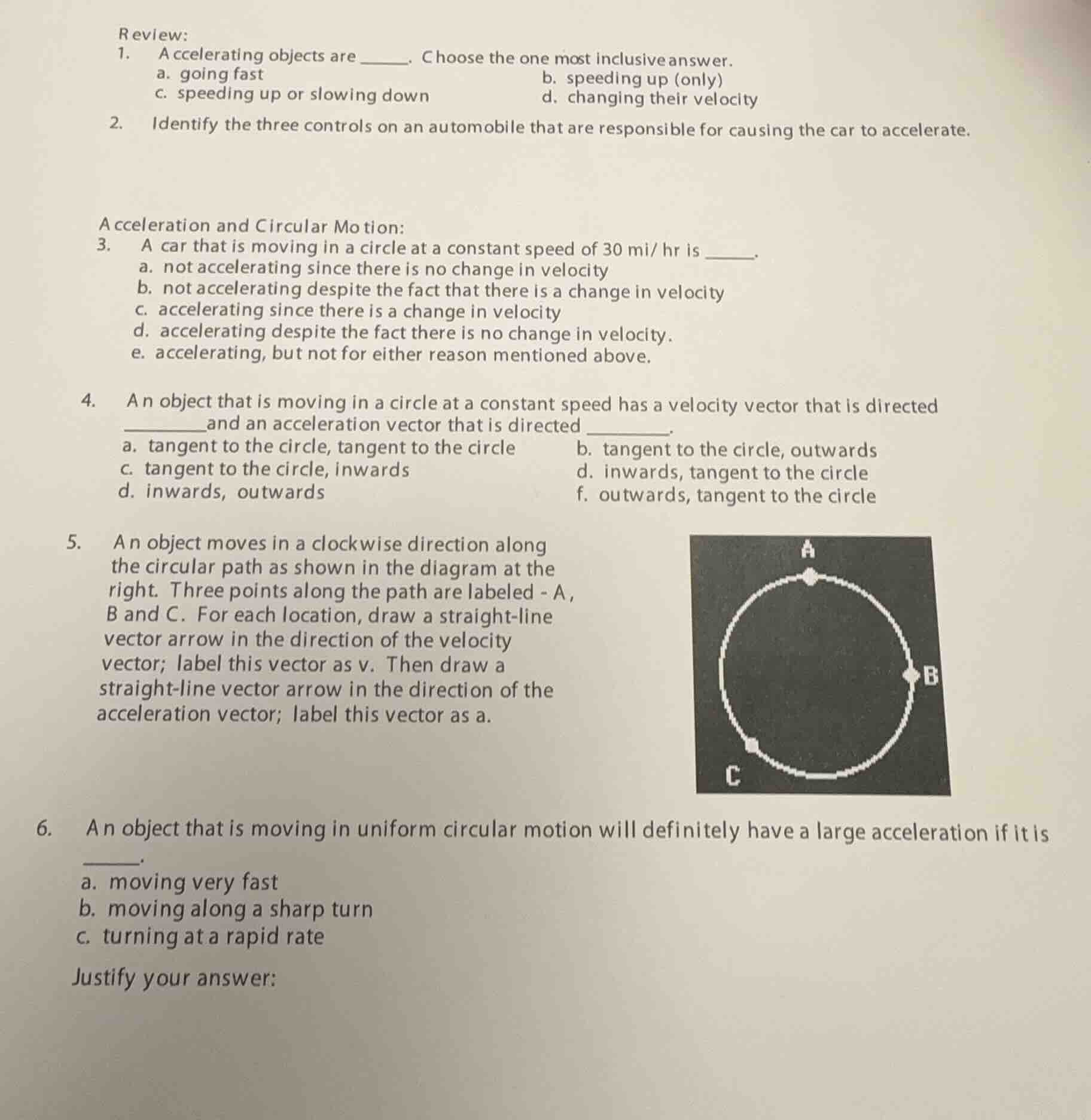
review: 1. accelerating objects are ____. choose the one most inclusive answer. a. going fast b. speeding up (only) c. speeding up or slowing down d. changing their velocity 2. identify the three controls on an automobile that are responsible for causing the car to accelerate. acceleration and circular motion: 3. a car that is moving in a circle at a constant speed of 30 mi/hr is __. a. not accelerating since there is no change in velocity b. not accelerating despite the fact that there is a change in velocity c. accelerating since there is a change in velocity d. accelerating despite the fact there is no change in velocity. e. accelerating, but not for either reason mentioned above. 4. an object that is moving in a circle at a constant speed has a velocity vector that is directed __ and an acceleration vector that is directed __. a. tangent to the circle, tangent to the circle b. tangent to the circle, outwards c. tangent to the circle, inwards d. inwards, tangent to the circle d. inwards, outwards f. outwards, tangent to the circle 5. an object moves in a clockwise direction along the circular path as shown in the diagram at the right. three points along the path are labeled - a, b and c. for each location, draw a straight - line vector arrow in the direction of the velocity vector; label this vector as v. then draw a straight - line vector arrow in the direction of the acceleration vector; label this vector as a. 6. an object that is moving in uniform circular motion will definitely have a large acceleration if it is ____. a. moving very fast b. moving along a sharp turn c. turning at a rapid rate justify your answer:
Step1: Define acceleration
Acceleration is defined as $\frac{\Delta v}{\Delta t}$, where $\Delta v$ is change in velocity (a vector, so change in speed or direction counts).
Step2: Solve Q1
Acceleration = any velocity change.
Q1 Answer: d. changing their velocity
Step3: Solve Q2
Car controls that change velocity: gas (speed up), brake (slow down), steering wheel (change direction).
Q2 Answer: Gas pedal, brake pedal, steering wheel
Step4: Solve Q3
Circular motion: direction changes, so velocity changes.
Q3 Answer: c. accelerating since there is a change in velocity
Step5: Solve Q4
Velocity = tangent to circle; acceleration = inwards (centripetal).
Q4 Answer: c. tangent to the circle, inwards
Step6: Solve Q5
For each point:
- Point A: $v$ points downward tangent; $a$ points inward to circle center.
- Point B: $v$ points left tangent; $a$ points inward to circle center.
- Point C: $v$ points upward tangent; $a$ points inward to circle center.
Step7: Solve Q6
Centripetal acceleration formula: $a_c = \frac{v^2}{r}$ or $a_c = \omega^2 r$ ($\omega$ = angular speed). Rapid turning = high $\omega$, so large $a_c$.
Q6 Justification: Centripetal acceleration depends on angular speed ($a_c=\omega^2 r$); rapid turning means high $\omega$, which directly increases acceleration. Speed alone (a) depends on radius, sharp turn (b) depends on speed, but rapid turning (c) guarantees high angular rate for large acceleration.
Q6 Answer: c. turning at a rapid rate

Snap & solve any problem in the app
Get step-by-step solutions on Sovi AI
Photo-based solutions with guided steps
Explore more problems and detailed explanations
- d. changing their velocity
- Gas pedal, brake pedal, steering wheel
- c. accelerating since there is a change in velocity
- c. tangent to the circle, inwards
5.
- Point A: Velocity vector ($v$) points downward tangent to the circle; acceleration vector ($a$) points inward toward the circle's center.
- Point B: Velocity vector ($v$) points left tangent to the circle; acceleration vector ($a$) points inward toward the circle's center.
- Point C: Velocity vector ($v$) points upward tangent to the circle; acceleration vector ($a$) points inward toward the circle's center.
- c. turning at a rapid rate
Justification: Centripetal acceleration is given by $a_c=\omega^2 r$, where $\omega$ is angular speed. Rapid turning means a high angular speed, which directly results in a large centripetal acceleration. High speed (a) or sharp turns (b) do not guarantee large acceleration without additional context, but a rapid turning rate ensures a large angular speed and thus large acceleration.