QUESTION IMAGE
Question
review for midterm, ws#6
bonding
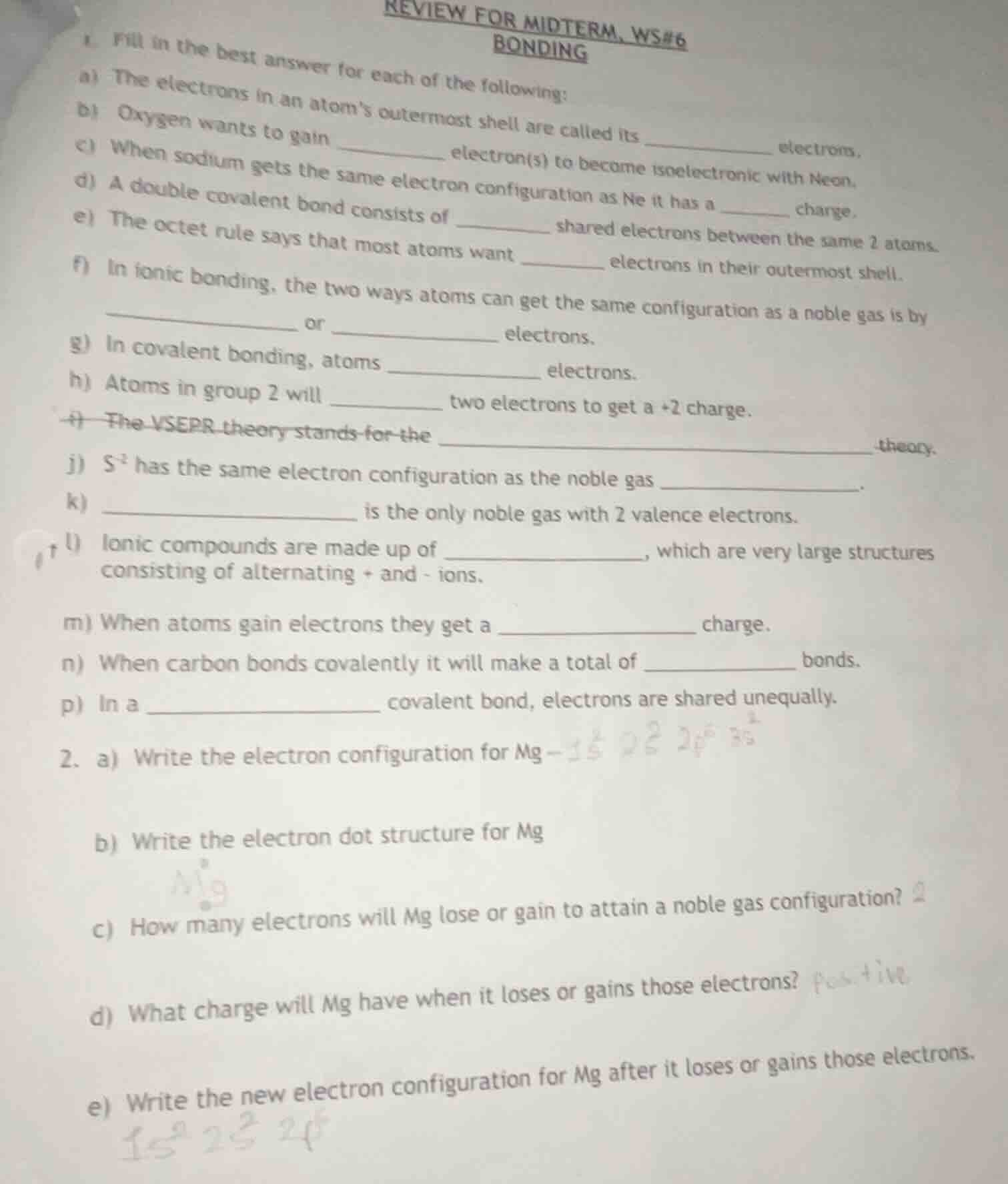
- fill in the best answer for each of the following:
a) the electrons in an atom’s outermost shell are called its ______ electrons.
b) oxygen wants to gain ______ electron(s) to become isoelectronic with neon.
c) when sodium gets the same electron configuration as ne it has a ______ charge.
d) a double covalent bond consists of ______ shared electrons between the same 2 atoms.
e) the octet rule says that most atoms want ______ electrons in their outermost shell.
f) in ionic bonding, the two ways atoms can get the same configuration as a noble gas is by ____ or ____ electrons.
g) in covalent bonding, atoms ______ electrons.
h) atoms in group 2 will ______ two electrons to get a +2 charge.
j) ( s^{2-} ) has the same electron configuration as the noble gas ______.
k) ______ is the only noble gas with 2 valence electrons.
l) ionic compounds are made up of ______, which are very large structures consisting of alternating + and - ions.
m) when atoms gain electrons they get a ______ charge.
n) when carbon bonds covalently it will make a total of ______ bonds.
p) in a ______ covalent bond, electrons are shared unequally.
- a) write the electron configuration for mg
b) write the electron dot structure for mg
c) how many electrons will mg lose or gain to attain a noble gas configuration?
d) what charge will mg have when it loses or gains those electrons?
e) write the new electron configuration for mg after it loses or gains those electrons.
Step1: Fill in part a
Valence electrons are outermost shell electrons.
Step2: Fill in part b
Oxygen has 6 valence electrons; needs 2 to reach 8.
Step3: Fill in part c
Sodium loses 1 electron, gets +1 charge.
Step4: Fill in part d
Double bond = 2 pairs = 4 shared electrons.
Step5: Fill in part e
Octet rule refers to 8 outer electrons.
Step6: Fill in part f
Ionic bonding: gain or lose electrons.
Step7: Fill in part g
Covalent bonding: share electrons.
Step8: Fill in part h
Group 2 atoms lose electrons for +2 charge.
Step9: Fill in part i
VSEPR = Valence Shell Electron Pair Repulsion.
Step10: Fill in part j
S²⁻ has same config as Argon (Ar).
Step11: Fill in part k
Helium (He) has 2 valence electrons.
Step12: Fill in part l
Ionic compounds form crystal lattices.
Step13: Fill in part m
Gaining electrons gives negative charge.
Step14: Fill in part n
Carbon forms 4 covalent bonds.
Step15: Fill in part p
Polar covalent bonds have unequal sharing.
Step16: Solve 2a: Mg electron config
Magnesium (atomic #12): $1s^2 2s^2 2p^6 3s^2$
Step17: Solve 2b: Mg electron dot
Mg has 2 valence electrons: $\ce{:\!Mg:}$
Step18: Solve 2c: Mg electron change
Mg loses 2 electrons for noble gas config.
Step19: Solve 2d: Mg ion charge
Losing 2 electrons gives +2 charge.
Step20: Solve 2e: Mg ion config
After losing 2 electrons: $1s^2 2s^2 2p^6$

Snap & solve any problem in the app
Get step-by-step solutions on Sovi AI
Photo-based solutions with guided steps
Explore more problems and detailed explanations
1.
a) valence
b) 2
c) +1
d) 4
e) 8
f) gaining; losing
g) share
h) lose
i) Valence Shell Electron Pair Repulsion
j) Argon (Ar)
k) Helium (He)
l) crystal lattices
m) negative (-)
n) 4
p) polar
2.
a) $1s^2 2s^2 2p^6 3s^2$
b) $\ce{:\!Mg:}$
c) Lose 2 electrons
d) +2
e) $1s^2 2s^2 2p^6$