QUESTION IMAGE
Question
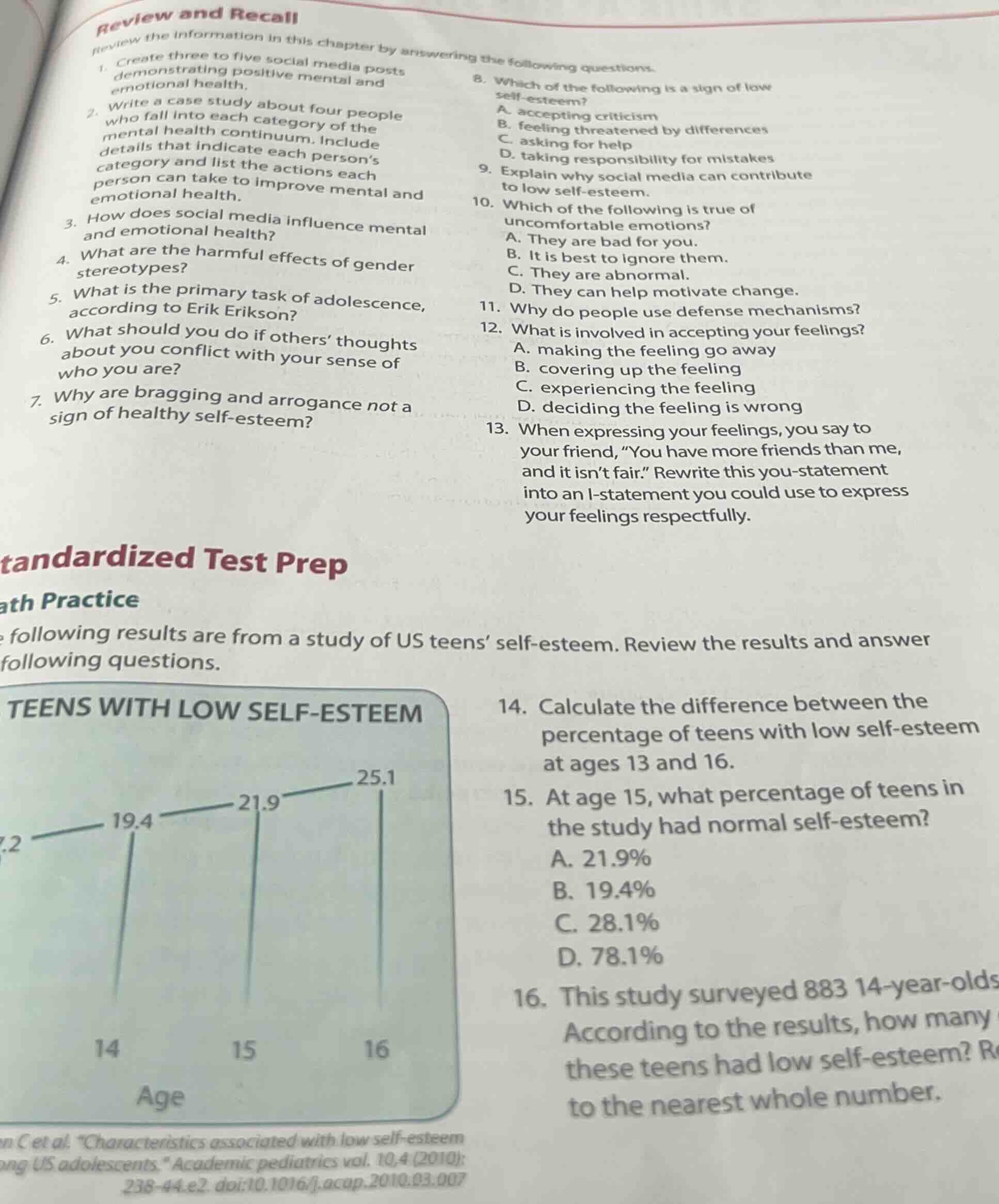
review and recallreview the information in this chapter by answering the following questions.1. create three to five social media posts demonstrating positive mental and emotional health.2. write a case study about four people who fall into each category of the mental health continuum. include details that indicate each persons category and list the actions each person can take to improve mental and emotional health.3. how does social media influence mental and emotional health?4. what are the harmful effects of gender stereotypes?5. what is the primary task of adolescence, according to erik erikson?6. what should you do if others thoughts about you conflict with your sense of who you are?7. why are bragging and arrogance not a sign of healthy self-esteem?8. which of the following is a sign of low self-esteem?a. accepting criticismb. feeling threatened by differencesc. asking for helpd. taking responsibility for mistakes9. explain why social media can contribute to low self-esteem.10. which of the following is true of uncomfortable emotions?a. they are bad for you.b. it is best to ignore them.c. they are abnormal.d. they can help motivate change.11. why do people use defense mechanisms?12. what is involved in accepting your feelings?a. making the feeling go awayb. covering up the feelingc. experiencing the feelingd. deciding the feeling is wrong13. when expressing your feelings, you say to your friend, \you have more friends than me, and it isnt fair.\ rewrite this you-statement into an i-statement you could use to express your feelings respectfully.standardized test prepath practicefollowing results are from a study of us teens self-esteem. review the results and answer following questions.teens with low self-esteem14. calculate the difference between the percentage of teens with low self-esteem at ages 13 and 16.15. at age 15, what percentage of teens in the study had normal self-esteem?a. 21.9%b. 19.4%c. 28.1%d. 78.1%16. this study surveyed 883 14-year-olds. according to the results, how many of these teens had low self-esteem? round to the nearest whole number.n c et al. \characteristics associated with low self-esteemong us adolescents.\ academic pediatrics vol. 10,4 (2010):238-44.e2. doi:10.1016/j.acap.2010.03.007
For Questions 8, 10, 12 (Multiple Choice):
- Q8: Low self-esteem involves feeling threatened by others' differences, as it reflects insecurity about one's own worth.
- Q10: Uncomfortable emotions signal unmet needs, which can motivate positive change.
- Q12: Accepting feelings means acknowledging and experiencing them instead of suppressing or denying them.
Step1: Note missing 13yo low self-esteem %
The graph does not include data for 13-year-olds, so this value is unavailable.
Step2: Calculate normal self-esteem (15yo)
Normal self-esteem = $100\% - 21.9\%$
Step3: Calculate low self-esteem count (14yo)
Number = $883 \times 19.4\%$
Social media often features curated, idealized content that can lead to unfair comparisons. Users may feel their own life, appearance, or achievements are inadequate relative to others' posts, eroding self-worth. It can also facilitate cyberbullying, negative feedback, or social exclusion, all of which lower self-esteem.

Snap & solve any problem in the app
Get step-by-step solutions on Sovi AI
Photo-based solutions with guided steps
Explore more problems and detailed explanations
- B. feeling threatened by differences
- D. They can help motivate change.
- C. experiencing the feeling
---