QUESTION IMAGE
Question
the roman catholic church
in medieval society
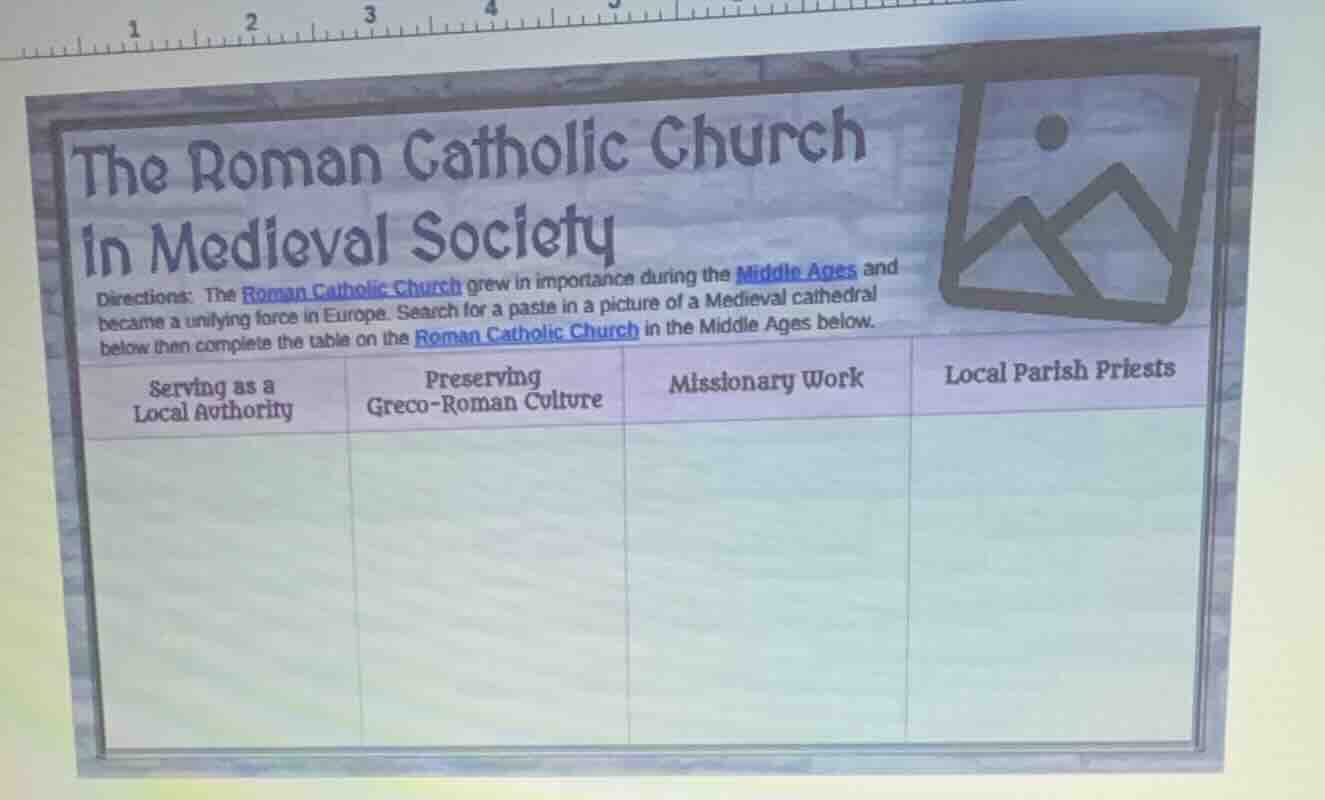
directions: the roman catholic church grew in importance during the middle ages and
became a unifying force in europe. search for a paste in a picture of a medieval cathedral
below then complete the table on the roman catholic church in the middle ages below.
serving as a
local authority | preserving
greco-roman culture | missionary work | local parish priests
- Serving as a Local Authority: The Church acted as a local governing body, resolving disputes, enforcing moral rules, and managing local resources like land, filling the power gap left by fragmented medieval kingdoms.
- Preserving Greco-Roman Culture: Monks in monasteries copied and preserved ancient Greek and Roman texts (philosophy, science, literature) that would have otherwise been lost, and taught classical knowledge in Church schools.
- Missionary Work: Missionaries like Saint Patrick and Saint Boniface traveled to pagan regions of Europe (e.g., Ireland, Germany) to convert local populations to Christianity, spreading Church influence and unifying diverse groups under the faith.
- Local Parish Priests: They were the main point of contact between the Church and ordinary people, leading weekly worship, administering sacraments (baptism, communion), providing spiritual guidance, and helping the poor and sick in local communities.
Additionally, a key example of a medieval cathedral to include is Notre-Dame Cathedral (Paris)—a Gothic-style cathedral, iconic of medieval religious architecture with flying buttresses, stained glass, and grand spires, representing the Church's wealth, power, and artistic influence in the Middle Ages.

Snap & solve any problem in the app
Get step-by-step solutions on Sovi AI
Photo-based solutions with guided steps
Explore more problems and detailed explanations
| Category | Details |
|---|---|
| Preserving Greco-Roman Culture | Monasteries copied ancient texts; Church schools taught classical philosophy/science; preserved Latin language. |
| Missionary Work | Converted pagan European groups (e.g., Germanic, Celtic peoples); spread Christian doctrine and Church influence across the continent. |
| Local Parish Priests | Led weekly worship, administered sacraments, provided spiritual support, aided local poor/sick, connected villagers to the wider Church. |
| Medieval Cathedral Example | Notre-Dame Cathedral (Paris): Gothic architectural landmark with flying buttresses, stained glass, and grand design, symbolizing the Church's medieval power and artistry. |