QUESTION IMAGE
Question
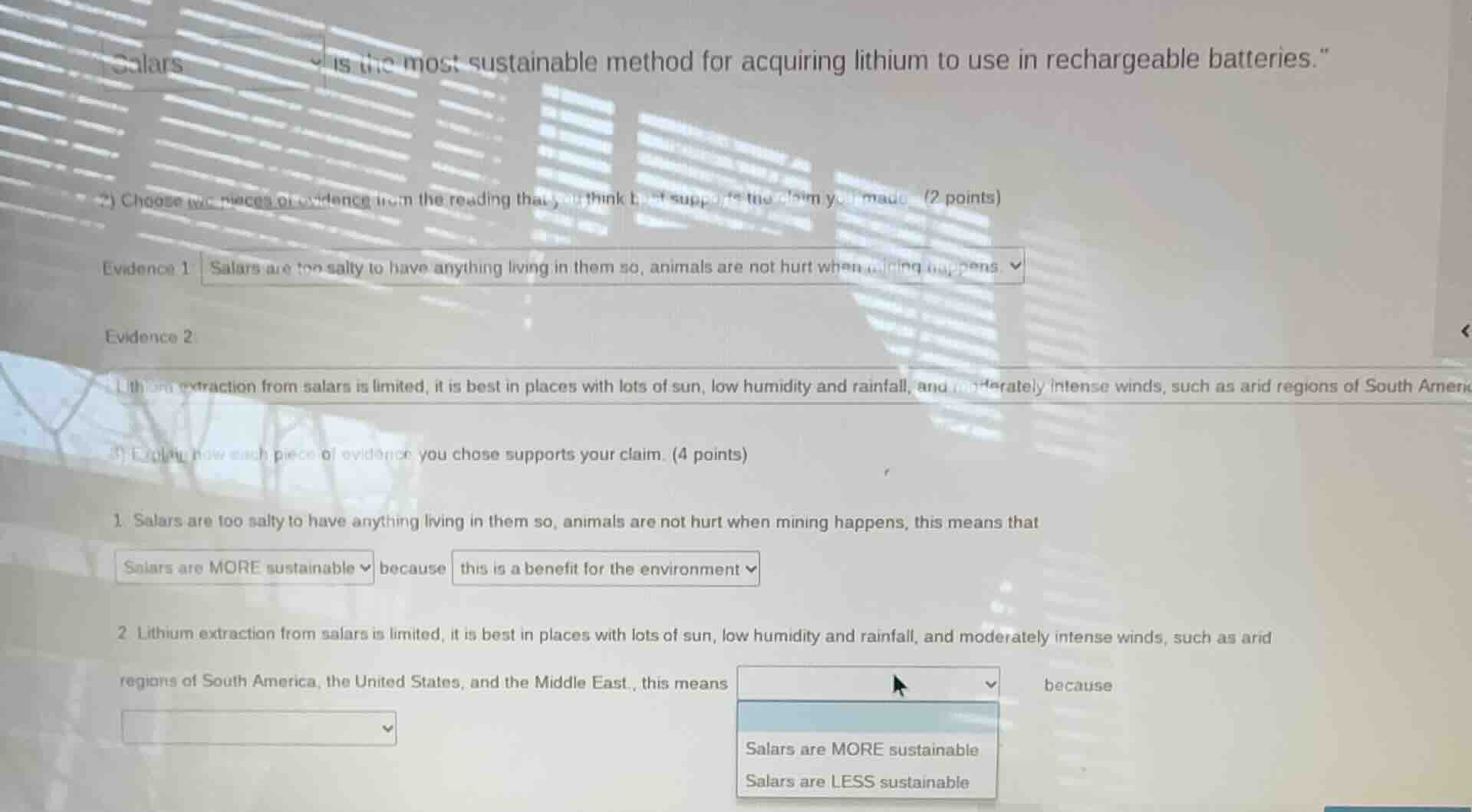
salars is the most sustainable method for acquiring lithium to use in rechargeable batteries.\
- choose two pieces of evidence from the reading that you think best support the claim you made. (2 points)
evidence 1: salars are too salty to have anything living in them so, animals are not hurt when mining happens.
evidence 2:
lithium extraction from salars is limited, it is best in places with lots of sun, low humidity and rainfall, and moderately intense winds, such as arid regions of south america
- explain how each piece of evidence you chose supports your claim. (4 points)
- salars are too salty to have anything living in them so, animals are not hurt when mining happens, this means that
salars are more sustainable because this is a benefit for the environment
- lithium extraction from salars is limited, it is best in places with lots of sun, low humidity and rainfall, and moderately intense winds, such as arid
regions of south america, the united states, and the middle east, this means ▼ because
▼
salars are more sustainable
salars are less sustainable
To solve this, we analyze the evidence about lithium extraction from salars:
For the dropdown (first part of the second explanation):
The evidence says extraction is “limited” and works in places with natural conditions (sun, low humidity, etc.). Sustainable methods often have limited environmental impact or use natural resources efficiently. So this supports that salars are more sustainable. Thus, we choose "Salars are MORE sustainable".
For the reason (second part of the second explanation):
The extraction uses natural conditions (sun, wind) and is limited, which means it likely has less environmental harm (e.g., no need for heavy industrial processes, relies on natural evaporation). So the reason ties to environmental benefits or efficient use of natural factors, like "it uses natural conditions (sun, wind) and limited extraction reduces environmental strain".
Filling the blanks:
- The first dropdown (after "this means"): Salars are MORE sustainable
- The reason (after "because"): For example, "it relies on natural conditions (sun, wind) and limited extraction reduces environmental impact" (or similar logic about sustainability from natural processes/limited extraction).
(Note: The exact wording for the "because" part can vary but should connect the evidence—limited extraction, natural conditions—to sustainability, e.g., "it uses natural resources (sun, wind) and limited extraction minimizes environmental disruption".)

Snap & solve any problem in the app
Get step-by-step solutions on Sovi AI
Photo-based solutions with guided steps
Explore more problems and detailed explanations
To solve this, we analyze the evidence about lithium extraction from salars:
For the dropdown (first part of the second explanation):
The evidence says extraction is “limited” and works in places with natural conditions (sun, low humidity, etc.). Sustainable methods often have limited environmental impact or use natural resources efficiently. So this supports that salars are more sustainable. Thus, we choose "Salars are MORE sustainable".
For the reason (second part of the second explanation):
The extraction uses natural conditions (sun, wind) and is limited, which means it likely has less environmental harm (e.g., no need for heavy industrial processes, relies on natural evaporation). So the reason ties to environmental benefits or efficient use of natural factors, like "it uses natural conditions (sun, wind) and limited extraction reduces environmental strain".
Filling the blanks:
- The first dropdown (after "this means"): Salars are MORE sustainable
- The reason (after "because"): For example, "it relies on natural conditions (sun, wind) and limited extraction reduces environmental impact" (or similar logic about sustainability from natural processes/limited extraction).
(Note: The exact wording for the "because" part can vary but should connect the evidence—limited extraction, natural conditions—to sustainability, e.g., "it uses natural resources (sun, wind) and limited extraction minimizes environmental disruption".)