QUESTION IMAGE
Question
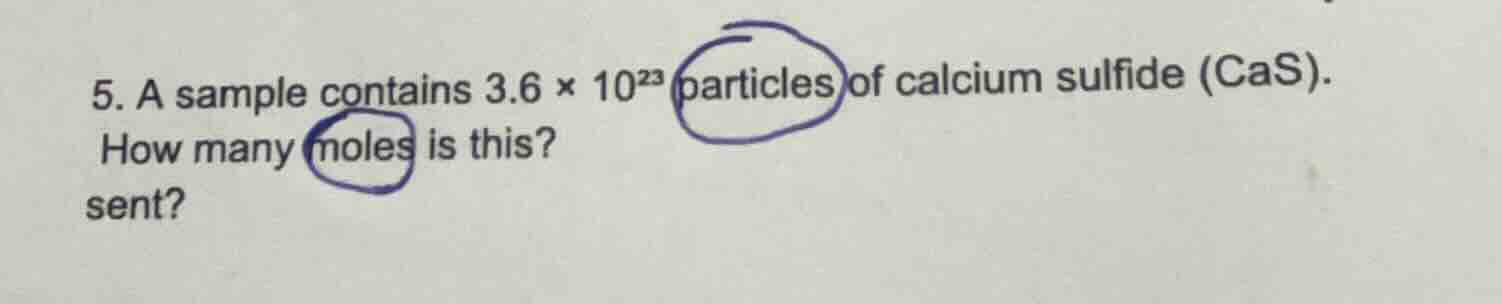
- a sample contains $3.6 \times 10^{23}$ particles of calcium sulfide (cas). how many moles is this? sent?
Step1: Recall the formula for moles from particles
The formula to calculate moles (\(n\)) from the number of particles (\(N\)) is \(n=\frac{N}{N_A}\), where \(N_A\) is Avogadro's number (\(6.02\times 10^{23}\) particles/mol).
Step2: Substitute the given values
We are given \(N = 3.6\times 10^{23}\) particles and \(N_A=6.02\times 10^{23}\) particles/mol. Substituting these values into the formula:
\(n=\frac{3.6\times 10^{23}}{6.02\times 10^{23}}\)
Step3: Perform the calculation
Simplify the expression. The \(10^{23}\) terms cancel out, and we have \(\frac{3.6}{6.02}\approx0.60\) (rounded to two decimal places).

Snap & solve any problem in the app
Get step-by-step solutions on Sovi AI
Photo-based solutions with guided steps
Explore more problems and detailed explanations
Approximately \(0.60\) moles.