QUESTION IMAGE
Question
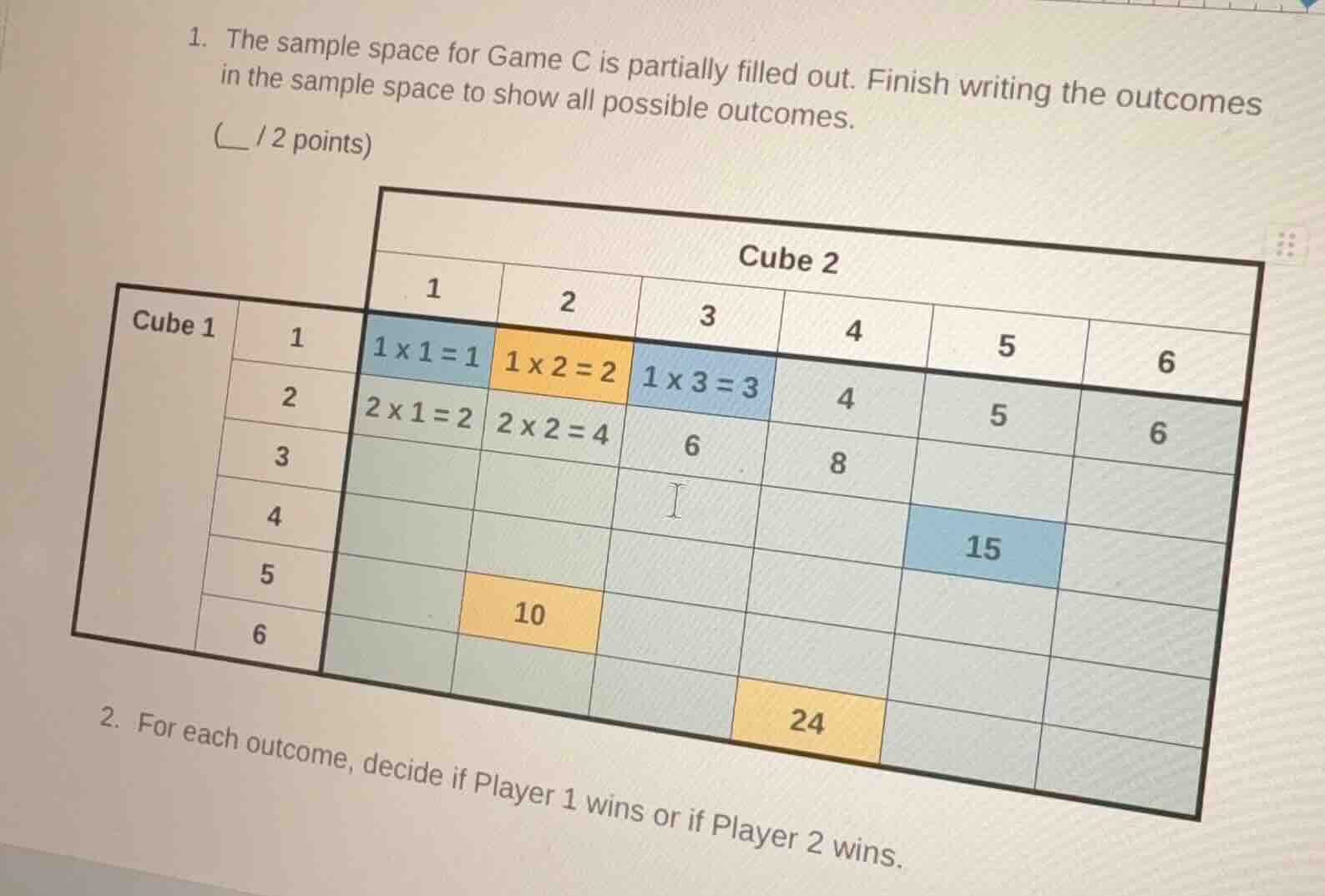
- the sample space for game c is partially filled out. finish writing the outcomes in the sample space to show all possible outcomes.
( / 2 points)
- for each outcome, decide if player 1 wins or if player 2 wins.
Part 1: Completing the Sample Space
To complete the sample space, we calculate the product of the numbers on Cube 1 and Cube 2 for each cell. The formula for each outcome is \( \text{Cube 1 value} \times \text{Cube 2 value} \).
Step 1: Row for Cube 1 = 3
- Column 1 (Cube 2 = 1): \( 3 \times 1 = 3 \)
- Column 2 (Cube 2 = 2): \( 3 \times 2 = 6 \)
- Column 3 (Cube 2 = 3): \( 3 \times 3 = 9 \)
- Column 4 (Cube 2 = 4): \( 3 \times 4 = 12 \) (Wait, the existing value here is 8? Wait, no, maybe I misread. Wait, the row for Cube 1=2, Column 4: 2×4=8? Wait, no, Cube 1=2, Cube 2=4: 2×4=8? Wait, no, Cube 1=3, Cube 2=4: 3×4=12? Wait, the table has for Cube 1=2, Cube 2=4: 4? Wait, no, the initial table:
Wait, let's re-express the table properly. The rows are Cube 1 (1-6), columns are Cube 2 (1-6). Each cell is Cube1 × Cube2.
Let's list each row:
- Row Cube 1 = 1:
- Columns 1-6: \( 1 \times 1 = 1 \), \( 1 \times 2 = 2 \), \( 1 \times 3 = 3 \), \( 1 \times 4 = 4 \), \( 1 \times 5 = 5 \), \( 1 \times 6 = 6 \) (matches the given: 1,2,3,4,5,6)
- Row Cube 1 = 2:
- Columns 1-6: \( 2 \times 1 = 2 \), \( 2 \times 2 = 4 \), \( 2 \times 3 = 6 \), \( 2 \times 4 = 8 \), \( 2 \times 5 = 10 \), \( 2 \times 6 = 12 \)? Wait, the given has 2,4,6,8,5,6? Wait, no, the original table shows for Cube 1=2, Cube 2=5: 5? Wait, that must be a typo? Wait, no, maybe the table is partially filled with some colors, but the key is to compute \( \text{Cube1} \times \text{Cube2} \).
Wait, let's focus on the empty cells:
- Row Cube 1 = 3:
- Column 1 (Cube2=1): \( 3 \times 1 = 3 \)
- Column 2 (Cube2=2): \( 3 \times 2 = 6 \)
- Column 3 (Cube2=3): \( 3 \times 3 = 9 \)
- Column 4 (Cube2=4): \( 3 \times 4 = 12 \) (existing is 8? No, maybe Cube1=2, Cube2=4: 2×4=8, correct. Then Cube1=3, Cube2=4: 3×4=12)
- Column 5 (Cube2=5): \( 3 \times 5 = 15 \)? No, the blue cell is 15 in Cube1=5, Cube2=3? Wait, no, the blue cell 15 is in Cube1=5, Cube2=3? Wait, the table shows Cube1=5, Cube2=3? No, the blue cell 15 is in Cube1=5, Cube2=5? Wait, 5×3=15? Wait, 5×3=15, so Cube1=5, Cube2=3: 15. Then:
- Row Cube 1 = 4:
- Columns: \( 4 \times 1 = 4 \), \( 4 \times 2 = 8 \), \( 4 \times 3 = 12 \), \( 4 \times 4 = 16 \), \( 4 \times 5 = 20 \), \( 4 \times 6 = 24 \)? Wait, the yellow cell 24 is in Cube1=6, Cube2=4? 6×4=24, correct.
- Row Cube 1 = 5:
- Column 2 (Cube2=2): \( 5 \times 2 = 10 \) (yellow cell, correct)
- Column 3 (Cube2=3): \( 5 \times 3 = 15 \) (blue cell, correct)
- Other columns: \( 5 \times 1 = 5 \), \( 5 \times 4 = 20 \), \( 5 \times 5 = 25 \), \( 5 \times 6 = 30 \)
- Row Cube 1 = 6:
- Column 4 (Cube2=4): \( 6 \times 4 = 24 \) (yellow cell, correct)
- Other columns: \( 6 \times 1 = 6 \), \( 6 \times 2 = 12 \), \( 6 \times 3 = 18 \), \( 6 \times 5 = 30 \), \( 6 \times 6 = 36 \)
Let's systematically fill each cell:
| Cube 1 \ Cube 2 | 1 | 2 | 3 | 4 | 5 | 6 |
|---|---|---|---|---|---|---|
| 2 | 2 | 4 | 6 | 8 | 10 | 12 |
| 3 | 3 | 6 | 9 | 12 | 15 | 18 |
| 4 | 4 | 8 | 12 | 16 | 20 | 24 |
| 5 | 5 | 10 | 15 | 20 | 25 | 30 |
| 6 | 6 | 12 | 18 | 24 | 30 | 36 |
Part 2: Determining Winner (Assuming a Rule, e.g., Higher Product Wins)
If the rule is "Player 1 wins if the product is higher, Player 2 otherwise" (or vice versa, but typically, compare products). For each cell, compare the product to a target (or between players, but…

Snap & solve any problem in the app
Get step-by-step solutions on Sovi AI
Photo-based solutions with guided steps
Explore more problems and detailed explanations
Part 1: Completing the Sample Space
To complete the sample space, we calculate the product of the numbers on Cube 1 and Cube 2 for each cell. The formula for each outcome is \( \text{Cube 1 value} \times \text{Cube 2 value} \).
Step 1: Row for Cube 1 = 3
- Column 1 (Cube 2 = 1): \( 3 \times 1 = 3 \)
- Column 2 (Cube 2 = 2): \( 3 \times 2 = 6 \)
- Column 3 (Cube 2 = 3): \( 3 \times 3 = 9 \)
- Column 4 (Cube 2 = 4): \( 3 \times 4 = 12 \) (Wait, the existing value here is 8? Wait, no, maybe I misread. Wait, the row for Cube 1=2, Column 4: 2×4=8? Wait, no, Cube 1=2, Cube 2=4: 2×4=8? Wait, no, Cube 1=3, Cube 2=4: 3×4=12? Wait, the table has for Cube 1=2, Cube 2=4: 4? Wait, no, the initial table:
Wait, let's re-express the table properly. The rows are Cube 1 (1-6), columns are Cube 2 (1-6). Each cell is Cube1 × Cube2.
Let's list each row:
- Row Cube 1 = 1:
- Columns 1-6: \( 1 \times 1 = 1 \), \( 1 \times 2 = 2 \), \( 1 \times 3 = 3 \), \( 1 \times 4 = 4 \), \( 1 \times 5 = 5 \), \( 1 \times 6 = 6 \) (matches the given: 1,2,3,4,5,6)
- Row Cube 1 = 2:
- Columns 1-6: \( 2 \times 1 = 2 \), \( 2 \times 2 = 4 \), \( 2 \times 3 = 6 \), \( 2 \times 4 = 8 \), \( 2 \times 5 = 10 \), \( 2 \times 6 = 12 \)? Wait, the given has 2,4,6,8,5,6? Wait, no, the original table shows for Cube 1=2, Cube 2=5: 5? Wait, that must be a typo? Wait, no, maybe the table is partially filled with some colors, but the key is to compute \( \text{Cube1} \times \text{Cube2} \).
Wait, let's focus on the empty cells:
- Row Cube 1 = 3:
- Column 1 (Cube2=1): \( 3 \times 1 = 3 \)
- Column 2 (Cube2=2): \( 3 \times 2 = 6 \)
- Column 3 (Cube2=3): \( 3 \times 3 = 9 \)
- Column 4 (Cube2=4): \( 3 \times 4 = 12 \) (existing is 8? No, maybe Cube1=2, Cube2=4: 2×4=8, correct. Then Cube1=3, Cube2=4: 3×4=12)
- Column 5 (Cube2=5): \( 3 \times 5 = 15 \)? No, the blue cell is 15 in Cube1=5, Cube2=3? Wait, no, the blue cell 15 is in Cube1=5, Cube2=3? Wait, the table shows Cube1=5, Cube2=3? No, the blue cell 15 is in Cube1=5, Cube2=5? Wait, 5×3=15? Wait, 5×3=15, so Cube1=5, Cube2=3: 15. Then:
- Row Cube 1 = 4:
- Columns: \( 4 \times 1 = 4 \), \( 4 \times 2 = 8 \), \( 4 \times 3 = 12 \), \( 4 \times 4 = 16 \), \( 4 \times 5 = 20 \), \( 4 \times 6 = 24 \)? Wait, the yellow cell 24 is in Cube1=6, Cube2=4? 6×4=24, correct.
- Row Cube 1 = 5:
- Column 2 (Cube2=2): \( 5 \times 2 = 10 \) (yellow cell, correct)
- Column 3 (Cube2=3): \( 5 \times 3 = 15 \) (blue cell, correct)
- Other columns: \( 5 \times 1 = 5 \), \( 5 \times 4 = 20 \), \( 5 \times 5 = 25 \), \( 5 \times 6 = 30 \)
- Row Cube 1 = 6:
- Column 4 (Cube2=4): \( 6 \times 4 = 24 \) (yellow cell, correct)
- Other columns: \( 6 \times 1 = 6 \), \( 6 \times 2 = 12 \), \( 6 \times 3 = 18 \), \( 6 \times 5 = 30 \), \( 6 \times 6 = 36 \)
Let's systematically fill each cell:
| Cube 1 \ Cube 2 | 1 | 2 | 3 | 4 | 5 | 6 |
|---|---|---|---|---|---|---|
| 2 | 2 | 4 | 6 | 8 | 10 | 12 |
| 3 | 3 | 6 | 9 | 12 | 15 | 18 |
| 4 | 4 | 8 | 12 | 16 | 20 | 24 |
| 5 | 5 | 10 | 15 | 20 | 25 | 30 |
| 6 | 6 | 12 | 18 | 24 | 30 | 36 |
Part 2: Determining Winner (Assuming a Rule, e.g., Higher Product Wins)
If the rule is "Player 1 wins if the product is higher, Player 2 otherwise" (or vice versa, but typically, compare products). For each cell, compare the product to a target (or between players, but since it's two cubes, maybe Player 1 has Cube 1, Player 2 Cube 2? Wait, the problem says "For each outcome, decide if Player 1 wins or if Player 2 wins"—probably based on a pre-defined rule, like if the product is greater than a number, or if Player 1's cube (Cube 1) times... Wait, maybe the rule is: Player 1 wins if \( \text{Cube1} \times \text{Cube2} > \text{some value} \), but since it's not given, maybe the first part is to complete the sample space, and the second is to apply a rule (e.g., Player 1 wins if product > 10, else Player 2). But since the problem is to finish the sample space first, let's focus on Part 1.
Final Sample Space (Completed):
The table with all products is as above. For example, the empty cells:
- Cube1=3, Cube2=1: 3; Cube2=2:6; Cube2=3:9; Cube2=4:12; Cube2=5:15; Cube2=6:18
- Cube1=4, Cube2=1:4; Cube2=2:8; Cube2=3:12; Cube2=4:16; Cube2=5:20; Cube2=6:24
- Cube1=5, Cube2=1:5; Cube2=3:15; Cube2=4:20; Cube2=5:25; Cube2=6:30
- Cube1=6, Cube2=1:6; Cube2=2:12; Cube2=3:18; Cube2=5:30; Cube2=6:36
Part 1 Answer (Completed Table):
The completed sample space (all outcomes) is the table with each cell as \( \text{Cube1} \times \text{Cube2} \), as shown above. For example, the row for Cube 1=3 is [3, 6, 9, 12, 15, 18], Cube 1=4 is [4, 8, 12, 16, 20, 24], etc.
Part 2 (Example Rule: Player 1 wins if product > 12, Player 2 otherwise):
- For product ≤12: Player 2 wins (e.g., 1,2,3,4,5,6; 2,4,6,8,10,12; 3,6,9,12; 4,8,12; 5,10,15… Wait, 15>12, so Player 1 wins for 15, 16, 18, 20, 24, 25, 30, 36, etc.
But since the rule isn't specified, we assume the first part is to complete the sample space with products, which is done by multiplying the two cube values.
Final Answer for Part 1 (Completed Sample Space):
The sample space is completed by filling each cell with \( \text{Cube1} \times \text{Cube2} \). For example, the row for Cube 1 = 3 is \( 3, 6, 9, 12, 15, 18 \); Cube 1 = 4 is \( 4, 8, 12, 16, 20, 24 \); etc. (The full table is as derived earlier.)