QUESTION IMAGE
Question
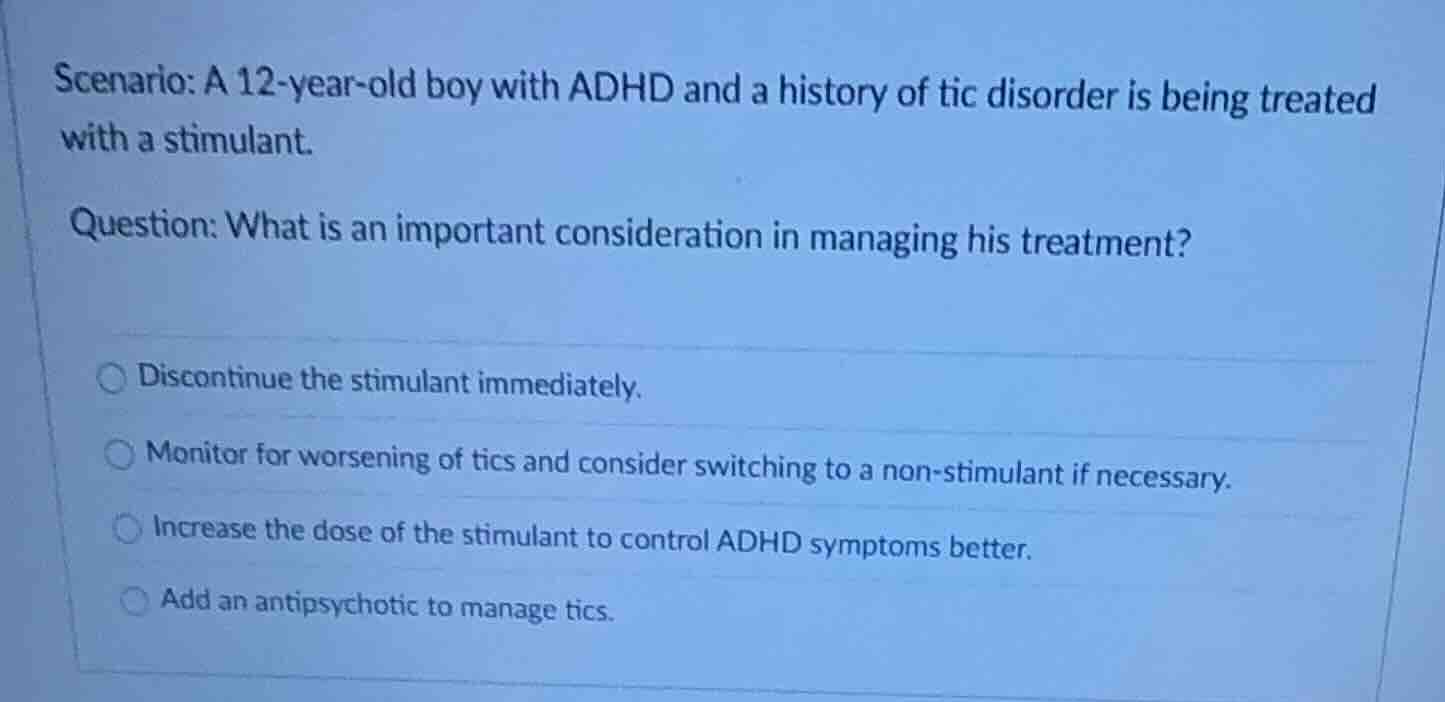
scenario: a 12-year-old boy with adhd and a history of tic disorder is being treated with a stimulant.
question: what is an important consideration in managing his treatment?
- discontinue the stimulant immediately.
- monitor for worsening of tics and consider switching to a non - stimulant if necessary.
- increase the dose of the stimulant to control adhd symptoms better.
- add an antipsychotic to manage tics.
Brief Explanations
- For the option "Discontinue the stimulant immediately": Abruptly stopping stimulants can cause rebound ADHD symptoms and isn't the first step; so this is incorrect.
- For the option "Monitor for worsening of tics and consider switching to a non - stimulant if necessary": Stimulants can sometimes exacerbate tics. Monitoring tics and being ready to switch to a non - stimulant (like atomoxetine) if tics worsen is a standard approach in managing ADHD with a history of tic disorder.
- For the option "Increase the dose of the stimulant to control ADHD symptoms better": Increasing the stimulant dose is likely to increase the risk of worsening tics, so this is not a good approach.
- For the option "Add an antipsychotic to manage tics": Antipsychotics have significant side effects and are not the first - line approach for managing tics in this context; non - stimulants for ADHD or adjusting the stimulant approach is preferred first.

Snap & solve any problem in the app
Get step-by-step solutions on Sovi AI
Photo-based solutions with guided steps
Explore more problems and detailed explanations
B. Monitor for worsening of tics and consider switching to a non - stimulant if necessary.