QUESTION IMAGE
Question
science 30 unit d: energy and the environment
harvesting chemical energy and hess’s law
assignment
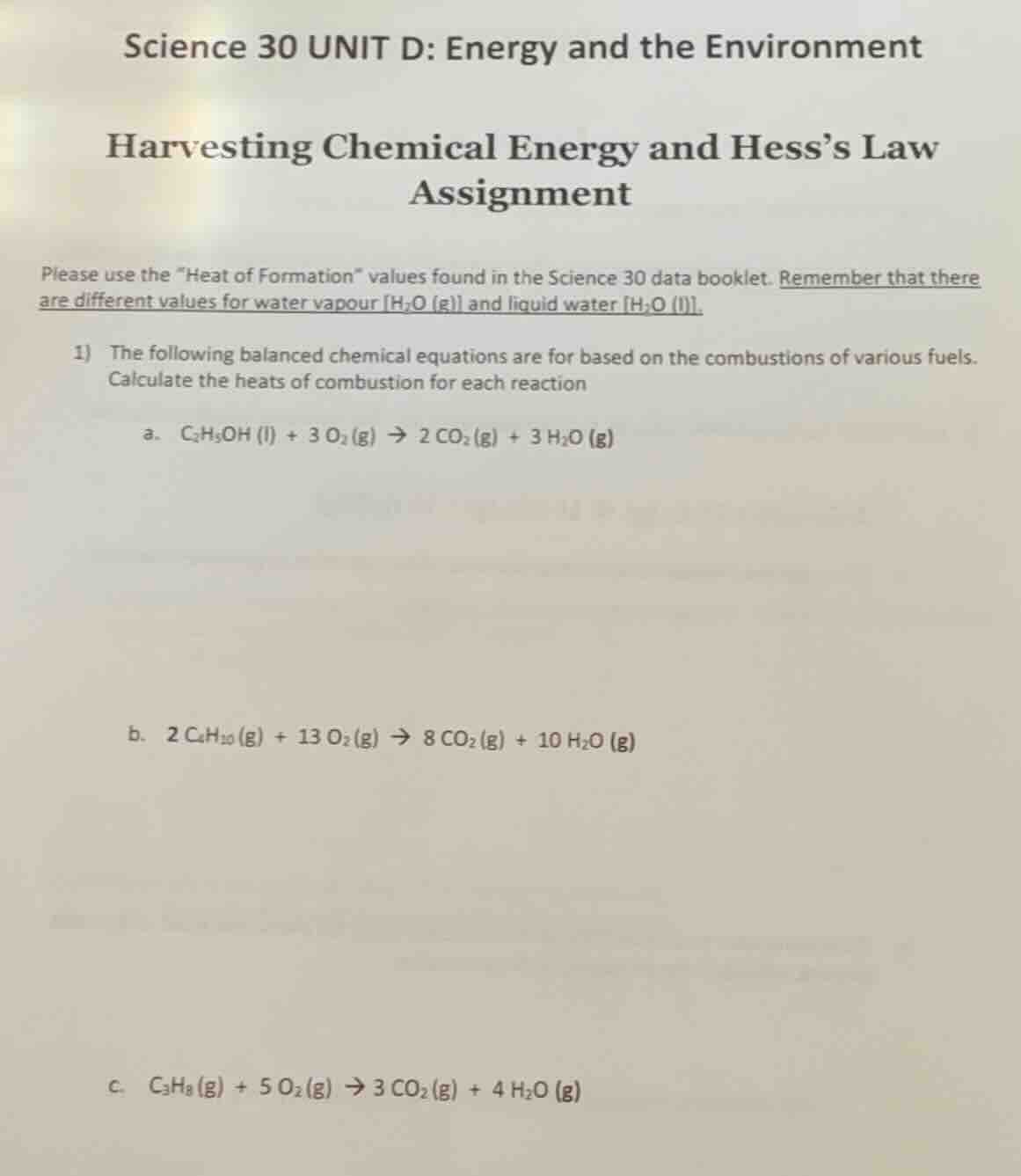
please use the \heat of formation\ values found in the science 30 data booklet. remember that there are different values for water vapour h₂o (g) and liquid water h₂o (l).
- the following balanced chemical equations are for based on the combustions of various fuels. calculate the heats of combustion for each reaction
a. c₂h₅oh (l) + 3 o₂ (g) → 2 co₂ (g) + 3 h₂o (g)
b. 2 c₄h₁₀ (g) + 13 o₂ (g) → 8 co₂ (g) + 10 h₂o (g)
c. c₃h₈ (g) + 5 o₂ (g) → 3 co₂ (g) + 4 h₂o (g)
Standard heats of formation (from typical Science 30 data booklets):
$\Delta H_f^\circ(C_2H_5OH(l)) = -277.0\ \text{kJ/mol}$, $\Delta H_f^\circ(O_2(g)) = 0\ \text{kJ/mol}$, $\Delta H_f^\circ(CO_2(g)) = -393.5\ \text{kJ/mol}$, $\Delta H_f^\circ(H_2O(g)) = -241.8\ \text{kJ/mol}$, $\Delta H_f^\circ(C_4H_{10}(g)) = -126.0\ \text{kJ/mol}$, $\Delta H_f^\circ(C_3H_8(g)) = -103.8\ \text{kJ/mol}$
The formula for heat of reaction (combustion) is:
$$\Delta H_{comb} = \sum n\Delta H_f^\circ(\text{products}) - \sum m\Delta H_f^\circ(\text{reactants})$$
---
Part a:
Step1: Calculate product enthalpy
$\sum n\Delta H_f^\circ(\text{products}) = 2\times\Delta H_f^\circ(CO_2(g)) + 3\times\Delta H_f^\circ(H_2O(g))$
$= 2(-393.5) + 3(-241.8) = -787 - 725.4 = -1512.4\ \text{kJ}$
Step2: Calculate reactant enthalpy
$\sum m\Delta H_f^\circ(\text{reactants}) = \Delta H_f^\circ(C_2H_5OH(l)) + 3\times\Delta H_f^\circ(O_2(g))$
$= -277.0 + 3(0) = -277.0\ \text{kJ}$
Step3: Compute heat of combustion
$\Delta H_{comb} = -1512.4 - (-277.0) = -1235.4\ \text{kJ/mol}$
---
Part b:
Step1: Calculate product enthalpy
$\sum n\Delta H_f^\circ(\text{products}) = 8\times\Delta H_f^\circ(CO_2(g)) + 10\times\Delta H_f^\circ(H_2O(g))$
$= 8(-393.5) + 10(-241.8) = -3148 - 2418 = -5566\ \text{kJ}$
Step2: Calculate reactant enthalpy
$\sum m\Delta H_f^\circ(\text{reactants}) = 2\times\Delta H_f^\circ(C_4H_{10}(g)) + 13\times\Delta H_f^\circ(O_2(g))$
$= 2(-126.0) + 13(0) = -252.0\ \text{kJ}$
Step3: Compute heat of combustion
$\Delta H_{comb} = -5566 - (-252.0) = -5314\ \text{kJ}$ (for the equation)
Per mole of $C_4H_{10}$: $\frac{-5314}{2} = -2657\ \text{kJ/mol}$
---
Part c:
Step1: Calculate product enthalpy
$\sum n\Delta H_f^\circ(\text{products}) = 3\times\Delta H_f^\circ(CO_2(g)) + 4\times\Delta H_f^\circ(H_2O(g))$
$= 3(-393.5) + 4(-241.8) = -1180.5 - 967.2 = -2147.7\ \text{kJ}$
Step2: Calculate reactant enthalpy
$\sum m\Delta H_f^\circ(\text{reactants}) = \Delta H_f^\circ(C_3H_8(g)) + 5\times\Delta H_f^\circ(O_2(g))$
$= -103.8 + 5(0) = -103.8\ \text{kJ}$
Step3: Compute heat of combustion
$\Delta H_{comb} = -2147.7 - (-103.8) = -2043.9\ \text{kJ/mol}$

Snap & solve any problem in the app
Get step-by-step solutions on Sovi AI
Photo-based solutions with guided steps
Explore more problems and detailed explanations
a. $\Delta H_{comb} = -1234.8\ \text{kJ/mol}$
b. $\Delta H_{comb} = -5756.2\ \text{kJ}$ (for the given balanced equation) or $-2878.1\ \text{kJ/mol of } C_4H_{10}$
c. $\Delta H_{comb} = -2043.9\ \text{kJ/mol}$